

This December is the 30th anniversary of the fall of the Soviet Union – how does an empire collapse?
- Written by Sheila Fitzpatrick, Professor of History at the Institute of Humanities and Social Sciences, Australian Catholic University
Imagine that in 2023, in the fourth year of a pandemic that has exacerbated tensions and damaged the economy, after months of wrangling over internal borders and a sharp rise in the prestige of state premiers vis-à-vis the prime minister, the premiers of New South Wales, Victoria and South Australia meet secretly and declare that the Commonwealth of Australia has effectively ceased to exist and the states will henceforth be independent nations.
(Western Australia, let us imagine, has already proclaimed its independent sovereignty, with Tasmania and Queensland not far behind.) While the US Ambassador has prior warning of the premiers’ move, the Australian Prime Minister does not. Within a few weeks, the PM has been forced to resign and the Australian flag is lowered for the last time in Canberra.
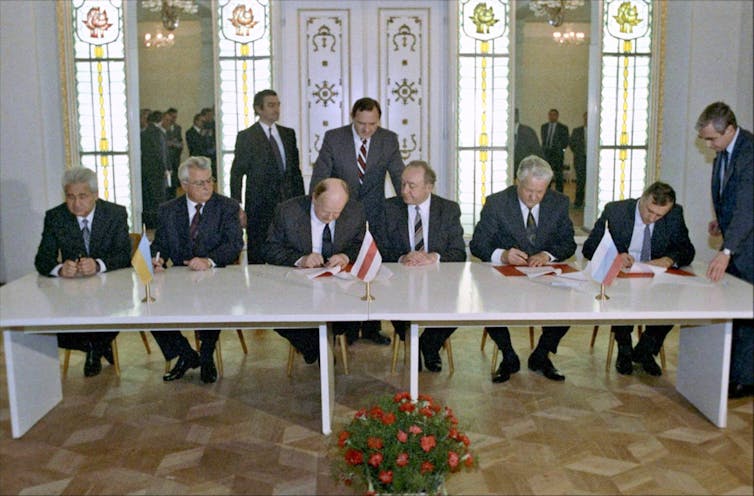
This isn’t exactly what happened in the Soviet Union as a result of the Belovezh Accords, signed by the leaders of three Soviet republics at a state dacha in Belorussia on 8 December 1991, but close enough.
It’s been 30 years since the Soviet Union dissolved in the wake of a bungled reform effort by Soviet leader Mikhail Gorbachev, elected General Secretary of the Soviet Communist Party in 1985.
The Soviet crisis of 1991
The Soviet Union, created by the Bolshevik Revolution of 1917, consisted of 16 constituent republics, named for their majority nationality (Russian, Ukrainian, Georgian and so on).
Despite some notorious episodes of repression, such as the deportation of Chechens from the Caucasus during World War II), ethnic discrimination was generally discouraged.
For all the vaunted centralisation of the Soviet system – run from Moscow by the Politburo of the country’s sole political party, the Communist Party of the Soviet Union, with branches down from republic to workplaces – Moscow in practice delegated substantial powers to its appointed republican leaders. Moscow had the power to fire, of course, but since the 1970s, it had been sparingly used.
The Soviet crisis of 1991 was brought on not by a pandemic but by Gorbachev’s “revolution from above’”, which promised democratic openness (glasnost) and economic restructuring (perestroika) to stimulate initiative and make the top-down system more flexible.
Unfortunately, Gorbachev left the economy as the last priority and started with democratisation, which had the effect of stirring up waves of criticism that undermined authority and trust, and things quickly became shambolic.
By mid 1991, with the glue of the Communist Party coming unstuck, most of the republican leaders had stopped listening to Moscow and changed their title from first party secretary to republican president.
The Baltic states and Armenia had already claimed sovereignty when the three presidents of Russia, Ukraine and Belorussia met in the Belovezh forest (Gorbachev not invited) and voted for independence and an end to the Union. On 25 December, Gorbachev resigned the Soviet presidency, and the Soviet flag over the Kremlin came down.
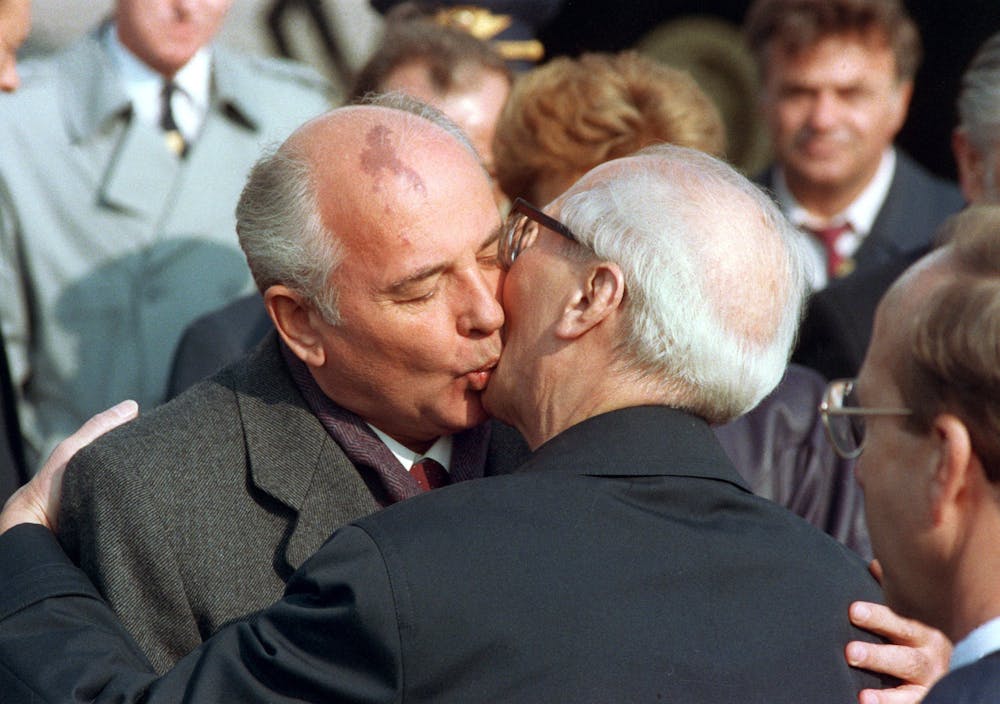
Decline of an ‘empire’
Only the three Baltic states, a late incorporation into the Soviet Union never fully accepted by the population, had well-developed popular independence movements, so there was urgent catching up to be done in the new successor states. Popular nationalism had to be stoked and national histories written, usually in terms of colonial oppression under Soviet (Russian) rule.
Western historians, who had not previously called the Soviet Union an “empire”, rushed to adjust their terminology: if a multinational state fell apart into national segments, what else could it be than a revolt of the colonies against imperial rule?
The term wasn’t even wholly inaccurate: Russia had been the largest and most populous republic, Moscow was the Union’s capital, and Russian its lingua franca.
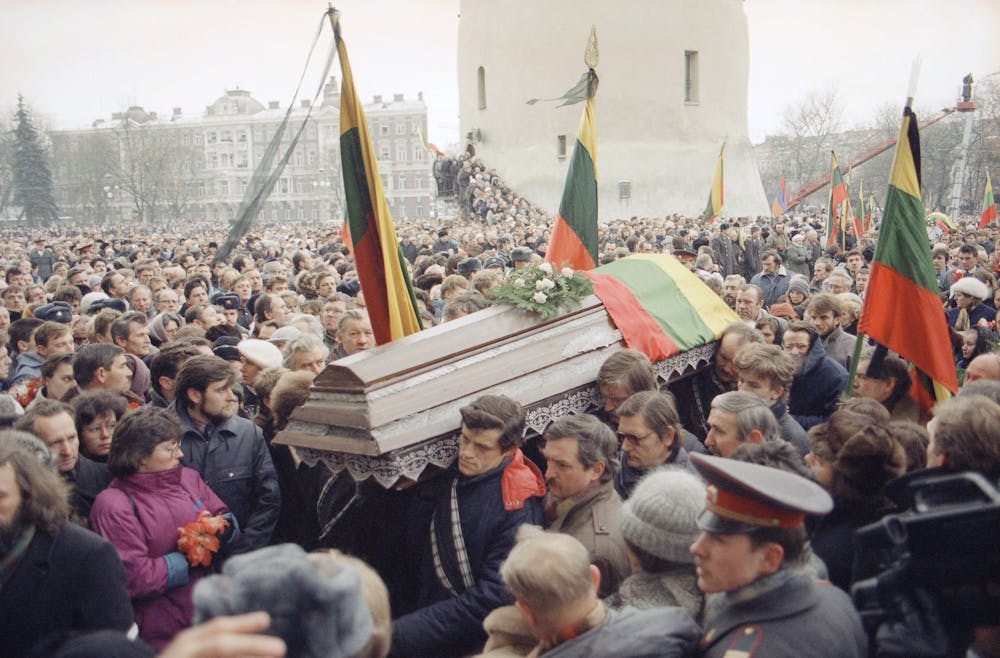 Pall-bearers carry a flag-draped casket during a funeral procession through Vilnius on Wednesday, Jan. 16, 1991 for 10 of the 14 people killed when Soviet troops stormed the Lithuanian broadcast centre.
AP
Pall-bearers carry a flag-draped casket during a funeral procession through Vilnius on Wednesday, Jan. 16, 1991 for 10 of the 14 people killed when Soviet troops stormed the Lithuanian broadcast centre.
AP
At some times in Soviet history, the flow of resources (“economic exploitation”) had mainly been from periphery to centre, though latterly more often the opposite.
If the Soviet Union was an empire, however, it was an odd one. Leaving aside its revolutionary founders’ anti-imperial ideology, there was the fact that, fearing undue Russian dominance, they had given the Russian Republic fewer powers and prerogatives than other republics, and generally discouraged Russian nationalism.
Read more: Back in the USSR: my life as a 'spy' in the archives
The Russian republic
Until Soviet career politician Boris Yeltsin fell afoul of Gorbachev and built up a power base in the Moscow party, the Russian republic had never played a significant role in Soviet high politics.
But when Yeltsin was elected president of the Russian Republic, Moscow became home to two presidents, which was clearly one too many. Gorbachev lost the contest, and the collapse of the Soviet Union was an almost unintended byproduct.
The march of the republics out of the Soviet Union was not a result of popular unrest (the Baltics being something of a special case) but of decisions taken by the republics’ (Soviet) bosses, with Yeltsin, president of the putative “imperial” nation, leading the way.
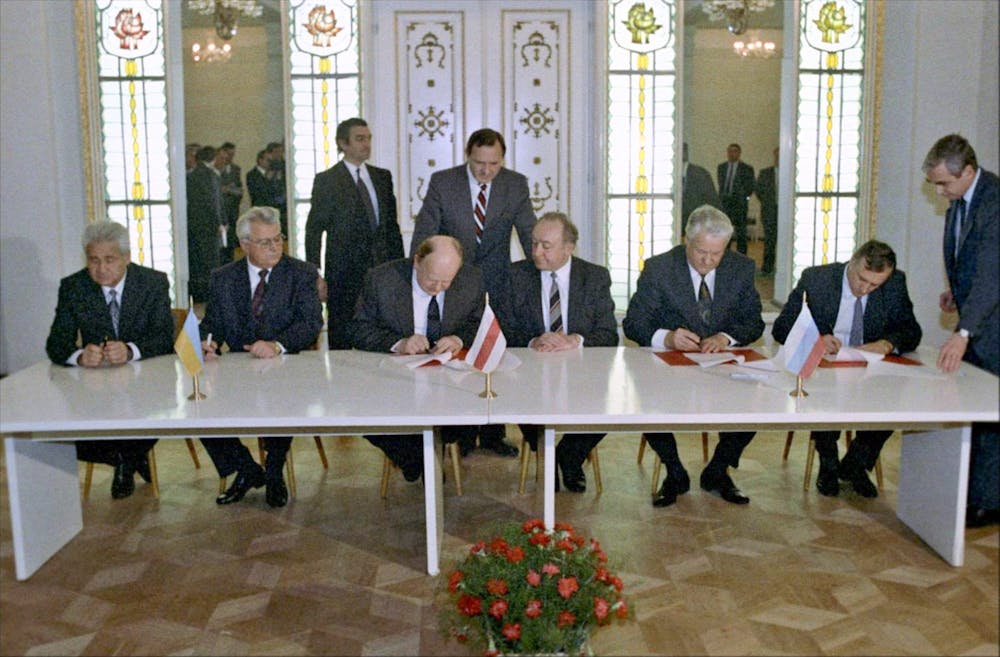 Ukrainian President Leonid Kravchuk (second from left seated), Chairman of the Supreme Council of the Republic of Belarus Stanislav Shushkevich (third from left seated) and Russian President Boris Yeltsin (second from right seated) during the signing ceremony to eliminate the USSR and establish the Commonwealth of Independent States.
RIA Novosti, CC BY
Ukrainian President Leonid Kravchuk (second from left seated), Chairman of the Supreme Council of the Republic of Belarus Stanislav Shushkevich (third from left seated) and Russian President Boris Yeltsin (second from right seated) during the signing ceremony to eliminate the USSR and establish the Commonwealth of Independent States.
RIA Novosti, CC BY
Shock and chagrin
If my imagined scenario ever took place in Australia, Australians would be plunged into a state of shock, surprise and confusion. That is exactly what happened to Soviet citizens, who until 1991 had assumed that, for better or worse, the USSR was an immutable fact of life.
Shock was the key word of 1990s Russia, accompanied by chagrin at losing superpower status and world respect. As Vladimir Putin said, anyone who didn’t regret the passing of the Soviet Union “had no heart” (though he added that those who sought to resurrect it “had no brain”), and sure enough, for years Russian opinion polls confirmed this.
The Soviet Union, its military and security services intact to the end, had seemed so armoured against change, so boringly solid. To give Putin the last word, “Who could have imagined that it would simply collapse?”
Sheila Fitzpatrick’s book The Shortest History of the Soviet Union will be published by Black, Inc in March
Authors: Sheila Fitzpatrick, Professor of History at the Institute of Humanities and Social Sciences, Australian Catholic University

















