

Why climate change must stay on the news agenda beyond global summits
- Written by Áine Kelly-Costello, University of Gothenburg
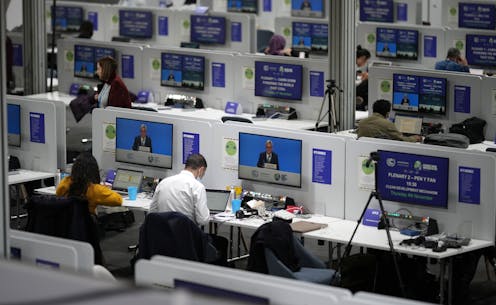
During last month’s COP26 summit, climate change was a ubiquitous story. News hooks abounded, from unpacking the flurry of non-binding pledges to reporting on the failure of rich nations to honour demands of countries at the frontline, criticising the summit as the “most exclusionary COP ever”.
Even in today’s crowded information landscape, mainstream news media continue to play an important role in shaping how we understand and act on climate change.
Based on research interviews with climate reporters, I argue the main stories are about climate breakdown and climate justice, and entire newsrooms, not just science and environment specialists, need to step up to demonstrate that understanding.
This needs to be reflected in the quantity and quality of climate coverage, well beyond the brief window of COP summits.
Climate change is every story
My research, which focused on interviews with journalists who consistently cover climate change, highlights how climate reporting directly challenges journalism’s traditional tendency to divide the world into rounds.
As Kennedy Warne, founder and former editor of New Zealand Geographic, puts it:
The exclusive deployment of science journalists to the climate beat has had the unfortunate problem or effect of scientising the whole thing, when it’s really a human life, human hopes, human dreams, human inter-generational responsibility type of issue.
While specialist expertise does matter, the lion’s share of climate coverage can no longer be left to a handful of science and environment reporters.
When it comes to ensuring climate stories get regular coverage across newsrooms of large media outlets, Stuff is taking a laudable lead. In early 2020, it established a climate desk with a climate editor and reporter. The climate desk journalists, Eloise Gibson and Olivia Wannan, set about embedding climate reporting within the organisation’s outputs.
Newsroom is an example of a smaller organisation in which climate coverage is also a priority and mainstay, with diverse and regular reporting within its climate emergency section.
Specialist reporters matter
Specialist climate reporters can build up a base of knowledge in a complex domain. But the journalists I interviewed were clear that media outlets don’t have to have a climate desk to produce more and better climate coverage.
On the science side, explaining the ecosystems and human implications from melting glaciers or freshwater policy is crucial.
In politics, reporters need to continue holding governments accountable to their promises, as many did recently in highlighting the dubious accounting in Aotearoa’s latest emissions reduction pledge.
Read more: COP26: New Zealand's new climate pledge is a step up, but not a 'fair share'
Reporters are responsible for connecting the consequences of rising emissions for people’s lives.
Stuff’s Charlie Mitchell describes a 2017 story about the impacts of coastal erosion on mostly low-income residents of the West Coast coal-mining town of Granity.
It sticks out for me because climate change can be quite abstract and hard to communicate in some ways. But in that story, it was very real, it was very tangible.
Alex Braae, a former reporter at The Spinoff, picks out a different kind of local story about a meeting on carbon farming in the economically run-down King Country town of Taumarunui. It detailed the concerns of local farmers about planting productive farmland with carbon-absorbing pines at the cost of local jobs and community cohesion.
It took into account the fact that we might know exactly what the scientific solutions to climate change are, but we don’t necessarily know how to turn scientific changes into social and political policy that won’t leave people behind.
Covering climate responsibly
The journalists I interviewed highlighted that in order to cover climate responsibly, they aim to:
● Provide accurate and contextualised stories
● strive for fair and diversified representation
● strive for regular and fresh coverage
● maintain emotional awareness
● make coverage interesting and relevant
● remain responsive to audience needs and feedback.
Accuracy is a tenet of responsible journalism. Another principle is balance, but journalists were clear that mainstream editors have understood the dangers of false balance for about a decade now. While climate denial is no longer platformed in a misguided effort to balance a story, this should apply to opinion columns as well.
Stories need to be based on evidence, which can come from Western science or other long-established knowledge systems like mātauranga Māori.
The journalists I interviewed said it was important to them to make a conscious effort to seek out and fairly convey a wide range of perspectives.
Those already marginalised or in vulnerable situations face disproportionate impacts and multiplied inequities.
Jamie Tahana, previously at RNZ Pacific and now RNZ Te Ao Māori, emphasises that being able to tie frontline perspectives into political and scientific climate discussion brings them to life, reminding us that decisions made at political summits like COPs amount to decisions about Pacific Islanders’ lives and livelihoods.
Connecting with audiences
When Rebekah White, editor at New Zealand Geographic, imagines climate reporting in a decade, she isn’t optimistic about lessening the class divide between mainstream media’s primary audiences and those most affected.
I suspect that it’s going to be much the same as today. A bunch of journalists trying to make something that predominantly affects under-privileged people relevant to the middle-class people who are the main consumers of their media.
Still, climate connects with our daily lives and our choices all the time, whether we acknowledge it or not. Stories about air pollution, house insurance, banking, living in poverty, e-scooters or the best vegan restaurants all have climate angles.
A 2019 Stuff survey garnered 15,248 responses and showed audiences were keen for more accessible and relatable climate coverage.
They asked for more coverage of the impacts of their lifestyle and political choices, reporting that holds politicians and industry to account and more emphasis on the farming sector, especially about how it is adapting.
They were also keen on more forecasting of future climate impacts, as well as hopeful and solutions-based stories.
COVID-19 need not be a deterrent to climate coverage. Globally, around two in three people think climate change is an emergency, even during the pandemic.
Canadian analysis shows while COVID-19 can compete with climate stories within a finite pool of audience attention, it also opens up opportunities to link the two. And a US study shows that while the amount of climate coverage dropped off during the early months of the pandemic, page views on climate stories didn’t.
Off the back of the momentum generated by COP26, it’s incumbent on all of Aotearoa’s newsrooms to ensure climate remains on the news agenda.
Authors: Áine Kelly-Costello, University of Gothenburg

















