

Ever wondered who would win in a fight between a dingo and a wolf? An expert explains
- Written by Euan Ritchie, Professor in Wildlife Ecology and Conservation, Centre for Integrative Ecology, School of Life & Environmental Sciences, Deakin University
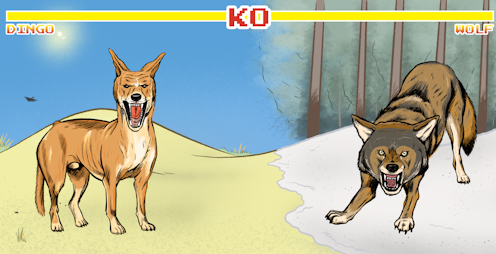
This article is part of the “Who would win?” series, where wildlife experts dream up hypothetical battles between predators (all in the name of science).
Imagine two of the world’s most iconic canids – a dingo and a wolf – head to head in a fight. Who would win?
Before we examine the combatants in more detail, we need to answer an important question first, which wolf and which dingo? Taxonomy – the way we describe, name and classify Earth’s biodiversity – remains contentious for both animals.
Dingoes are recognised as a species in their own right by some, but not others. And, dingoes are quite different in their size and appearance, depending on whether they live in Australia’s alpine and forested areas, deserts, or tropical regions.
As for wolves, there are North American (“Grey”), Mexican, Eurasian, Himalayan, Asiatic, Indian and Tibetan, Red, African golden, Ethiopian and even “ghost wolves” – yes, ghost wolves! Ghost wolves are species we can recognise from the past using genetic information, but they no longer survive and no fossils are known to exist.
And then there are “wolves” that aren’t wolves at all: the fox-like maned wolf in South America, and the gargantuan, now-extinct dire wolf.
The maned wolf is a canine from South America, but is neither a wolf nor a fox. ShutterstockFor the purposes of this battle, let’s assume it’s between a grey wolf and an alpine dingo.
Why do dogs, dingoes and wolves fight?
For wild canids, fights occur for many reasons, within and between species when they overlap. Wolves and dingoes fight for mates, to attain dominance within packs, and to establish and maintain their territories.
So, let’s get to know each opponent a little better.
Dingoes and wolves are both social and intelligent species, capable of complex behaviours and problem solving.

Grey wolves are what we call hyper-carnivores, feeding predominantly on other animals, in many cases large prey such as deer, elk, moose and bison.
Dingoes are omnivores with a broad, varied diet. They eat everything from fruits, to invertebrates, to small and large vertebrates – think lizards, birds, wombats, wallabies, possums, kangaroos, and feral animals like goats and deer. Dingoes will also scavenge food and carcasses.
Read more: Dingo dinners: what's on the menu for Australia's top predator?
Prior to European invasion, dingoes likely occupied all of mainland Australia.
Aside from humans, it’s thought the grey wolf was once the world’s most widespread mammal, where it, and its subspecies, occurred across much of Europe, Asia, and North and Central America. But, like with dingoes, humans have caused substantial population and range decline of wolves.
The battle: terrain is crucial
The terrain of the arena for our combatants would be crucial. Dingoes and wolves are capable of moving at great speeds, sustained for long periods of time, especially in open country. Both can reach top speeds in the range of 50-60 kilometres per hour!
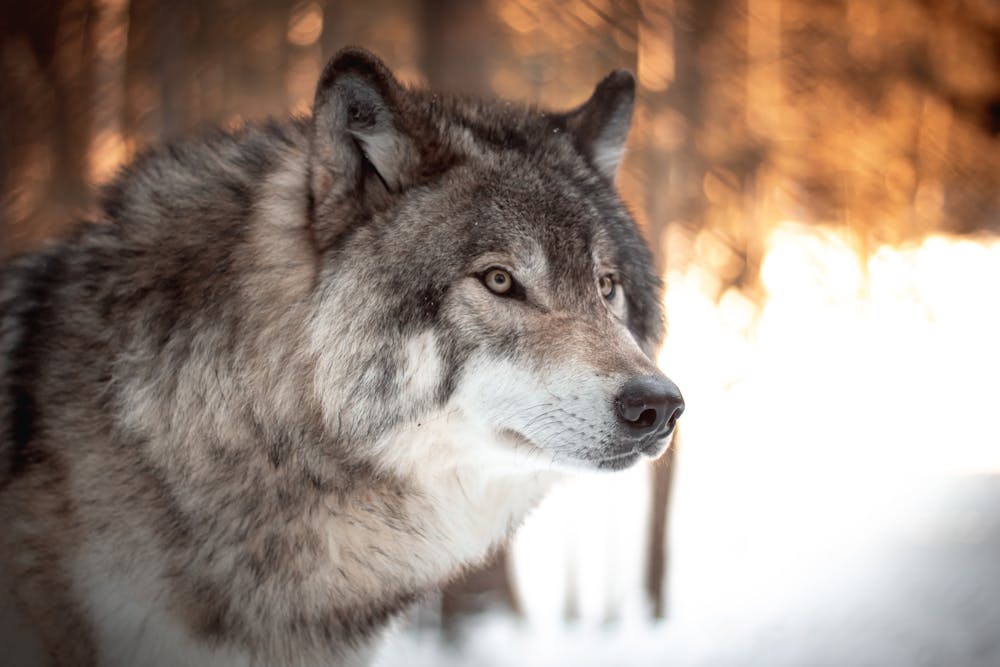
However, dingoes arguably have the advantage in tight spots, in terms of their much smaller size, greater agility and flexibility, and climbing abilities. Dingoes typically weigh between 15 and 20 kilograms, while grey wolves are usually in the range of 30-65kg, and up to around 80kg for some males.
Dingoes have been recorded vertically jumping 2 metres and climbing fences, making them quite cat-like in many respects. So, if the battle occurs among many obstacles and on steep terrain, this will give dingoes an edge.
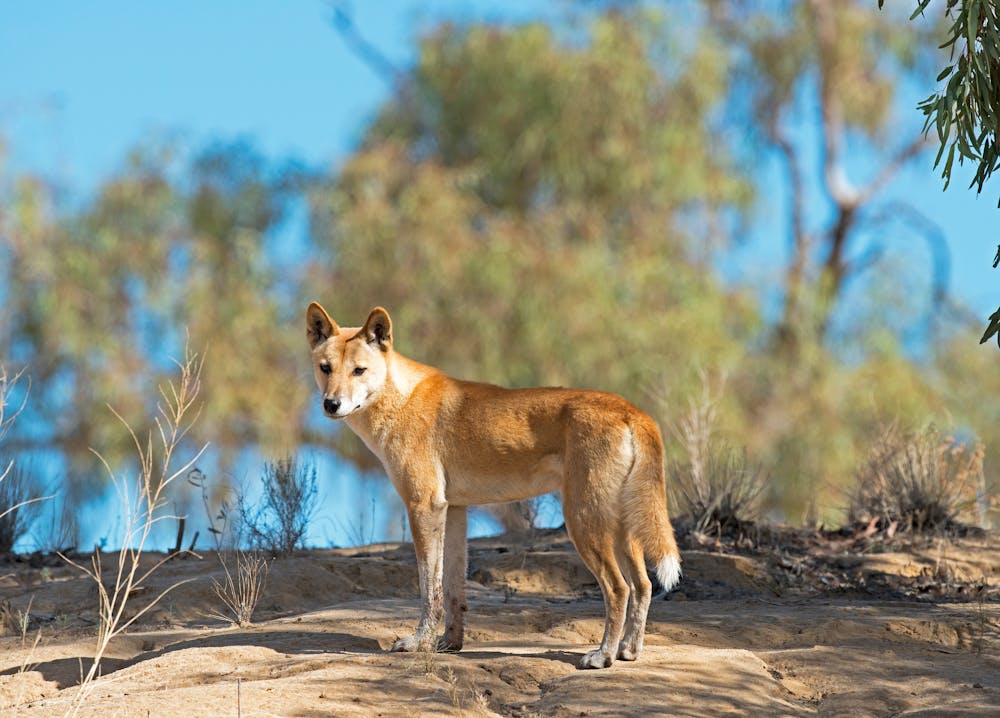 Dingoes are perfectly adapted to Australia’s conditions.
Shutterstock
Dingoes are perfectly adapted to Australia’s conditions.
Shutterstock
But if the fight is in the open, the much heavier, taller, and longer wolves will be too much for dingoes. They also pack a heavier bite quotient (bite force relative to body mass) of 136 as compared to the dingo’s 108.
Having said that, wolves are much taller than dingoes, around 65-80 centimetres and 45-60cm at their shoulders, respectively. So it’s possible a wily dingo could dash under the legs of a tall wolf and launch an attack on the vulnerable underbelly.
What about pack vs pack?
The final factor to consider is whether the fight is simply one dingo vs one wolf. Both can occur as individuals or in packs.
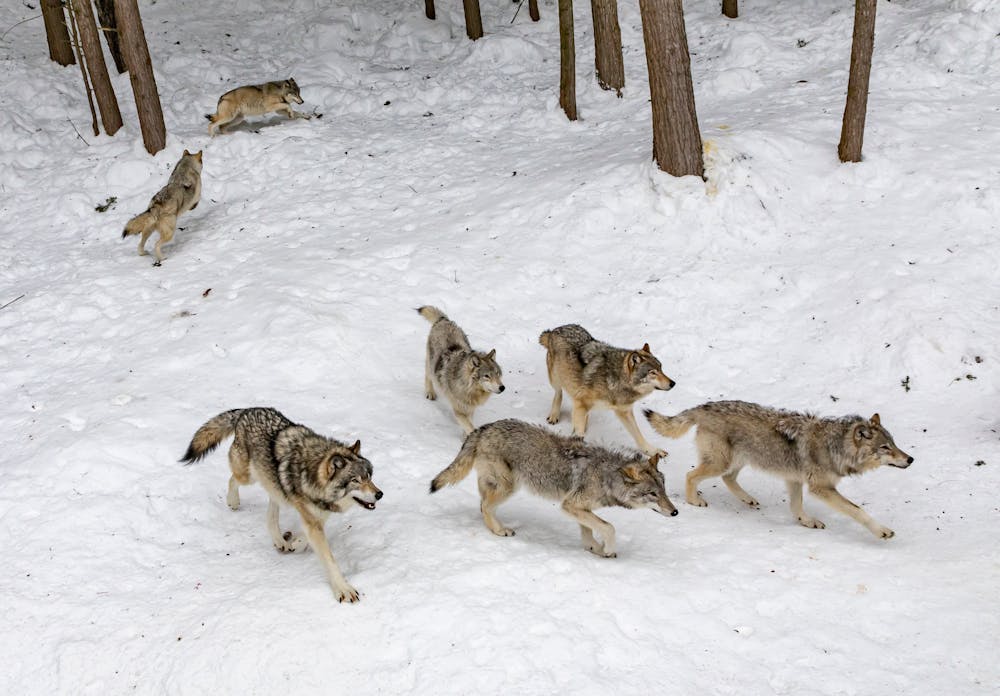 Grey wolves can be in packs with 20 or more individuals.
Eva Blue/Unsplash, CC BY
Grey wolves can be in packs with 20 or more individuals.
Eva Blue/Unsplash, CC BY
Dingoes are typically found alone, in pairs or in small packs of a few individuals, but occasionally can be found in much larger, less socially cohesive groups of ten or more when food resources are plentiful.
Wolves, on the other hand, are often found in groups of between five and ten, but much larger packs of 20 or more can also occur.
I spoke to Lyn Watson, who runs the Dingo Discovery and Research Centre. She says dingoes are “flight, rather than fight, canids”. This is wise behaviour, as dingoes are small in number and size and can’t rely on a large pack, like wolves sometimes can, to substitute them should they become injured in a fight.
She goes on to say that from her 30 years of observations, female dingoes are particularly deadly.
While dingoes are small, bonded pairs will fight in a coordinated way. Males fight in traditional neck and throat grabs, or “elbow”, but their bonded other has a completely different mode - and it’s deadly.
The female will stay at the periphery then dart into the soft parts of the combatant that is threatening her mate. She aims to maim - and does so, targeting the most “sensitive” of areas, enough said!
So if it’s pack vs pack, wolves will be far too strong. But if a single wolf was unlucky enough to come across a pack of dingoes, the tide could turn strongly in favour of dingoes.
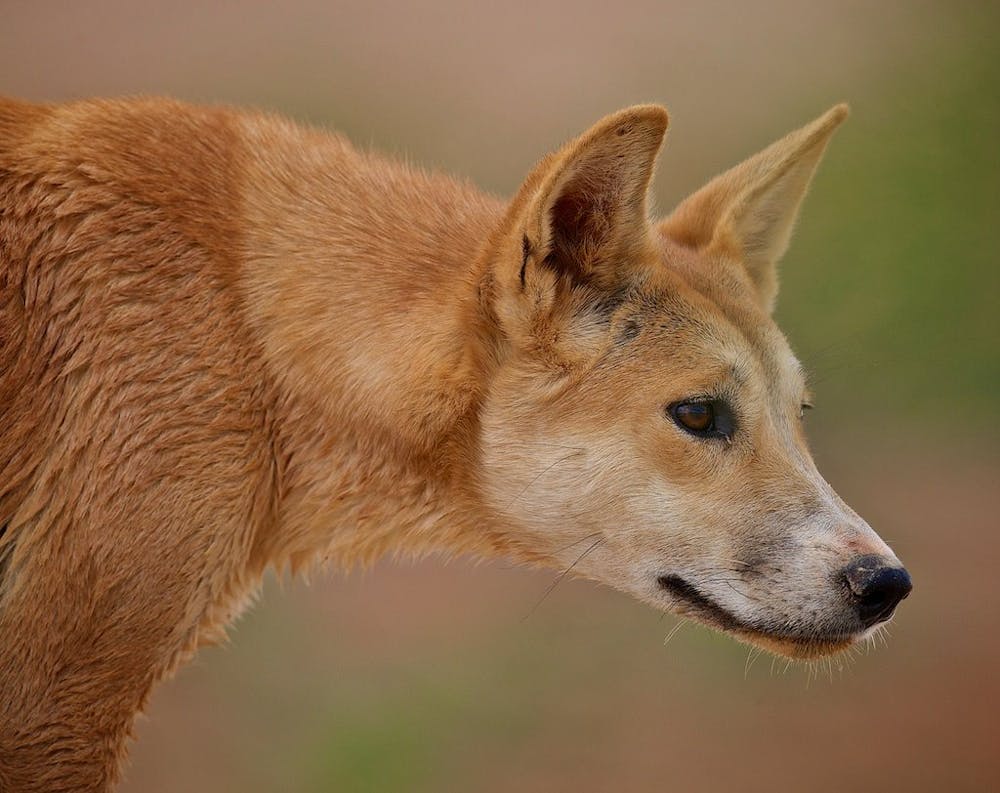 Female dingoes aim to maim when they fight.
Angus Emmott
Female dingoes aim to maim when they fight.
Angus Emmott
Learning to live together
Even though wolves and dingoes fight in the wild, despite common perceptions, they generally pose a very small risk to people, especially if we adhere to advice such as not feeding them.
Domestic and feral dogs pose a far greater risk to us. It’s estimated that around the world, dogs bite and injure tens of millions of people annually. In the US alone, it’s thought around 4.5 million people are bitten by dogs each year.
Of course, in reality wolves and dingoes will never fight each other in the wild. The greatest threat they both face is the ongoing destruction of their habitats and widespread direct persecution from humans (trapping, poisoning, shooting, and exclusion from areas), often aimed at protecting livestock.
Like other apex predators, dingoes and wolves have critical roles in our ecosystems and, in many cases, have deep cultural significance for Indigenous people. We must find more ethical and sustainable ways to share our world.
Read more: How to live with large predators – lessons from Spanish wolf country
Authors: Euan Ritchie, Professor in Wildlife Ecology and Conservation, Centre for Integrative Ecology, School of Life & Environmental Sciences, Deakin University

















