

Vaccinated or not, Novak Djokovic should be able to play at the Australian Open
- Written by Keith Rathbone, Senior Lecturer, Modern European History and Sports History, Macquarie University
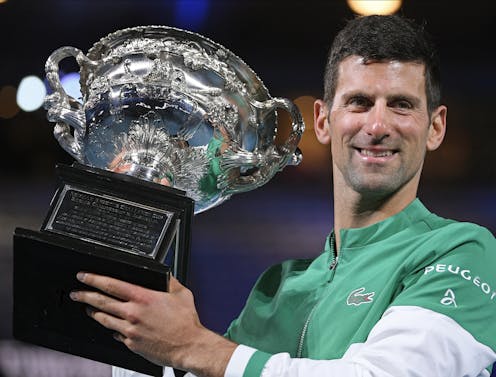
Novak Djokovic told the media last week “you will know very soon” if he is going to play in the Australian Open in January, for a chance to win a tenth title. He is on the list of entrants to the tournament, but he has not yet clarified whether he will participate and under what conditions.
With the tournament set to begin in just over a month, speculation has been running wild regarding Djokovic’s vaccination status (he has declined to say publicly), as well as whether special medical exemptions could be provided to unvaccinated players to compete in Melbourne.
Tennis Australia has mandated all players must be vaccinated to play or provide a medical exemption. It has strongly denied any “loopholes” would be available to players seeking an exemption.
The Victorian Sports Minister Martin Pakula has reiterated the government’s top priority was the safety of the “Victorian community”.
Yet, Djokovic’s unclear vaccination status – and his preeminent position in the sport – has (again) raised questions about vaccine mandates.
Djovokic’s father, Srdjan Djokovic, has called the mandates a form of blackmail and suggested his son will not play under these conditions.
Djokovic himself claims to favour freedom of choice, but his reluctance to be clear with Tennis Australia and the public obscures what should be a simple issue. His vaccination status shouldn’t matter – he should still be able to play.
Special rules for elite athletes?
Throughout the COVID pandemic, Tennis Australia and other sporting organisations have led the way in organising large-scale events in a safe and responsible way without them becoming COVID super-spreaders.
We should trust the organisations to work closely with the Commonwealth and state governments to develop COVID protocols that will allow sports to continue and keep locals safe. These should be bespoke rather than general, and could include a range of strategies other than vaccine mandates, such as masking, quarantines, social distancing, and COVID bubbles.
If Djokovic is unvaccinated, his entry into Australia would seemingly be against Commonwealth policy. But the government already makes exceptions for elite athletes in many ways.
This might rankle with everyday people – a separate and seemingly less rigorous border policy for athletes – but athletes have always had different rules when it comes to overseas travel and work.
Most countries have a special visa procedures for elite athletes, for instance. Before COVID, athletes coming to Australia also bypassed many ordinary border rules around importing equipment and goods and earning money without long-term working rights.
These special rules have continued during the pandemic. Freedom for athletes to travel has been a cornerstone principle for many sporting organisations, such as the International Olympic Committee. For example, the IOC is currently working with the Chinese government to allow travel for unvaccinated athletes for the 2022 Winter Olympics (with a 21-day quarantine), even though China’s borders have been closed to most other travellers.
Extensive research has been done by sporting organisations on how to host events like this safely.
A proven track record
In Australia, who needs to be reminded athletes have already enjoyed special rules that made their travel possible when everyone else was locked down?
In 2020, AFL and NRL players – and in some cases, their families – travelled widely into states with border lockdowns. Australian athletes have also been the beneficiaries of special hotel quarantine provisions, priority access to vaccinations, and forewarnings from government officials about border closures.
Actors, business executives, and politicians have similarly had less onerous border and travel restrictions than ordinary Australians. These industries bring in valuable dollars, but they also serve important public functions, including providing entertainment and leadership.
Different rules might have set the stage for stadiums to become COVID super-spreaders, but sporting organisations have proven their critics wrong.
For example, even without vaccines, the 2021 Australian Open was kept safe through the use of restricted fan zones, mandatory masking, social distancing, frequent testing of players and staff, electronic line calling, and of course the much-maligned mandatory 14-day hotel quarantine on arrival.
The US Open did not mandate vaccines for players this year. Players were instead tested when they arrived in the US and then every four days, and they were ordered into isolation if they returned a positive result. (Fans, however, were required to be vaccinated.)
Recently, Football Australia successfully navigated a COVID scare when a Matilda tested positive after returning to Sydney for a friendly match against Brazil. The protocols put in place – including isolating the positive player immediately – prevented any further spread and the Matildas hosted two successful games.
Read more: Can the Olympics still be cancelled? Yes, but the legal and financial fallout would be staggering
What is the cost?
Without special exemptions for athletes, our sporting organisations would take a major financial hit.
The NBA went ahead with its playoffs in 2020 with a COVID bubble (and without crowds), as did the Tokyo Olympics in 2021. Cancelling both would have cost billions of dollars.
To be sure, COVID bubbles cost money, but they are justified due to the long-term financial benefits these events can bring. For instance, Tennis Australia reported A$100 million in losses from June 2020 to September 2021 due to cost of hosting the 2021 Australian Open.
However, in the past decade, the Australian Open has contributed more than A$2.7 billion to the Victorian economy.
The 2022 Australian Open will be the first Grand Slam to require player vaccinations. Tournament director Craig Tiley’s position is understandable. Hemmed in by the need to protect his employees from the threat of infection, as well as his desire to work with the Victorian government, the Australian Open and Tennis Australia seem less receptive to risk than other sporting organisations.
However, the fact remains that COVID is already here. It is unlikely to be spread much further due to any sporting competition and we need to consider new ways of living with it, and each other, in the coming year.
Authors: Keith Rathbone, Senior Lecturer, Modern European History and Sports History, Macquarie University

















