

100 years ago, this man discovered an exquisite parrot thought to be extinct. What came next is a tragedy we must not repeat
- Written by Russell McGregor, Adjunct Professor of History, James Cook University
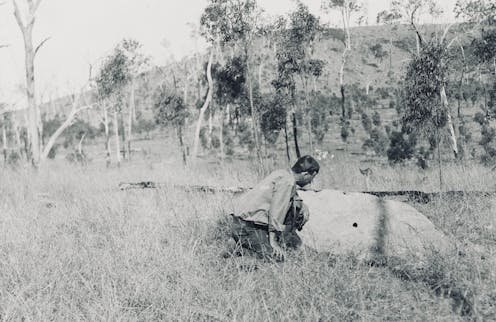
Exactly 100 years ago tomorrow, a bird that had been relegated to extinction made a comeback. The exquisitely beautiful paradise parrot was rediscovered by Cyril Jerrard, a grazier from Gayndah in Queensland’s Burnett district, on December 11 1921.
But its return was fleeting. Scattered pairs were seen around Gayndah until 1929. Some were seen around nearby Gin Gin in the 1930s. After that came only rumour and hope.
Today, the paradise parrot has the tragic status of extinct. It’s the only mainland Australian bird species known to have suffered that fate since colonisation.
On the 100th anniversary of the parrot’s rediscovery, we might revisit the event and consider why the bird’s resurrection was so brief. From that, we may gain insights into how to help the many species threatened with extinction today.
Our ‘avarice and thoughtlessness’
In 1924, a few years after rediscovering the paradise parrot, Jerrard identified the reasons for its decline. “Directly by our avarice and thoughtlessness,” he wrote, “and indirectly by our disturbance of the balance so nicely preserved by nature, we are undoubtedly accountable for the tragedy of this bird.”
Although a grazier, he acknowledged “the most fatal change of all” was wrought by the pastoral industry.
Jerrard’s collaborator in trying to save the bird, the journalist and birder Alec Chisholm, also nominated pastoralism – especially the burning of grasslands – as a main factor in the decline, along with trapping for the aviary trade and feral cats.
But while Jerrard and Chisholm could point out why the paradise parrot was sliding towards extinction, they were unable to do much about it. In books, newspapers and magazines, Chisholm publicised the parrot’s plight and pleaded for its preservation. His pleas didn’t exactly fall on deaf ears, but they were inadequate to counter a social ethos that privileged economic gain over avian loss.
Besides, ornithologists in the 1920s and 1930s had a lamentably limited repertoire of strategies to save endangered species.
On the latter issue, things have changed dramatically. We now have comprehensive scientific studies of the risks facing endangered species, and a vast array of remedial measures.
There are gaps in the science and imperfections in the conservation strategies, but there is a potential to rescue endangered species today that was lacking when the paradise parrot was rediscovered.
Lessons for the golden-shouldered parrot
Take, for example, the paradise parrot’s close relative, the golden-shouldered parrot of Cape York Peninsula. Currently listed by the International Union for the Conservation of Nature as endangered, it faces threats similar to those that annihilated its southern cousin last century.
In the heartland of golden-shouldered parrot territory, pastoralists Sue and Tom Shephard are devoted to preserving the parrots on their station, as was Jerrard 100 years ago. But unlike the Gayndah grazier, the Shephards have scientific backup.
From the pioneering studies of environmental scientists in the 1990s to more recent investigations, scientists working on Cape York Peninsula have scrutinised the species’ needs and advised on how to safeguard them. They place particular stress on fire management.
The birds eat seeds from several preferred grasses, which require specific fire regimes to thrive. The availability of seed affects the parrot’s breeding success. Fire also helps maintain the birds’ grassy woodland habitat and leaves fewer places for predators to hide.
But since European colonisation, fire regimes in Australia have changed dramatically across northern Australia. It has meant the golden-shouldered parrot has less food and is more vulnerable to predators.
Read more: Where to find courage and defiant hope when our fragile, dewdrop world seems beyond saving
Chisholm in the 1920s knew fire had something to do with the paradise parrot’s demise, but his writings on the topic were sketchy and vague. There was then no clear understanding of the fire ecology of this land, still less of the role of Indigenous fire regimes or willingness to learn from them.
Now, we have detailed calibrations of the type and intensity of fires needed to ensure breeding success for the golden-shouldered parrot and to minimise its loss to predators. Traditional owners of its territory, the Thaypan and Olkola peoples, collaborate with pastoralists and ecologists, linking traditional knowledge with Western science to reestablish fire regimes beneficial to the parrot.
While we’re better equipped today to rescue endangered species than was the case for the paradise parrot last century, that’s no cause for complacency.
Despite the superior conservation strategies and technologies now available, the drivers of extinction identified by Cyril Jerrard in the 1920s – our “avarice and thoughtlessness” – remain stubbornly persistent.
Prioritising bird welfare
If we’re to ensure the golden-shouldered parrot and other endangered species do not go the way of the paradise parrot, we need scientific strategies and technologies. But we need more than those. Sometimes, at least, we need to subordinate avarice to avian welfare.
For that, we need to connect, emotionally and ethically, with the birds around us. Birds must matter to us – not merely in an abstract or objectified fashion but as beings of intrinsic worth.
That’s what Chisholm was getting at in his 1922 book, Mateship with Birds, the concluding chapter of which was titled “The Paradise Parrot Tragedy”. In the lavish language then fashionable among nature writers, he urged readers to:
“dispute the dangerous idea that a thing of beauty is a joy for ever in a cage or cabinet; and disdain, too, the lopsided belief that the moving finger of Civilisation must move on over the bodies of ‘the loveliest and the best’ of Nature’s children”.
He and Jerrard lacked the tools and technologies to avert the paradise parrot’s tragedy, but not an appreciation of our moral responsibility to try to do so. We now have the tools and technologies, but our moral compass seems as fickle as ever.
Authors: Russell McGregor, Adjunct Professor of History, James Cook University

















