

Courts around the world have made strong climate rulings -- not so in New Zealand
- Written by Nathan Cooper, Associate Professor of Law, University of Waikato
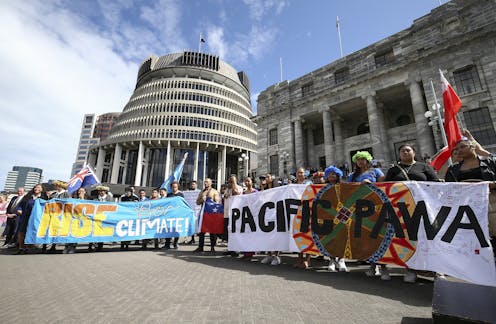
New Zealand made two important climate commitments at the COP26 summit last month — to halve emissions by 2030 and to join the global methane pledge to cut methane emissions by at least 30% by 2030.
But what happens if these pledges are inadequate for the climate emergency we face? And how can we ensure future climate commitments are bold enough, and actually fully met, to bring about the transformation necessary to limit global warming to 1.5℃?
One response is climate litigation, the use of courts to compel governments and corporations to take greater action to mitigate climate change.
The number of climate-related court cases is increasing around the world. In some countries, it has achieved strong rulings, but in New Zealand, the courts recently pushed the responsibility back to policymakers.
New Zealand’s international pledges join obligations in domestic legislation, including the much vaunted Zero Carbon Act, which commits to reduce emissions (excluding methane from livestock) to net zero by 2050.
They also have to be matched against the Climate Change Response Act, which sets requirements around emissions budgets.
New Zealand’s pledge to cut domestic emissions by half by the end of this decade reflects the country’s revised commitment under the Paris Agreement, known as a Nationally Determined Contribution (NDC). It has already been criticised for its over-reliance on purchasing carbon credits from overseas.
Read more: COP26: New Zealand's new climate pledge is a step up, but not a 'fair share'
The government’s commitment to “play its part” towards the global methane pledge may also be weaker than the promise suggests. It will likely mainly involve meeting its pre-existing target to cut methane emissions from livestock by 10% (on 2017 levels) by 2030.
The consequences of insufficient ambition globally will be felt at home. New Zealand’s natural environment will continue to degrade and climate instability become more severe.
Court action brings some progress
In various jurisdictions, climate litigation is achieving notable progress in environmental protection and forcing stronger action on emissions cuts. Just in 2021, court rulings in France, Australia and the Netherlands show the potential climate litigation has to bring significant change.
In May this year, in an action brought by eight children regarding plans to expand a coal mine, the Australian federal court agreed the government has a duty of care to protect young people from climate change. The court held that common law should impose responsibility on those who do harm through atmospheric pollution.
However, in New Zealand the courts recently declined to offer significant, let alone transformational, legal remedies for similar harm. They were not persuaded that using common law doctrines was suitable for this purpose. Instead, they signalled the response should come from appropriate regulation.
The case of Smith v Fonterra Co-operative Group Ltd 2021 was the first in New Zealand to target corporates for their greenhouse gas emissions. Mike Smith, spokesperson for the Climate Change Iwi Group, brought a claim against seven New Zealand companies. The claim was based on three points: public nuisance, negligence and breach of duty of care.
The High Court struck out the public nuisance and negligence claims in March 2020. The case proceeded to the Court of Appeal regarding the novel duty of care claim. But the court was not persuaded this novel duty of care should be created for the purpose of requiring a small number of emitters to comply with more onerous requirements than those imposed by statute.
The court said such private litigation, if successful, would be a costly and inefficient response to climate change nationally and arbitrary in its impact. Instead of using tort law, the Court of Appeal stated climate change “calls for a sophisticated regulatory response at a national level supported by international co-ordination”.
Litigation isn’t an ideal response to climate change
Meanwhile, Lawyers for Climate Action New Zealand (LCANZI) have begun a judicial review of the Climate Change Commission’s recommendations to government on carbon budgets and other measures to reduce emissions.
LCANZI’s statement of claim emphasises the need for domestic laws to be interpreted consistently with the Paris Agreement, the right to life (in the New Zealand Bill of Rights Act), Te Tiriti o Waitangi principles (in particular the exercise of rangatiratanga) and tikanga Māori.
The outcome of this case remains to be seen. But following the decision in Smith v Fonterra, it’s important to concede litigation isn’t an ideal response to the climate crisis and won’t guarantee success. An effective “sophisticated regulatory response” would be preferable.
Whatever happens in the LCANZI case, its emphasis on integrating international law, human rights, treaty obligations and tikanga Māori offers a vision of how we might pursue ambitious climate change action.
The challenge will be to design regulation that is both robust enough to ensure all obligations (international and domestic) are sufficiently ambitious to achieve environmental protection and sophisticated enough to articulate the unique context of Aotearoa. But in the face of a climate emergency, it’s worth trying.
Authors: Nathan Cooper, Associate Professor of Law, University of Waikato

















