

Doctors are trained to be kind and empathetic – but a 'hidden curriculum' makes them forget on the job
- Written by Eleonora Leopardi, Lecturer in Clinical Education, University of Newcastle
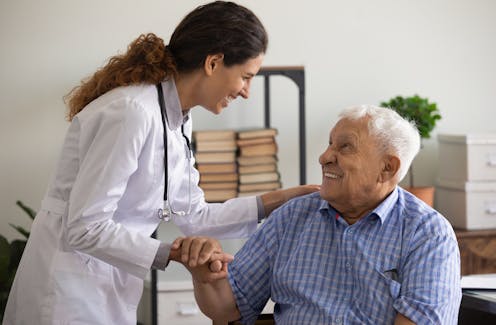
Health-care professionals are often idealised, especially in recent times, as heroes. But meeting a physician can be an underwhelming experience.
Patients and families can find themselves on the receiving end of curt communications or seemingly uncaring attitudes. This is understandably disappointing. A worried, scared patient looks to the doctor not just as the person who will take the lead of the situation, but as someone who can understand their feelings and emotions.
The good news is doctors are trained to provide care and empathy. The bad news is the training doesn’t always make a difference in the long run: a “hidden curriculum” of medical education can explain this.
Read more: Hospital emergency departments are under intense pressure. What to know before you go
Teaching students empathy and communication
In the 1990s, medical educators realised students’ training was too focused on biomedical sciences and did not take into account the experience of patients and their families. Most medical schools now invest considerable effort to make sure future doctors are well equipped to support their patients and be empathetic practitioners.
In the words of William Osler – who created the first residency program to get aspiring physicians out of the lecture theatre and bring them to the bedside:
The good physician treats the disease; the great physician treats the patient who has the disease.
This idea underpins most modern medical school curricula, with a focus on person-centred care. In our medical school we deliver an extensive communication skills curriculum across the five-year program. In the first two years, the training covers verbal communication and body language, making decisions with the patient, not for the patient, and listening actively. At the end of this initial training, we are confident that students are sensitive, empathetic, and caring.
The patient-centred approach has been a feature of medical training for several decades, so we should be seeing a system dominated by those trained in this way. But we’re not and unfortunately, it isn’t just veteran medicos who are the problem.
Don’t be like Doctor House.Learning to fit in
Young and vibrant new graduates lose at least some of their empathy as they progress through medical school and postgraduate training. A series of unwritten and often unintended consequences of education, the “hidden curriculum” is what students learn without anyone teaching them.
First coined in 1968 for school settings by educational scholar Philip Jackson, the phenomenon went on to be identified in all areas of education, including medical training.
After medical school, learners who enter a new environment start changing their views and their behaviours to align with those of the more senior members of the profession and “become part of the team”. Students who learn the unofficial rules of a clinical environment might be more easily accepted within the social group. But there are also negative consequences.
In the classroom, our students learn to pick up on cues from their patients, to use reflective listening and ask about their patients’ concerns. In the clinical environment, research shows students do not see these skills used by the more experienced clinicians around them or the supervisors they look up to and want to impress. Soon, good habits can be replaced by poorer behaviours. And, when the students become supervisors and mentors themselves, the cycle can continue.
We are in the middle of a compassion crisis says this ICU doctor.Making empathy the norm
Empathetic, warm clinicians definitely exist. The challenge is to make these clinicians the norm rather than the exception and to change the environment so the hidden curriculum has a positive influence on students and graduates.
Researchers, educational institutions, health-care institutions and patients can create and maintain a clear cultural and organisational expectation for doctors to meet a minimum standard of communication skills.
Firstly, researchers can challenge assumptions about the way the health system prevents doctors from being empathetic. Time pressure is often cited as an excuse to cut short on human connection, but the evidence tells us meaningful, person-centred communication doesn’t take more time than doctor-centred communication in a consultation. And strong empathetic connections can not only improve patient outcomes but also give doctors greater job satisfaction.
Read more: True grit – we measured it and found it protected doctors from career burnout
Rewarding the good
Academic health-care institutions such as teaching hospitals should improve their programs to support the doctors’ communication skills, and flood the system with empathetic doctors. They should also support new doctors so that work and study stress don’t cause burnout that can block empathy.
Patients should be encouraged to provide reviews of their doctors’ communication, and identify both positive and negative examples of care. This feedback should be kept in consideration by the health-care system and professional organisations such as the Australian Medical Council. Good communication and empathy should be explicitly rewarded, recognised in employment and promotion processes.
It is each doctor’s responsibility to be the best doctor they can be – but they can’t do it alone. We can all contribute to make the environment better, and help medical students hold onto their empathy as they become doctors.
Read more: You should care about your doctor's health, because it matters to yours
Authors: Eleonora Leopardi, Lecturer in Clinical Education, University of Newcastle

















