

Trees get sunburnt too – but there are easy ways to protect them, from tree 'sunscreen' to hydration
- Written by Gregory Moore, Doctor of Botany, The University of Melbourne
We all know how hot and damaging the summer sun can be in Australia and most of us are only too willing to take sensible precautions, and slop on sunscreen.
It’s not only humans that suffer from sunburn and its consequences. Some pets, such as cats and dogs, can get sunburnt in some of their less furry places, and pig farmers have long known the damage sun can do to their prized stock.
But have you ever wondered about sun damage to plants? Can trees be sunburnt? It may surprise you to know the answer is actually yes!
Tree sunburn tends to occur during hot spring days or in early summer, when trees are full of moisture. So let’s explore why it happens, and the easy ways you can protect your trees from damage.
Sun scorch on leaves
Many of you may be thinking of sun scorch, which occurs on the leaves of some of our favourite garden plants on a hot summer’s day: the brown, wilted hydrangea leaves or the large blotchy brown patches that appear on camellia leaves that weren’t there at the beginning of the day. This is sun damage, but is not the same as sunburn on trees.
Leaf scorch can occur because leaves are exposed to high levels of solar radiation. The damage is often exacerbated by a low level of soil moisture, which reduces the cooling effect of transpiration (when water evaporates from leaves).

One popular and widely published cause of sun scorch on leaves is water droplets on the surface acting as a lens that focuses the sun’s rays and intensifies the heat – a bit like a magnifying glass. But this is a myth. There is little evidence it occurs and considerable evidence that it doesn’t.
So what does cause leaf scorch? Well, we’re not sure. However, it’s possible and perhaps likely very high levels of radiation increase temperatures within some of the leaf cells. This damages the cells’ metabolic processes and limits the ability to photosynthesise in a process called “photoinhibition”. If enough cells are damaged, you can get general brown or dead leaf tissue.
Sunscald and sunburn
When dealing with trees, sunburn is also referred to as “sunscald” – which is unfortunate as there are two different processes at work, but even scientists often use the terms sunburn and sunscald interchangeably.
In the northern hemisphere, sunscald usually occurs towards the end of winter, when a warm day is followed by a freezing night. The cells in the bark of the trunk or branches have become active during the warm day, and are then badly damaged as they rupture during the cold night.
 A sunburnt tree trunk.
Shutterstock
A sunburnt tree trunk.
Shutterstock
Damage can be extensive, or even fatal, for some young trees and is nearly always greatest on the south and southwest facing tissue.
Short term temperature differences in Australia aren’t usually as extreme, so this sort of sunscald rarely occurs here. However, we do come across sunburn in trees when the sun causes serious damage to the bark of the trunk or branches.
If the damage is severe enough, sunburn kills the bark causing necrosis – the death of cells or tissue.
It’s usually a problem for trees with smooth and thin bark, such as several fruit tree species (stone fruits like apricot, plum and peach), birches, plane trees and some eucalypts. Trees with thick, fibrous or rough bark, such as oaks, elms, conifers and thick, rough barked eucalypts are usually insulated and protected.
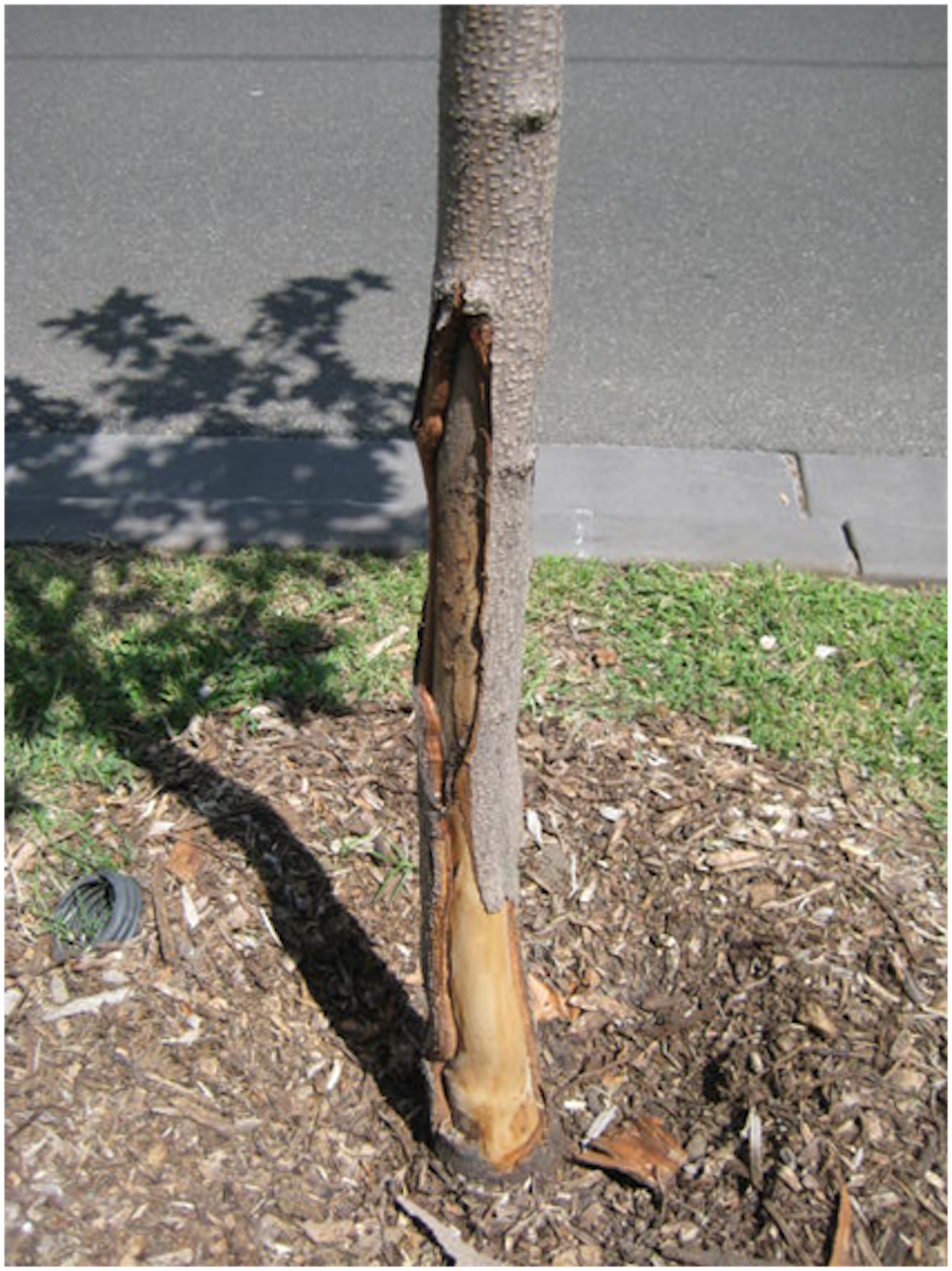 A sunburnt plane tree.
Greg Moore, Author provided
A sunburnt plane tree.
Greg Moore, Author provided
In Australia, sunburn nearly always occurs on trunks facing north or northwest, where exposure to the sun is hottest. Sunburn can also occur on the upward facing side of branches of a tree directly exposed to the sun, and is common after pruning exposes previously shaded branches, such as on thin-barked street trees pruned for powerline clearance.
Why does it happen?
Sunburn tends to occur in late spring and early summer, when bark tissues are full of moisture and actively growing.
Cells in the bark are damaged or killed by high levels of radiation and high temperatures. While high temperature can directly kill plant tissues, photoinhibition is another probable contributor.
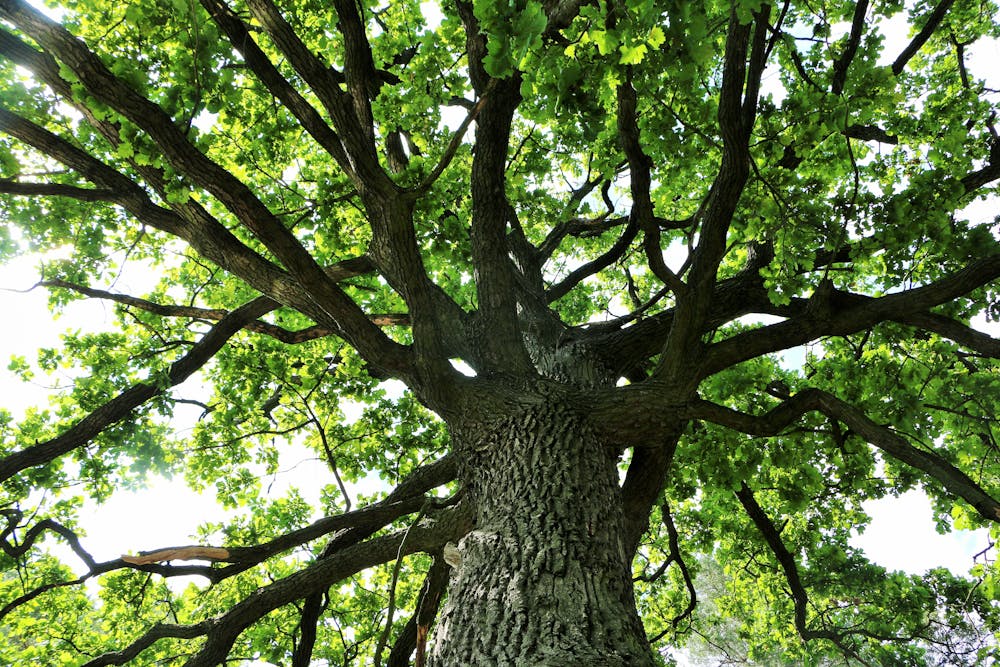 Trees like oak, with thick rough bark aren’t vulnerable to sunburn.
Shutterstock
Trees like oak, with thick rough bark aren’t vulnerable to sunburn.
Shutterstock
Sunburn damage may take time to manifest, but in smooth-barked trees, lesions may be over 1.5 metres in length, and over 100 millimetres wide. The tree tissue browns, dies, dries and splits, with the bark peeling back to expose the wood below. The wound can give access to pests and diseases, and slow growth in young trees.
Likewise, sunburn damage to fruit is common and often causes it to rot. In younger trees, it may prove fatal.
How to slip slop, slap for trees
The risk of both sunscald and sunburn has left an enduring legacy in Australia, as many post-war migrants to Australia from the Mediterranean region – particularly those from Italy and Greece – would routinely whitewash the base of their fruit trees.
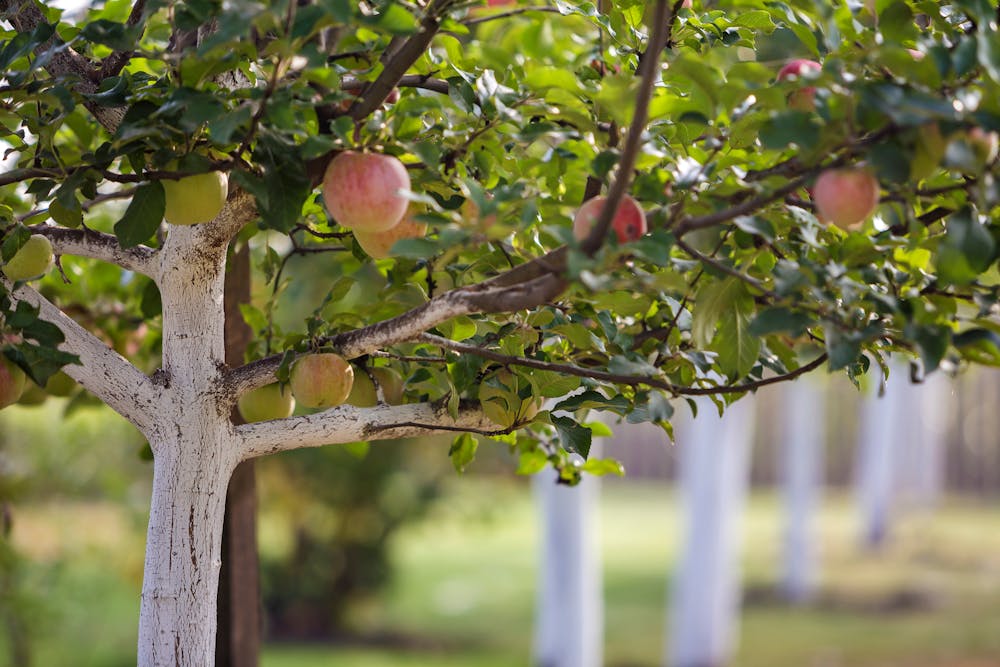 Whitewashing tree trunks and branches can help keep your tree feel and look cool.
Shutterstock
Whitewashing tree trunks and branches can help keep your tree feel and look cool.
Shutterstock
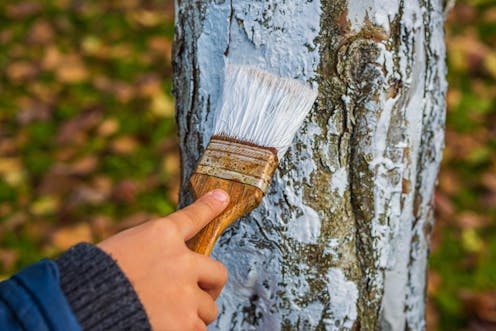
Sunscald may not have been much of a problem in their new home, but the whitewash was, and remains, a protection against sunburn – a literal slip slop, slap for trees! The whitewash shields the bark from the sun, reflects radiation and keeps darker coloured bark cooler.
Other ways of protecting trees from sunburn include wrapping them in light coloured paper, cardboard or cloth, planting susceptible trees in shadier parts of the garden and, for some trees, retaining lower branches that will naturally shade the trunk.
But one of the best ways to avoid tree sunburn is to make sure your trees are properly irrigated ahead of very hot days as transpiration, like sweating, keeps tissues cooler. And of course, a good mulch around the base of the trees maximises efficient water use and keeps soils cooler.
So while you protect yourself from the sun this summer, remember to take care of your trees, too, and keep them well hydrated.
Authors: Gregory Moore, Doctor of Botany, The University of Melbourne

















