

Modern Australian
The Times

Country is an urgent call to learn from Indigenous knowledges to care for the land

  • Written by Taylor Coyne, Doctoral Candidate, UNSW
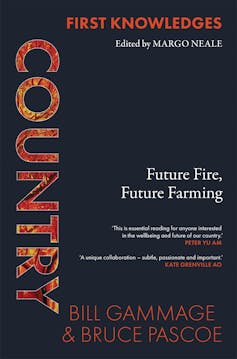
A black book cover with the words

“We know we can do better than this, don’t we?”

This line sits towards the concluding paragraphs of Country: Future Fire, Future Farming, by Yuin, Bunurong and Tasmanian activist and author Bruce Pascoe and non-Indigenous historian Bill Gammage.

The book is part of the wider six-part “First Knowledges” series published by Thames and Hudson in collaboration with the National Library of Australia. It focuses on a collection of topics, including astronomy, design, law and, in the case of this book, Country.

As stated by editor Margo Neale in the introduction, the overarching series is designed to “stimulate and provoke you to enlarge your mind and expand your worldview to encompass limitless other possibilities, including ways in which you can learn from the Aboriginal archive of knowledge embodied in Country.”

For many, the book will be a timely invitation to be a part of constructive dialogue and a call to take action, especially in light of the lacklustre resolutions from COP26 and following the Black Summer bushfires.

For myself, a non-Indigenous scholar researching waters throughout Eora Country, I humbly come to this review with deep awareness of my position, and firmly take up the invitation to be part of this dialogue and follow through with action.

Read more: How the Dark Emu debate limits representation of Aboriginal people in Australia

A conversation between experts

Country: Future Fire, Future Farming is crafted to present the two authors’ own personal perspectives, while drawing on rich evidence to support their claims.

After their co-written opening chapter, Pascoe starts off the book’s first three solo-written chapters. Then, Gammage takes over with the next four, before they round off their thoughts in two distinctly separate but ideologically similar concluding chapters.


A black book cover with the words
Thames & Hudson Australia At the core of their book, Pascoe and Gammage affirm in varying ways that Aboriginal people were - and are - farmers and agriculturalists. Pascoe expands on this in his chapters by describing the ways Aboriginal peoples have made use of the plants and animals across Australia. According to Pascoe, using and understanding these knowledges can make farming in Australia better. Gammage’s chapters focuses almost entirely on fire – its use by Aboriginal people as a tool to farm the land, and the detrimental misunderstandings of Aboriginal fire practices appropriated by non-Indigenous people. Consistently throughout the book, there is a subtle dialogue that emerges between the two authors. The dialogue could at times be more pressing, especially when contrasting perspectives arise, such as their differences in dating Aboriginal people’s presence on the continent or their interpretations of particular terms. On their own, the wonderfully detailed chapters provide ample room to reflect on key ideas (farming and fire) which both authors have become known for. That said, at times, I craved a more emphatic conversation between the two. Two Aborginal Aunties digging for honey ants.
Shutterstock Payment where payment is due In both subject and in tone, Country: Future Fire, Future Farming feels like a polite conversation, with any arguments quite restrained. Pascoe writes with urgency and an enthusiasm as vibrant as the landscapes he describes. He opens the book’s first chapter with an unequivocal call to arms – what is happening across Australia with land care (as well as the many other issues relating to Indigenous affairs) is not good enough anymore. Quite consistently throughout, Pascoe reaffirms the idea that Aboriginal land care is done with the aim to better the “common wealth”, in contrast to the damaging practices of non-Indigenous settlers. He asserts Aboriginal people should be the primary beneficiaries of wealth generated by land care practices that are environmentally and economically productive. Similarly, Gammage directs non-Indigenous peoples not to “commandeer traditional expertise” – a hard-pressed claim to refute. This tension of wanting to celebrate Indigenous knowledges while also ensuring it is not appropriated by non-Indigenous people for economic gain has been articulated as “bio-piracy.” The scholars Dr Daniel Robinson and Dr Miri Raven focus on this issue extensively in their work. Read more: Australia's agriculture sector sorely needs more insights from First Nations people. Here's how we get there We know we can do better than this The bulk of the book outlines the many intricate knowledges that Indigenous people across Australia have maintained. Pascoe works tirelessly to address the misconception surrounding “hunter-gatherering” - the idea that Indigenous peoples were only ever nomadic hunter-gatherers – which is also at the core of Pascoe’s acclaimed work, Dark Emu. In addition, Pascoe’s witty, sharp, and conversational chapters on plants and animals are what many have come to expect of him. Gammage presents a pragmatic recount of the importance of fire to people in Australia – both Indigenous and non-Indigenous, now and in the past. It is detailed and logical. In places, the practicality of Gammage’s writing overwhelms the reflexive narrative I was craving, especially when read against the works of Victor Steffensen or Vanessa Cavanagh. That said, both the breadth of materials the two authors engage with, and the depth with which they are analysed, is impeccable. Recent critiques of Pascoe’s engagement with evidence in relation to Dark Emu have brightened the discussions in this space. Quite pleasantly, Pascoe makes some effort to respond to these critiques, stating, Hunting and gathering is a sustainable and healthy lifestyle but it is not the only thing that Aboriginal and Torres Strait Islander people did. The book’s interpretation of historical material, such as Pascoe’s commentary on the Melbourne Museum’s recent Indigenous Bread research, or Gammage’s interrogation of historical archives, is invigorating, contemplative and lush. Reading the book excites me to want to act to care for land, and respectfully celebrate Indigenous knowledges. If you have a desire to be part of the action, then this book is for you. Country: Future Fire, Future Farming opens space for dialogue, but readers need to want to be part of this conversation to begin with. Authors: Taylor Coyne, Doctoral Candidate, UNSW

Read more https://theconversation.com/book-review-country-is-an-urgent-call-to-learn-from-indigenous-knowledges-to-care-for-the-land-172142

What’s Trending in Men’s Jewellery This Father’s Day!

Finding a Father’s Day gift that feels personal, stylish and genuinely wearable is not always easy. While socks and novelty mugs have traditionall...

Road Signs: Understanding Their Role in Clear and Effective Signage

Effective signage and display hardware can help businesses communicate information, promote products and organise customer or visitor movement. Road...

Bottle Label Printing: Key Factors to Consider Before Your Next Packaging Run

Effective packaging begins with understanding the product, bottle material, artwork and production requirements when planning bottle label printing. H...

Planning a Long-Distance Move With Interstate Movers Melbourne

Moving between states involves more planning than a typical local relocation. Along with packing and transporting household belongings, you need to...

Understanding the Role of an I/O Controller in Industrial Automation

Modern industrial systems depend on accurate communication between sensors, machines and control systems. An I/O controller can help manage this commu...

How the Right Mining Hose Supports Demanding Operations

Mining environments place considerable demands on equipment used for material transfer, water management and processing. Hoses operating in these co...

Simple Ideas for Making Social Gatherings More Memorable

We have all been to those parties where everyone just stands around the kitchen island, staring at their phones, waiting for someone else to make a mo...

Outdoor Wall Lights: Improving Exterior Lighting Around Your Home

Lighting can influence how a room looks, feels and functions, so the right fitting should be selected according to both appearance and practical req...

Commercial Office Cleaning: Combining Routine Office Cleaning With Melbourne Service

Keeping a workplace clean requires a service that can accommodate everyday tasks as well as the particular needs of the business. Professional comme...

Caravan Sales in Queensland: How to Find the Right Caravan for Sale QLD

Caravan ownership is about more than having somewhere to sleep while travelling. For many Queenslanders, it is one of the best ways to explore regio...

What Sir Walter Buffalo Turf Actually Costs in 2026 (And Why Quotes Vary So Much)

Two quotes landed on a Hills District homeowner's kitchen table last spring for the exact same 80-square-metre backyard. One said $12 a metre. The o...

Nearly 1,300 NSW Hospital Beds Are Occupied By People Who Are Ready To Go Home

1,276 people in NSW hospitals have been medically cleared for discharge but remain in hospital because they're still waiting for NDIS or aged care sup...

National Survey Launched to Measure Operational Impacts of Federal NDIS Policy Reforms

The effects of recent NDIS reforms are beginning to move beyond policy papers and into day to day service delivery. A new national survey is asking ...

Beyond the Nappy Cake: Baby Shower Gifts That Get Used

What new Australian parents unwrap, keep, and quietly thank you for months later. Six weeks after my daughter was born, I did an audit of the baby sh...

Parent-Advocates Are Reshaping Frontline Disability Service Delivery

Parents have always been part of the disability sector. They advocate, coordinate services, challenge decisions and often become the person holding ev...

Vista Cruises Enters "Two-Flagship Era" as Vista Aurora Completes Inaugural Voyage

Vista Aurora Sets Sail along the Yangtze. (Photo courtesy of the company)YICHANG, China — August 5, 2026 — Vista Aurora, a high-end interprovinc...

A Digital Preparation Checklist For International Medical Conferences

An international medical conference compresses many responsibilities into a few days. A delegate may need to present research, move between venues, ...

The Growing Popularity of Lab Grown Diamonds in Sydney and Hong Kong

The diamond industry has changed significantly in recent years as more buyers seek ethical, affordable, and sustainable alternatives to mined diamon...















