

the dual stories at the heart of Christmas
- Written by Robyn J. Whitaker, Senior Lecturer in New Testament, Pilgrim Theological College, University of Divinity
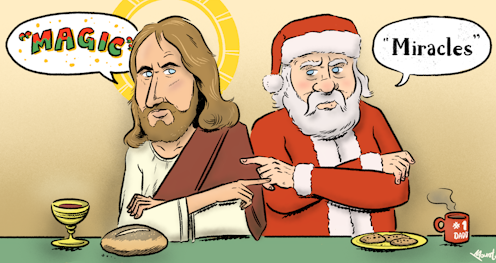
Christmas, at least in Western countries like Australia, brings together diverse myths and European traditions. Santa magically produces and delivers presents to the entire world in one night, hot Australians dream of a white Christmas, Jesus’s miraculous birth to a young virgin is re-enacted in nativity plays, and Christians gather to worship and celebrate the great mystery that this baby is God incarnate (God made flesh).
There is plenty of magic, mystery and miraculous activity to be found in these traditions. Is this what is meant by “the magic of Christmas Day” as Celine Dion croons?
Magic and miracles are treated as two very different things in the Christian tradition. Magic is bad, miracles are good. By magic, I do not mean the modern art of illusion that leaves us amazed by a brilliant sleight of hand or optical illusion. I mean magic in the ancient sense – something experienced as “real” but inexplicable; something that made the impossible possible, such as curing paralysis or leprosy.
Read more: What history really tells us about the birth of Jesus
In the polemics of the Bible, miracles were legitimate religious activity but magic was not. According to the Old Testament book of Deuteronomy, people who practise magic – practices that included making children pass through fire, casting spells, consulting the dead, or divination (prophecy or fortune telling) – do not belong in God’s community. This suspicion about magic has plagued Christianity throughout the centuries, leading to everything from 16th and 17th-century witch trials to boycotts of Harry Potter books. Magic is suspicious and, in the minds of some, associated with demonic powers.
The problem is, many of Israel’s prophets and even Jesus did several of the things banned in Deuteronomy or labelled derogatively as “magic” in the Bible.
Jesus was considered a source of power in the Bible as he travelled around teaching and performing miraculous healings. He even raised a man from the dead. Crowds flocked to him to be healed, bringing along their sick children or those unable to walk in the hope of a miracle.
Even Jesus’s clothes had magical properties. The Gospels record a story of a woman with a long-term bleeding disorder who touched the fringe of his garment and was healed by the power that went out from him.
At other times, Jesus seems to use more traditional magical methods to heal, such as when he mixed mud with his saliva to cure a blind man. Was it magic, medicine, or miracle? It depends on your perspective.
Scientific minds might be sceptical of all such stories, but in their ancient context, this was how a magician behaved – and whether or not Jesus would have been considered a magician in his lifetime is a serious historical question.
In 1978, Morton Smith, then professor of ancient history at Columbia University, published Jesus the Magician. He argued that, from a historical point of view, many of Jesus’s healing activities would have looked similar to what other travelling magicians did in the first century CE.
For example, Jesus often utters a phrase over the person he is healing, much like rituals recorded in ancient magical papyri. Perhaps out of fear of this association, Jesus’s utterances are usually translated from the Aramaic into Greek in the Bible, precisely to make clear that they are not magical spells.
For Christians, it is the belief that Jesus is the Son of God that means his source of power is divine and therefore his deeds miraculous, not magic. But dissenting perspectives come through to us from history. John’s Gospel records that some of the Jewish crowd accused Jesus of being possessed by demons – a logical explanation for his miraculous deeds if you did not think him from God.
Whether or not one believes the Jesus story, there is a historical context that makes sense of the kinds of things Jesus did in that period, whether one calls it magic or miracle.
Santa, however, is another matter. The idea that a North Pole-dwelling bearded man delivers presents to all the world’s children in one night is sheer, modern, capitalist fantasy. Not all children actually receive presents, and adults know Santa is not real – after all we have to buy all those presents – but the joyful excitement of children at such a possibility can be contagious.
However, there is a danger that if we talk about Santa’s magical present-giving properties in the same way we talk about a baby’s birth in a room in Bethlehem 2,000 years ago, we are confusing categories in really unhelpful ways.
From a historical point of view, the “magic” evoked in each tradition is fundamentally different. Moreover, while both have historical kernels and both evoke a sense of the miraculous, one is tied to a religious tradition that points us beyond ourselves and the other is designed to make us buy more.
Read more: A Christmas story: the arrival of a sweet baby boy – or a political power to change the world
At the heart of Jesus’s birth narratives in the Bible is a belief that this baby came to bring peace to the Earth, liberate the oppressed and bring abundant life to all. How this works precisely is part of the mystery.
To compare this religious tradition with Santa is not to have a dig at Santa per se. Perhaps the mystery of the Christmas season is that somehow in the conflation of these quite diverse traditions a touch of magic can found in the hopeful expectation of children and the joy of giving and receiving gifts.
But the truly miraculous Christmas would be one where all receive what they need, where all are fed, and where peace reigns.
Authors: Robyn J. Whitaker, Senior Lecturer in New Testament, Pilgrim Theological College, University of Divinity
Read more https://theconversation.com/miracles-and-magic-the-dual-stories-at-the-heart-of-christmas-166505

















