

Moths eating your clothes? It's actually their hungry little caterpillars – here's how to get rid of them
- Written by Ying Luo, PhD Candidate at the Research School of Biology, Australian National University
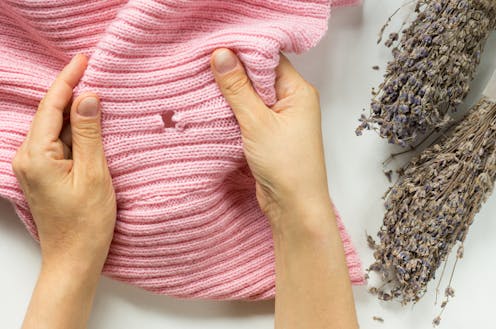
Have you opened your post-lockdown wardrobe, only to discover some of your beautiful summer clothes have holes in them? You’re probably blaming clothes moths but the real culprits are the larvae (caterpillars).
But who are these moths? The fact that they’re feeding on your precious clothes, fabrics and yarn actually reflects an interesting and – for moths – unusual biology.
Read more: Curious Kids: How do moths eat our clothes?
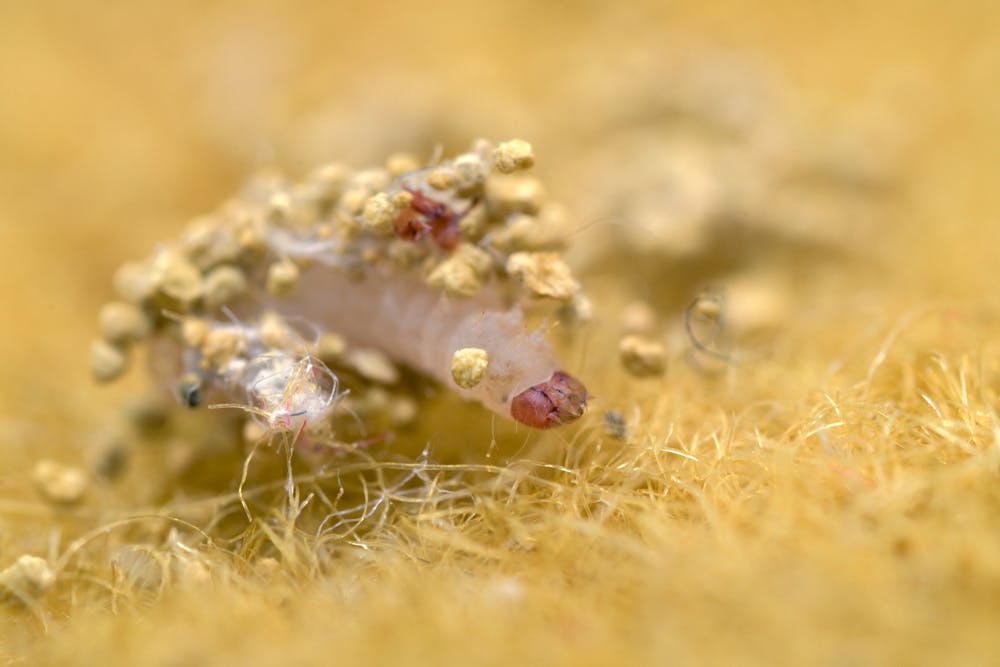
An old foe
Early references to clothes moths in Greek and Roman literature suggest humans have been battling clothes moths for thousands of years. Clothes moths are part of an ancient lineage of moths (Tineidae) and as such have preserved some quirky behaviours and adaptions that have led to a few species becoming pests.
The most well-known species of clothes moths in Australia are the webbing clothes moth (Tineola bisselliella) and the case-making clothes moth (Tinea pellionella). These common names refer to the appearance of silk spun by the caterpillars as shelter.
The adult clothes moth ranges in size from 4mm to 9mm – about the size of a grain of rice. Once the larvae turn into adult moths, they never eat again.
An inconvenient diet
The evolutionary origin of clothes moths diverged from 98% of all other moths a long time ago, so these moths do some things differently from most other moths.
Most tineid species don’t feed on living plants like “normal” caterpillars, but on rotting wood, fungi, lichens, detritus and even bat poo in caves. So it is unsurprising some species even feed on the keratin (a kind of protein) found in natural fibres.
They love to nibble on items derived from animals such as fur, wool and silk. But the synthetics or mixed fibres in your wardrobe aren’t safe either. Clothes moth larvae have been known to feed on synthetic and blended fibres, particularly those stained with sweat or food. The preferred diet of these caterpillars means some species have become unwelcome pests in our homes.
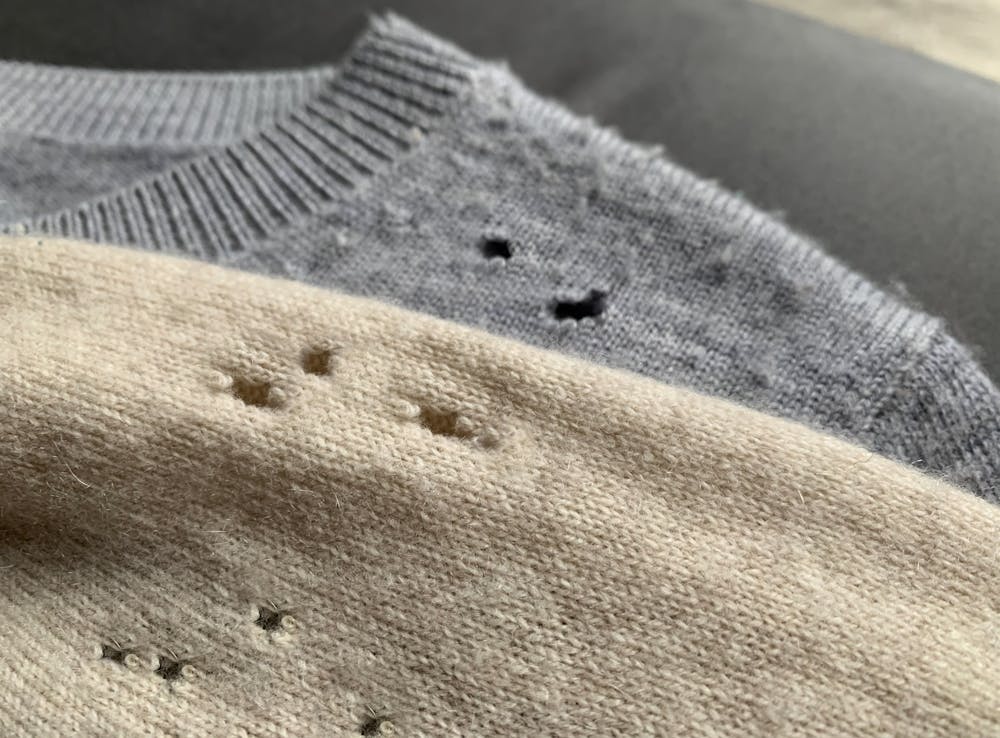 They love to nibble on items derived from animals such as fur, wool and silk. But synthetics or mixed fibres aren’t safe either.
Shutterstock
They love to nibble on items derived from animals such as fur, wool and silk. But synthetics or mixed fibres aren’t safe either.
Shutterstock
Not all clothes moths are pests!
Fortunately, only a few species from this group containing over 2,600 species are pests. In Australia we have over 190 known species of moths belonging to the clothes moth group, and many more unnamed specimens located at the Australian National Insect Collection are waiting for scientists to formally name them.
Researchers are working to understand more about the diversity and behaviour of moths that feed in unconventional ways, including the authors of this article. One of us (Ying Luo) is currently studying moths whose larvae feed inside a leaf, rather than on the outside of a leaf. Luckily, you won’t find these inside your wardrobe.
Why are they in my house – and how do I get rid of them?
The introduced clothes moths are a well-established pest in Australia and were brought here by accident. But how did they get into your house?
Sadly, you probably brought the eggs or larvae home yourself. They may have been hidden in a piece of clothing thrifted from the op-shop, borrowed from a friend or even bought new from a big brand store.
One of the best methods for keeping on top of clothes moths is to regularly check your clothing. Like their wild cousins, clothes moths enjoy dark, enclosed spaces.
You could try packing your clothes away in plastic tubs or bags, but this may mean you check on your clothes less often. You could risk sealing in some clothes moth larvae with your clothes.
If you haven’t been using certain clothes – the summer clothes packed away during winter for example, or any work or going-out clothes that stayed in the wardrobe during lockdown – then this is the perfect environment for clothes moths larvae to settle in for a nice, undisturbed feast.
Bring them out for washing and airing every now and then, and you could even give your wardrobe a refresh while you’re at it.
If you already have an infestation, you should remove all your clothing from the wardrobe and give the space a good vacuum. Some larvae may even be present in the carpet (if you have it). Wash all clothing before putting it back into the wardrobe.
What about moth balls?
Modern mothballs are a crystallised form of a chemical known as 1,4-dichlorobenzene (C₆H ₄Cl₂).
Over time, it turns (or “sublimates”) into a gas, which produces the strong smell you probably associate with moth balls.
They are used to deter moths – but if you already have an infestation, mothballs will not help.
And you may need quite a high concentration to be effective. At that point, you might not particularly enjoy the strong smell of the mothballs on your clothes.
Here at the Australian National Insect Collection even we have to keep an eye out for unwanted insects!
We use a commercial form of “moth balls” to deter pests, and quarantine incoming specimens to prevent future infestations. But don’t worry about quarantining your clothes, we’ve found that careful observation is also an effective way to stay on top of pesty moths!
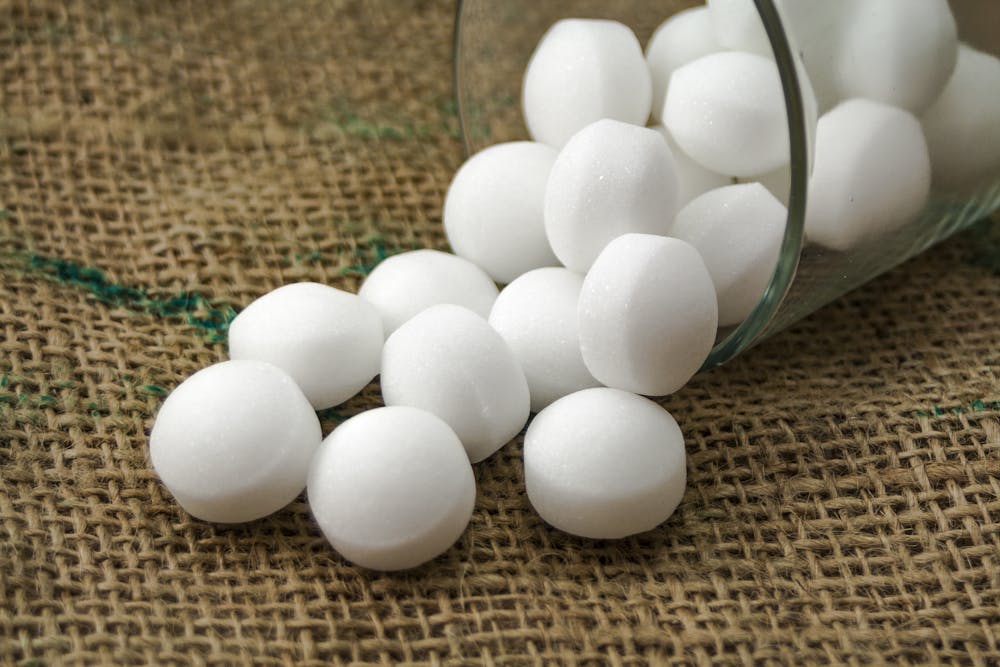 If you already have an infestation, mothballs will not help.
Shutterstock
If you already have an infestation, mothballs will not help.
Shutterstock
Authors: Ying Luo, PhD Candidate at the Research School of Biology, Australian National University

















