

DNA molecules in ancient dirt offer a treasure trove of clues to our past
- Written by Mike W Morley, Associate Professor, Flinders University
Archaeological deposits typically consist of a mix of artefacts and the remains of plants and animals — including the occasional human fossil — all held in a matrix of dirt. But these days, we dig for a lot more besides fossils and artefacts.
Now we can find clues to the deep past in the very dirt that we excavate. Alongside plant and animal remains, the sediments in an archaeological deposit might also contain ancient DNA molecules that can be extracted and used to identify the species that once lived there.
This was the case at Denisova Cave in southern Siberia, where “sediment DNA” revealed the evolutionary comings and goings of two now-extinct groups of humans who once lived there: the Neanderthals and a mysterious group dubbed the Denisovans.
Recent advances in this new field of genetic research offer exciting opportunities to study the geographic spread, timing and behaviour of past human populations. The possibility of obtaining clues from sediment DNA is important also because human remains (bones and teeth) are rarely preserved at archaeological sites.
Our new research, published in Proceedings of the National Academy of Sciences, reveals exactly where the DNA in archaeological sediments comes from — at a microscopic scale.
DNA in the dirt
Together with colleagues from around the world, we extracted ancient DNA from intact blocks of resin-soaked sediment collected at 13 archaeological sites in Europe, Asia, Africa and North America. From these blocks, we identified a variety of mammals, including Neanderthals in a sample from Denisova Cave.
We recovered ancient DNA from 23 of the 47 blocks analysed, including samples from Russia, Germany, France and Turkey, but not from samples collected at sites in Israel, Morocco, South Africa or the United States.
These results align with previous reports on the limits of ancient DNA preservation in bones and teeth. DNA survival depends on the complex interaction of environmental conditions, including temperature, humidity and soil composition. It is usually much better preserved in cold and dry environments than in deserts or the tropics.
Although DNA can survive in sediments for tens of thousands of years under favourable conditions, lingering questions persist about where these DNA molecules originate, and whether they could have been transported by water between archaeological layers.
In archaeological research, it’s crucial to know the exact location of where a piece of evidence was found. Sediment layers are laid down over many millennia, so if DNA molecules find their way into older or younger layers, then our estimates of their age could potentially be out by thousands of years.
Setting the record straight
To investigate whether DNA molecules can indeed be transported by water from one archaeological layer to another, we looked at sediment samples from caves occupied in the past by humans and other animals.
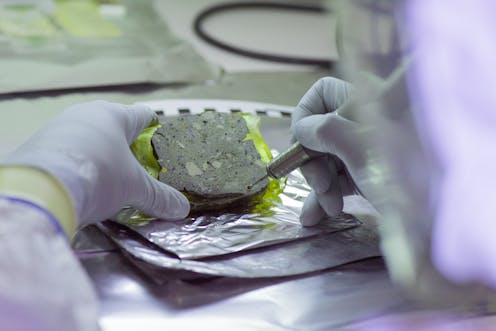
We cut resin-soaked blocks of cave sediment into thin slices for microscopic imaging and genetic analysis. From these, we successfully extracted DNA from blocks dug up as long as 40 years ago.
The blocks were originally collected and set in hardened resin to help understand how archaeological sites were formed. But our relatively new-found ability to retrieve ancient DNA from these samples opens new possibilities to explore the past.
We used a dental drill to bore tiny holes into the sediment slices and were encouraged to find the resulting powder contained ancient DNA. So we then looked in detail at particular microscopic features preserved intact in the blocks from which we cut the slices, and targeted them for genetic analysis.
In our samples, the ancient DNA was concentrated in millimetre-sized “hotspots”. These were typically associated with tiny fragments of bone — in effect, microfossils — or fossilised faeces. By understanding better where DNA is preserved in sediments, we now know which microscopic features to target in future studies.
Resin-hardened sediment blocks are very stable over time and are unlikely to become contaminated by other sources of DNA, such as modern DNA from present-day humans.
Blocks of resin-soaked sediment can be found in archaeology storerooms around the world, offering a largely untapped reservoir of clues about ancient human populations and the animals and plants that lived alongside them.
Read more: Dishing the dirt: sediments reveal a famous early human cave site was also home to hyenas and wolves
Excavation in the laboratory
In a pandemic world, where access to archaeological sites might be limited, these sediment blocks might also usher in a new era of “scientific excavation”, carried out in the lab, not in the field.
Detailed analyses of archived sediment blocks could reduce the need to travel to remote sites. Already a financially and environmentally costly exercise, it has become even more challenging during the current pandemic.
Pinpointing the origin of DNA in archaeological dirt will help us to refine this understanding, especially for sites that lack ancient bones and teeth.
Authors: Mike W Morley, Associate Professor, Flinders University

















