Sydney's dams may be almost full – but don't relax, because drought will come again
- Written by Ian Wright, Senior Lecturer in Environmental Science, Western Sydney University
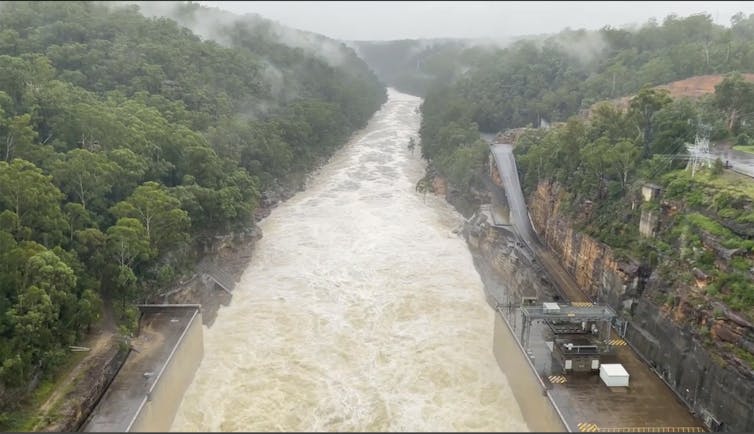
Dams serving capital cities such as Canberra, Hobart and Sydney are near full after two years of widespread rainfall. But these wet conditions won’t last.
Under climate change, droughts in Australia will become more frequent and severe. Our drinking water supplies, and water crucial for irrigation and the environment, will dwindle again.
Sydney, Australia’s most populous city, is among those that must prepare for the next drought. The NSW government is developing the Greater Sydney Water Strategy, to guide water management in coming decades.
Among the plan’s more contentious proposals are increased use of Sydney’s existing desalination plant and expanding the use of recycled water (highly treated sewage), including for drinking water. So let’s examine whether such measures are enough to secure Sydney’s water future.
A city of water scarcity
During the most recent drought from 2017 to 2020, Sydney’s water storage levels dropped by 50% of full dam capacity in two years – a much faster depletion than in previous droughts.
Inflows into Sydney’s dams have dropped over the past 30 years. From 1991 to 2020, inflows averaged 770 million litres a year – 45% less than the long-term average.
The news isn’t all bad. Sydney used less water in 2019-20 than it did in 1990, despite its population growing from 3.8 million to 5.4 million.
But as the Greater Sydney Water Strategy states, increasing climate variability means that, without action, the city could face a shortage of drinking water as periods of severe drought become longer and more frequent.
Desalination for the nation?
The strategy raises the prospect of increased use of Sydney’s existing desalination plant, and building a second plant in the Illawarra region south of Sydney.
Desalination removes salt from sea water to create drinking water. The Millenium drought – from the late 1990s until 2010 – prompted several major Australian cities, including Sydney, to build desalination plants.
The technology can revolutionise water supply. For example, in 2020-21, Perth’s two desalination plants supplied 47% of the city’s water. But desalination plants can also face limitations and challenges.
The plants are expensive to build and to operate – and can sit idle for years, as the Kurnell plant did between 2012 and 2019. This can make them politically unpopular and see them criticised as “white elephants”.
Even at full production, the Kurnell plant produces only 15% of Sydney’s daily demand. And while an additional plant in the Illawarra will extend desalinated supply to more households, the technology can’t supply water to all parts of Sydney due to the city’s complex distribution infrastructure.
As I discuss below, expanded use of recycled water is a better option for Sydney than more desalination.
Read more: Melbourne's desalination plant is just one part of drought-proofing water supply
Can we stomach recycled water?
Many Australian cities, including Sydney, already use recycled water – sewage that has been heavily treated – in applications such as watering golf courses and parks, flushing toilets and fighting fires.
The draft plan raises the prospect of also adding recycled water to drinking supplies, which has long been a vexed issue in Australia. Some people oppose it on health grounds, while others just can’t get over the “yuck” factor.
The concept of recycled water has a lot going for it. For example, analysis suggests it would be far cheaper and use much less energy than desalination.
Making better use of recycled water would also reduce the environmental impact of disposing of wastewater in rivers and oceans. And the potential supply of recycled water will only increase as populations grow.
Finally, good recycled water projects are used continuously, not just at times of water stress. The Rouse Hill recycled water scheme in Sydney, which supplies 32,000 properties for non-drinking water uses, is a great model.
The draft plan says recycled water would not be added to drinking supplies without public support, but past history suggests this may be hard to achieve. In 2006, for example, Toowoomba residents rejected a plan to drink recycled water, despite the town facing a grave water shortage.
However, as urban water supplies become ever more scarce, Australians may have to get used to the idea of drinking recycled water – and authorities will have to find new and better ways of selling the concept to the public.
The Sydney water plan recognises this. It emphasises the need for public consultation, and raises the prospect of investing in a recycled water demonstration plant to “highlight the safety of demonstrated and proven technology”.
Read more: When water is scarce, we can't afford to neglect the alternatives to desalination
A major omission
The plan shows how Sydney’s growing population could sustainably adapt to to a drier future. But it ignores one important measure for reducing water use - charging customers a penalty for excessive water use.
Under the measure, also known as an “inclining block tariff”, the rate per unit of water increases as the volume of consumption increases.
Research has shown water pricing can be an effective way to manage water scarcity, as well as helping water utilities recover the costs of their services. Australian cities such as Melbourne, Canberra and Brisbane apply inclining block tariffs to water, but Sydney does not.
Sydney Water’s price regulator, IPART, has argued against charging high water users more, saying it would provide less incentive for smaller households to conserve water and impose unfair costs on larger households.
Granted, water pricing is a complex issue and may require protections for lower-income users and the environment.
But under worsening climate change, our major cities cannot eschew any opportunity to ease pressure on water supplies.
Authors: Ian Wright, Senior Lecturer in Environmental Science, Western Sydney University