Post-pandemic, ‘small business fetishism’ could cost us jobs
- Written by Saul Eslake, Vice-Chancellor’s Fellow, University of Tasmania

Small business is “the engine room of Australia,” the “backbone of our economy,” the “hope of the side”.
They are the words used by the then treasurer and now prime minister Scott Morrison to justify special treatment for small businesses, an approach shared by leaders in every political party from Labor to One Nation to the Australian Greens
It’s a belief that underpins a wide range of grants and subsidies, free advice programs and preferential tax treatments, including
exemptions from payroll tax
a lower rate of company tax
discounts on personal income tax if unincorporated
exemptions in prescribed circumstances from capital gains tax
up-front tax-deductibility of capital investments
less onerous arrangements for remitting the goods and services tax.
What is extraordinary about the “engine room of the economy” doctrine is the complete absence of any evidence for it.
Advocates point to the large number of people who work for small businesses.
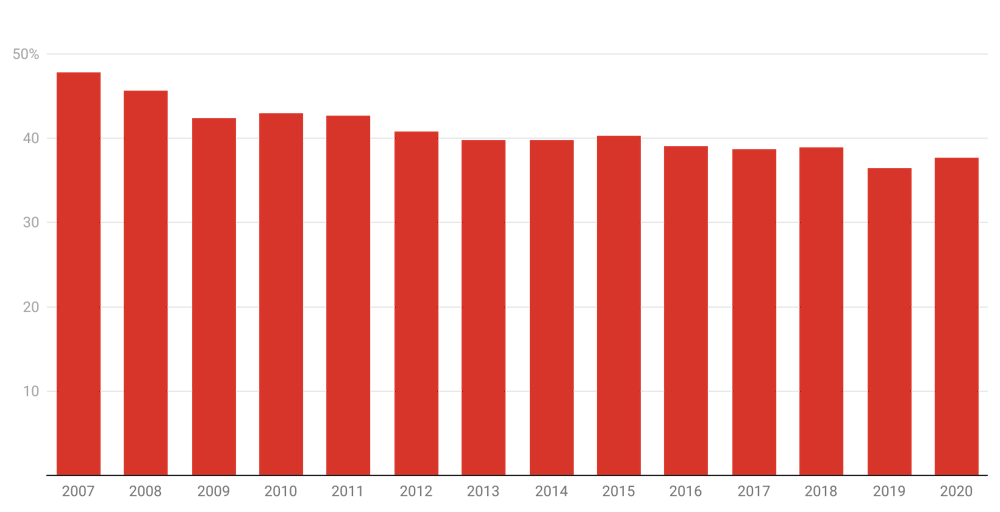
According to the Bureau of Statistics’ most recent count (in which small businesses are defined as those with fewer than 20 employees), they employed 4.67 million people as at the end of June 2020. That’s equivalent to 37.7% of total employment.
The ‘engine room’ that sheds jobs
What is less often pointed out is that number – 4.67 million – is smaller than it has been in all but four of the past 13 years. At no stage in the past 13 years have more Australians been employed in small businesses than in June 2007.
Rather than being the engine room of job creation, small business has presided over job destruction, creating not one single net new job in aggregate in 13 years.
Employment in small businesses has declined 6.3% in 13 years in which employment in medium-sized businesses has increased by 46.4% and employment in large businesses has increased by 48.4%.
Employment in small businesses as a share of total employment
Nor has the “instant asset write-off” advanced to small businesses in the 2015-16 budget done anything to enhance capital expenditures by small businesses.
Gross fixed capital expenditure by small businesses fell 16.1% between 2014-15 (the year before the instant asset write-off) and 2018-19 (the year before the pandemic) – a much larger decline than in capital expenditures by medium-sized businesses (2.7%) and large businesses (6%).
Another pervasive myth is that small businesses are more innovative.
Less productive, less innovative
While some small businesses undoubtedly are innovative, the ABS surveys of innovation activity have consistently found small businesses are less likely to engage in any form of innovative activity than medium-sized or large businesses.
Productivity is lower at small businesses than at larger ones.
The ABS puts gross value added per person employed in small businesses at A$24,000, or 21% below the average for all businesses in 2019-20. Gross value added per person in large businesses was almost $41,000 - 36% above the average.
Lower productivity might be one reason why, in 2019-20, small businesses paid their employees 35% less than the average wage or salary paid by all businesses. Medium-sized businesses paid an average of around 12% more, and large businesses paid almost 34% more.
Apparent average annual wage or salary by size of business
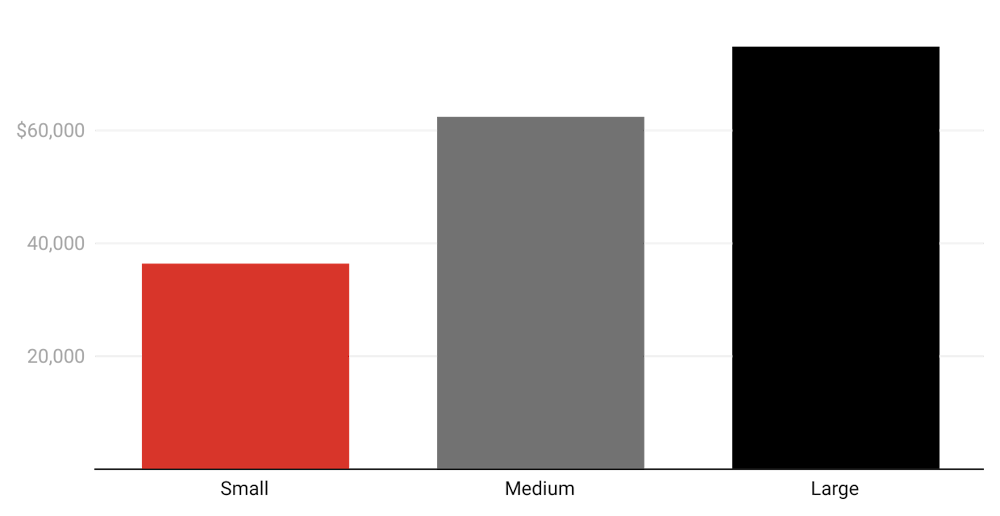 Average annual wage or salary is obtained by dividing total wages and salaries paid by each category of business in 2019–20 by the average number of employees as at 30 June 2019 and 30 June 2020. In the absence of relevant data, no allowance is made for differences in the proportion of full or part-time employment between businesses of different size.
ABS Australian industry 2019–20, and author’s calculations
Average annual wage or salary is obtained by dividing total wages and salaries paid by each category of business in 2019–20 by the average number of employees as at 30 June 2019 and 30 June 2020. In the absence of relevant data, no allowance is made for differences in the proportion of full or part-time employment between businesses of different size.
ABS Australian industry 2019–20, and author’s calculations
The obvious conclusion outlined more fully in my new piece in the Australian National University journal Agenda is the widely held belief small business is the “engine room of the economy” is simply wrong – as is the corollary that increased assistance to businesses simply because they are small is a good way to boost employment, investment, innovation and economic growth.
Less keen to pay tax
One thing small businesses are not particularly good at is paying the required tax.
The Australian Taxation Office Tax Gap program finds small businesses (which it defines as those with incomes of up to $10 million per year) voluntarily paid only 86.3% of the personal and company income tax they should have paid if they had fully complied with its interpretation of the 2018-19 tax law.
This is larger than any of the tax gaps calculated by the ATO.
The ATO finds high wealth voluntarily paid 91.4% of what should have been paid had they fully complied. Large corporations paid 91.7%.
Read more: Is small business really the engine room of Australia's economy?
The Tax Office numbers suggest small businesses accounted for 49% of what it defines as uncollected money. Large corporations and high wealth individuals accounted for only 10% and 3%.
Again, this is strikingly at odds with the popular perception that small businesses are unfairly persecuted by the ATO and that all of Australia’s fiscal problems would disappear if only “the top end of town” paid its fair share of tax.
During the pandemic, small businesses needed support
That’s not to say the substantial assistance provided to small businesses during COVID-19 were unjustified. Small businesses account for a disproportionately large share of most of the sectors that were hardest hit by the restrictions imposed in order to suppress COVID-19, hospitality among them.
Had governments not provided the extensive support for small businesses they did, it is highly likely the economy would have contracted by more, and the unemployment rate would have risen by more in the middle of last year.
However, it will be important to ensure this support does not become entrenched.
Policies that serve to prolong the existence of small businesses – which, as noted, on average have lower levels of productivity than larger businesses – will slow down the rate at which factors of production can move to higher productivity uses within industries and across the economy.
Post-pandemic, new businesses will matter most
Ideally, existing schemes of preferential tax treatment and other forms of assistance to small businesses, simply because they are small, should be scrapped entirely and replaced with preferential tax treatment for new businesses.
There are at least five reasons for this:
first, new businesses are more likely to be started in sectors of the economy with more sustainable economic prospects – whereas small businesses are typically in the sector they started in
second, new businesses are much more likely to create jobs than small businesses – one recent study showed firms aged less than two years created 1.44 million Australian full time equivalent jobs between 2006 and 2011 while firms aged three years or older shed around 400,000 jobs
third, new businesses are much more likely to innovate than small ones – indeed, the desire to introduce a new product or service, or to produce an existing product or service in a new way, is one of the principal motives for starting a new business
fourth, since there is no way new business can prevent itself from eventually becoming older, assistance can’t be gamed by new businesses staying new in the same way as it can be gamed by small businesses staying small
fifth, since almost all new businesses are inevitably small and most small businesses are not new, the budgetary cost of measures designed to help new businesses will be much less than the cost of measures designed to help small businesses, leaving more room to assist all businesses.
The Reserve Bank has repeatedly stressed the importance of lifting wages growth. The government in last year’s Intergenerational Report stressed the importance of lifting productivity growth.
We will emerge from COVID badly if we don’t take the opportunity to realign our programs in line with reality so they best achieve this.
Authors: Saul Eslake, Vice-Chancellor’s Fellow, University of Tasmania
Read more https://theconversation.com/post-pandemic-small-business-fetishism-could-cost-us-jobs-173653