

Experience the spectacular sounds of a Murrumbidgee wetland erupting with life as water returns
- Written by Mitchell Whitelaw, Professor of Design, School of Art and Design, Australian National University
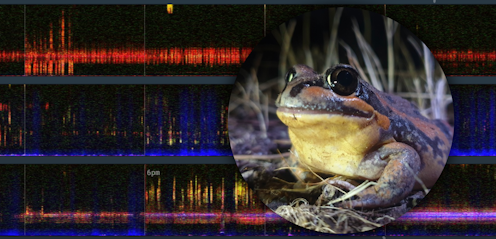
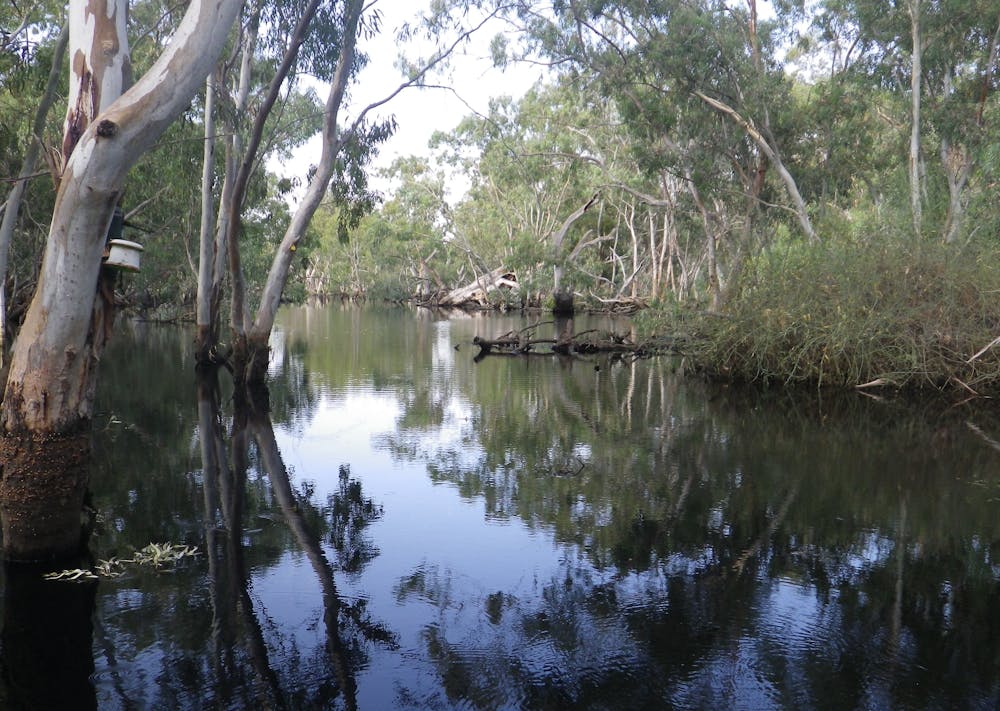
In the southwestern corner of New South Wales, along the Murrumbidgee river, frogs are calling in a wetland called Nap Nap. This is Nari Nari country – nap nap means “very swampy” in traditional language.
Nap Nap is one of many inland wetlands across Australia to receive so-called “environmental water”: water allocated and managed to improve the health of rivers, wetlands and floodplains.
Long-term monitoring shows how these environmental flows sustain big old trees and cycle nutrients through the ecosystem. They drive breeding for frogs, waterbirds, reptiles and fish, and protect endangered species. This is a good news story for our inland waterways – but it’s mostly told through scientific reports.
We wanted to use ecological data to convey not just facts but feelings, and create a vivid digital portrait of life in Nap Nap. So we produced The Sound of Water, using audio, images and water data to reveal the patterns and rhythms of the swamp.
In part, this is about finding an engaging way to tell an important story. But there’s a bigger agenda here too: how might we use environmental data to amplify humanity’s attachment to the living world?
Addressing an imbalance
Healthy wetlands rely on varying river flows. When a river is flooding or at high flow, water is delivered to wetlands, enabling seeds to sprout and animals to move and breed. When the river is at low flow, wetlands enter a natural drying phase.
But across Australia, thousands of wetlands have lost their natural connection to rivers. Lower river flows – the result of water regulation and diversions required to meet human needs – means many wetlands no longer experience these natural cycles.
Environmental flows seek to address this imbalance. Managed by water authorities, the flows involve strategically delivering water to replenish rivers, wetlands and floodplains.
Our project – a design-science collaboration – was funded by the Commonwealth Environmental Water Office’s Flow-MER program, which undertakes long-term monitoring of the ecological impact of environmental water allocations.
The Sound of Water
Across nine days in spring of 2020, an environmental flow of about 16,000 million litres rolled into Nap Nap swamp in the Lowbidgee floodplain after a brief dry spell. The Lowbidgee floodplain is near the confluence of the Kalari (Lachlan) and Murrumbidgee rivers in New South Wales.
The frogs began calling as the water returned. But don’t take our word for it - listen for yourself:
In this clip, you can hear the squelchy, “cree-cree” call of tiny, hardy Murray Valley froglets. You can also hear inland banjo frogs, whose “dok” call sounds a bit like a plucked string; spotted marsh frogs with a machine-gun like “duk-duk-duk”; and the shrill, rattling call of Peron’s tree frog.
This recording comes from an audio logger used in Flow-MER’s environmental monitoring. These automatic devices record for five minutes every hour, day and night – that’s two hours of sound captured every day.
Seeing wetland sounds
To reveal the content of all this audio, we used a visual representation of sound known as a spectrogram. We adapted a technique developed by researchers at the Queensland University of Technology which enables ecologists to visualise and analyse thousands of hours of recordings.
We visualised almost a year’s worth of audio from Nap Nap – more than 700 hours.
The below image contains spectrograms of audio from June 2020, which was a dry period in the swamp. The colourful central band corresponds to the noisy daylight hours, when woodland birds dominate.
The vivid blue areas are wind and rain noise. The pink and orange are mostly bird calls, and continuous sounds like cricket calls show up as strong horizontal bands (top right).
The mostly dark outer bands correspond to the nights, which in dry periods are fairly quiet.
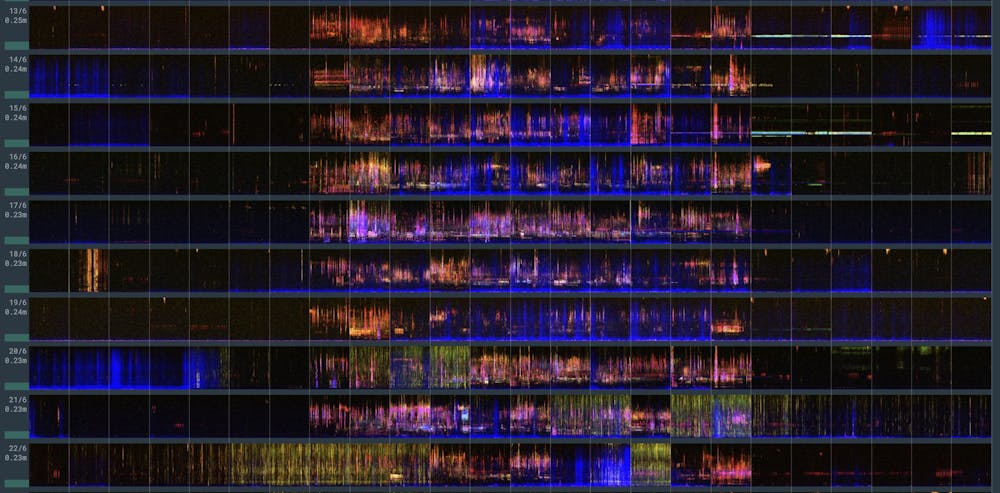 Spectrograms of Nap Nap audio from June 2020. Each row shows a single day, made up of 24 hourly segments.
Authors provided
Spectrograms of Nap Nap audio from June 2020. Each row shows a single day, made up of 24 hourly segments.
Authors provided
But as the environmental water flow reached Nap Nap, the night lit up with frog calls. Our story focuses on this moment. We found a way to link the visuals to the source audio, creating interactive timelines in which we can see, hear and explore the wetland soundscape.
The stars of our story are Nap Nap’s frogs, and our most important find was a southern bell frog. Once widespread across southeastern Australia, these frogs are now found in only a few isolated populations.
Their distinctive call indicates the ecological health of Nap Nap, and the value of these environmental flows. Here you can listen to its deep, growling call, which appears as a sequence of pink and purple blobs along the bottom of the spectrogram.
Read more: We name the 26 Australian frogs at greatest risk of extinction by 2040 — and how to save them
Spectrogram of a southern bell frog calling at Nap Nap (3 September 2020, 8pm). Image: Gayleen Bourke.A data portrait of a living place
Our design uses a scroll-based interaction technique sometimes termed “scrollytelling”. It works because it’s familiar (everyone can scroll) and translates well to all kinds of devices. It lets us lead the audience step by step into the place, the data and the spectrograms, while still encouraging exploration.
The Sound of Water builds on established techniques to create something new. It shows how design and science can unite to tell environmental stories in a richer way – with both facts and feelings. This matters because Nap Nap, and thousands of places like it, need people to care about their protection.
To explore the full version of The Sound of Water, click here.
Authors: Mitchell Whitelaw, Professor of Design, School of Art and Design, Australian National University

















