

Modern Australian
The Times

Legendary band Yothu Yindi and their trailblazing call for a treaty

  • Written by Aaron Corn, Professor and Inaugural Director, Indigenous Knowledge Institute, The University of Melbourne

Legendary band Yothu Yindi and their trailblazing call for a treaty

Review: Writing in the Sand: The Epic Story of Legendary Band Yothu Yindi and How Their Song Treaty Gave Voice to a Movement by Matt Garrick (ABC Books)

Readers are advised this article contains depictions of deceased people. Special thanks to Witiyana Marika of Yothu Yindi for confirming it is acceptable to publish the late Mandawuy Yunupiŋu’s name.

Few musicians have had as profound an impact on Australia’s cultural and political life as those in Yothu Yindi. Formed in 1986, this revolutionary band brought together Indigenous musicians from the Yolŋu town of Yirrkala in Northeast Arnhem Land and their non-Indigenous, or Balanda, friends who played in a Darwin band called the Swamp Jockeys.

Their union became fertile ground for new musical dialogues between very different styles, cultures and ideas with the band’s innovative songs drawing on Yolŋu musical elements and lyrics.

Their sources were Manikay, the ancestral Yolŋu song tradition performed in public ceremonies, and Djatpaŋarri, a playful and exuberant popular song form composed and performed by young men in Yirrkala from the 1930s to the 1970s. These overt borrowings afforded Yothu Yindi their distinctive sound.

Sung in both English and Yolŋu languages, Yothu Yindi’s early hits included spirited rock anthems such as Djäpana: Sunset Dreaming and Treaty. These songs affirmed traditional ideas and values for local Yolŋu audiences, while resonating across Australia with the Aboriginal Reconciliation movement of the early 1990s.

The band’s biggest hit, Treaty, released in 1991, was informed by the Yirrkala community’s deep sorrow over their 1971 Supreme Court loss in a case brought against the bauxite mine that had consumed their surrounding homelands.

The song contributed significantly to popularising calls for the Australian government to negotiate a treaty with Indigenous peoples in recognition of their human rights and unceded sovereignty.

Despite the gravity of such themes in many of Yothu Yindi’s songs, the band’s generosity of spirit towards people from all walks of life shone through.

Growing into a group of increasingly diverse musicians over time, Yothu Yindi advocated their own vision for an Australia in which Indigenous people and others could live together in mutual respect and harmony.

Read more: My favourite album: Yothu Yindi's Tribal Voice

An anthem for all Australians

Writing in the Sand: The Epic Story of Legendary Band Yothu Yindi and How their Song Treaty Gave Voice to a Movement is a new book by Matt Garrick, an award winning writer and ABC News journalist based in Darwin. It is both Garrick’s first book and the band’s first biography.
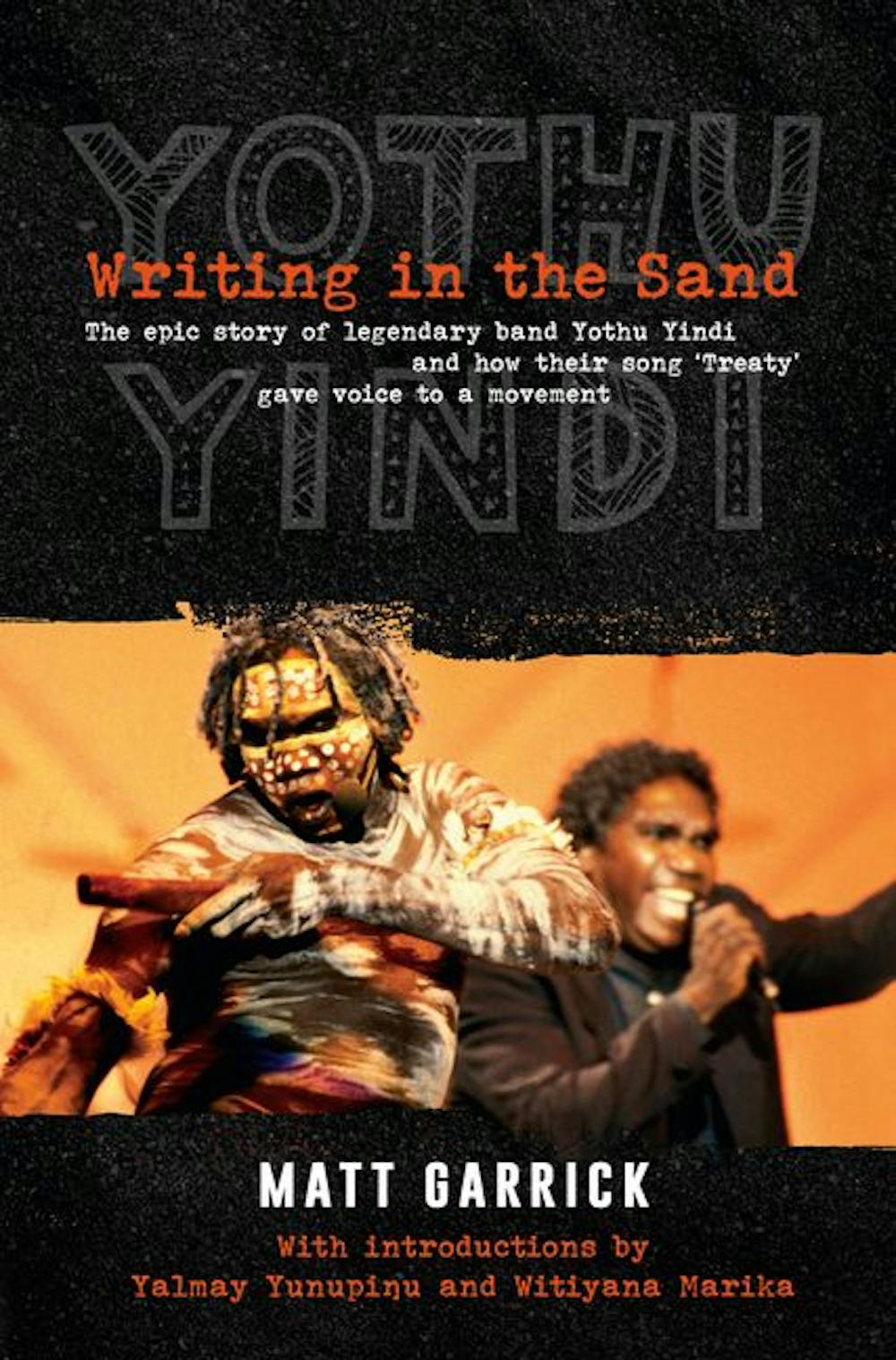
Book cover
Writing in the Sand marks 30 years since the release of Treaty. The book’s title is taken from the song’s first verse, which laments the failed 1988 promise of Australian Prime Minister Bob Hawke to make a treaty with Indigenous peoples within the lifetime of his parliament. As the first book to comprehensively chronicle Yothu Yindi’s globetrotting career, Writing in the Sand deepens our understanding of this remarkable band’s achievements. It brings together a multitude of diverse voices to breathe life into this story, vividly illustrated by previously unpublished photos from the band’s archive. Much love and care has been taken to respect and honour the memories of deceased musicians, including Yothu Yindi’s late singer Mandawuy Yunupiŋu, as well as Slim Dusty, who toured with the band. Their contributions are contextualised by Garrick’s extensive interviews with Yothu Yindi musicians, including Witiyana Marika, Stu Kellaway and Jodie Cockatoo, as well as Yunupiŋu’s widow, Yalmay Marika-Yunupiŋu, and a wide array of collaborating artists, including Peter Garrett, Paul Kelly, Neil Finn, Joy McKean, Bart Willoughby and Andrew Farriss. These interviews beautifully illustrate the humanity of Yothu Yindi’s creative process. For example, when Kelly joined Yunupiŋu on his ancestral homeland at Biranybirany, they wrote the first few lines of Treaty together as an anthem for all Australians. The book also addresses the early musical influences that shaped Yothu Yindi’s sound, from the formative affinity of the band’s Yolŋu musicians with Slim Dusty, to the irreverent country originals of the Swamp Jockeys in a 1980s Darwin inundated with blues cover bands. Finding a balance The name Yothu Yindi means child and mother. The yothu–yindi relationship between children and mothers, and their respective mala, or clans, is fundamental to maintaining systemic balance within Yolŋu society. This tenet provided a foundation for the band’s inclusion of musicians from a wide array of backgrounds and influences from around the globe. Its importance is engagingly explained in the book through the words of Witiyana Marika. Read more: Friday essay: how Indigenous songs recount deep histories of trade between Australia and Southeast Asia The book also mentions the important Yolŋu concept of ganma, the balanced meeting of fresh and salt waters in certain estuaries. This metaphor for the meeting of different cultures and knowledges inspired and informed Yunupiŋu’s prolific career as an educator and a musician. Even at this present time of widening hyper-partisanship on a global scale, when people’s perceived differences threaten to overwhelm our common humanity, Yothu Yindi offers us these quintessentially Australian lessons about the intrinsic value of social harmony and mutual respect in creating a more inclusive world for all. In an Australia yet to make a treaty with Indigenous peoples, Yothu Yindi is more relevant now than ever. The Gupapuyŋu App is a free download from Charles Darwin University that provides a Yolŋu language pronunciation guide. Authors: Aaron Corn, Professor and Inaugural Director, Indigenous Knowledge Institute, The University of Melbourne

Read more https://theconversation.com/legendary-band-yothu-yindi-and-their-trailblazing-call-for-a-treaty-173843

Celebration of Life vs Traditional Funeral: What's the Difference?

When saying goodbye to someone you love, there is no single way to honour their life. Every family has different traditions, beliefs, and preference...

Building Approval for Roofing Projects: What Homeowners Need to Know

Roofing projects are an important part of maintaining and protecting your home. Whether you're repairing storm damage, replacing an ageing roof, or ...

Chatswood Tutoring And Its Role In Academic Achievement

Academic success often requires more than classroom attendance alone. Students face increasing expectations as they progress through school, particu...

Why Laser Hair Removal Treatments Continue Growing In Popularity

Managing unwanted hair can become time-consuming and frustrating for many people, especially when shaving, waxing, and other temporary methods requi...

Choosing the Right Devices for a Flexible Workplace

For IT leaders managing large fleets, the device layer is where workforce productivity and security policy meet. The shift towards flexible and hybrid...

How Business Advisory Services Help Companies Achieve Sustainable Growth

Every business owner aims to build a profitable and sustainable organisation. While dedication, innovation, and hard work are important, achieving l...

Why Body Contouring Has Become A Popular Cosmetic Treatment

Many people maintain healthy lifestyles through regular exercise and balanced eating habits but still struggle with stubborn areas of fat that are d...

How to Choose the Right POS Hardware for Your Business in Australia

A lot of Australian business owners spend weeks researching POS software but buy hardware almost as an afterthought. That's a mistake. The wrong har...

Why Material Handling Hose Is Critical for Industrial Efficiency

A high-performance material handling hose is an essential component in industries that transport abrasive, dry, or bulk materials on a daily basis...

How to Choose the Right Lawyer in Melbourne for Your Situation

Choosing legal support can feel difficult, especially when the stakes are personal or business-related. The right lawyer in Melbourne should underst...

Hoteliers Look to Clever Value Adds to Increase Revenue

The Australian hospitality industry is still in recovery mode after a notoriously rough patch in recent years. While there has been a post-COVID tra...

Moving to Queensland? Here’s How to Prep Your Car for the Big Move North

There’s no sign of the northern migration slowing down, with thousands of southerners fleeing from chaotic lifestyles and cooler climates for a brig...

Diesel Shortage to Impact Trades and Contractors

Strait of Hormuz blockage affecting all major parts of trades and construction Trades and construction across residential, commercial and industria...

Why Holiday Home Owners Turn to Rental Management Agents

The Allure — and the Reality — of Renting Out Your Property Owning a holiday home is a dream for many Australians. Whether it's a beachside sha...

Why Finding Reliable Doctors In Bundoora Is Important For Long-Term Health

Access to quality healthcare plays an important role in maintaining overall wellbeing and managing health concerns early. Trusted Doctors in Bundoor...

Understanding the Different Types of Car Services: Minor vs Major

When it comes to car maintenance, one of the most important things every vehicle owner should understand is the difference between a minor and a maj...

How Superannuation and TPD Insurance Work Together

Superannuation is an essential part of financial planning in Australia. It is designed to provide individuals with income during retirement, helping...

Tiny Towns funding granted for Mt Hotham and Mt Buller upgrades

Alpine Resorts Victoria (ARV) has welcomed funding support from the Victorian Government’s  Tiny Towns Fund, with both Mt Hotham and Mt Buller se...
















