

how 40 years of biopics showed Princess Diana on screen
- Written by Giselle Bastin, Associate Professor of English, Flinders University
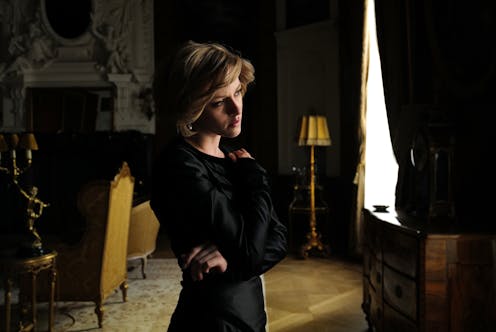
Since the earliest Princess Diana biopics appeared soon after the royal wedding in 1981, there have been repeated attempts to bring to the screen the story of Diana’s journey from blue-blooded ingenue through to tragic princess trapped within – and then expelled from – the royal system.
A long string of actresses, with replicas of the outfits she wore and a blond wig (sometimes precariously) in place, have walked through episodic storylines, charting the “greatest hits” of what is known of Diana’s royal life.
Biopics about the princess tend to be shaped according to the dominant mythic narratives in circulation in any given phase of Diana’s life. The first biopics were stories of fairytales and romance. From the 1990s, the marriage of Charles and Diana took on the shape of soap opera and melodrama.
Now, with the Crown (2016–) and Spencer (2021), Diana has become a doomed gothic heroine. She is a woman suffocated by a royal system that cannot, will not, acknowledge her special place in the royal pantheon.
Read more: Spencer: how Diana became the popular culture princess
Fairytales and soap operas
The first Dianas appeared on American television networks within months of the July 1981 wedding of Charles and Diana.
Both Charles and Diana: A Royal Love Story (starring Caroline Bliss) and The Royal Romance of Charles and Diana (starring Catherine Oxenberg) invested wholesale in a fairytale lens.
They told of the young and virginal beauty who had captured the attention of the dashing prince, whisked off to a life of happily ever after.
The Diana biopics fell quiet for the first years of the marriage (fairytales don’t tend to interest themselves in pregnancies and apparent marital harmony), and then reemerged after the publication of Andrew Morton’s exposé, Diana: Her True Story (1992).
Morton’s biography was written from taped interviews with the princess and inspired the next generation of Diana biopics, ones that I call the “post-Morton” biopics, which borrow from Diana’s own scripting of her life.
A series of actors were enlisted to play Diana in these made-for-television productions.
Oxenberg turns up again in Charles and Diana: Unhappily Ever After (1992). In Diana: Her True Story (1993), Serena Scott-Thomas (who, incidentally, turns up in the 2011 television biopic William and Kate as Catherine Middleton’s mother Carole) does her best with a terrible script and series of wigs.
Others gave it their best shot. We had Julie Cox in Princess in Love (1996), Amy Seacombe in Diana: A Tribute to the People’s Princess (1998), Genevieve O'Reilly in Diana: Last Days of a Princess (2007) and, briefly, Michelle Duncan in Charles and Camilla: Whatever Love Means (2005).
But even large budget films (such as 2013’s cinema-release Diana, directed by Oliver Hirschbiegel and starring Naomi Watts) had critics and audiences letting out a collective yawn.
In film after film we were offered yet another uninspired, soap opera-style representation of the princess’s life.
A gothic tale
Critics’ voices were quelled somewhat with the appearance of Emma Corrin’s Diana in season four of The Crown.
With Netflix’s high budget and quality production values, many — including myself — felt Peter Morgan’s deliberate combination of accuracy and imaginative interpretation of Diana’s royal life offered something approximating a closer rendition of the “real” princess than we’d been presented with before.
Read more: The Crown season 4 review: a triumphant portrait of the 1980s with a perfectly wide-eyed Diana
And then we come to the most recent portrayal of Diana on screen, Pablo Larraín’s Spencer (2021), starring Kristen Stewart as Diana. What, royal biopic watchers wondered, could it possibly do to top The Crown’s Diana?
Spencer’s statement in the film’s opening offers a clue: it promises to be a “fable from a true tragedy”.
This is a film where genre imperatives and creative imaginings are placed at the forefront of its representation of the princess.
Taking its cue from the gothic themes and tropes Diana can be heard invoking on the Morton tapes, Spencer’s heroine is trapped in a frozen Sandringham setting, gasping for air to the point where her voice rarely lifts above a soft, almost suffocated, whisper.
She tears at the pearls encircling her throat. She rips open the curtains sewn shut by staff. She self-harms with wire cutters. She runs like an animal hunted down manor house corridors and across frosty Norfolk fields.
She is haunted by the ghost of Anne Boleyn, another royal wife rejected by her husband, prompting one reviewer to ask: “is Spencer the ultimate horror movie?”
Larraín and Stewart’s Diana has her precursor in the spectral, gothic Diana who appears in the 2017 future-history television film King Charles III, based on Mike Bartlett’s 2014 play. The anguished howl of this Diana (played by Katie Brayben) echoes throughout the palace in the same way Spencer’s Diana is framed as the royal who will haunt the Windsors for decades to come.
The lamentable Diana: The Musical (2021) on Netflix (a filmed version of the Broadway production starring Jeanna de Waal) – with its cliched storyline, two-dimensional characterisation, awkward costuming and early 1980s Andrew Lloyd Webber-style aesthetic – offers some evidence that, even in 2021, the creators of Diana stories haven’t altogether abandoned their investment in the Diana of 1981.
But with Spencer, we have a Diana shaped by both the princess’s own version of her story, and the screen Dianas that came before her. Spencer suggests new directions and potential for the telling of royal lives.
Authors: Giselle Bastin, Associate Professor of English, Flinders University

















