

Laws governing undersea cables have hardly changed since 1884 – Tonga is a reminder they need modernising
- Written by Karen Scott, Professor in Law, University of Canterbury
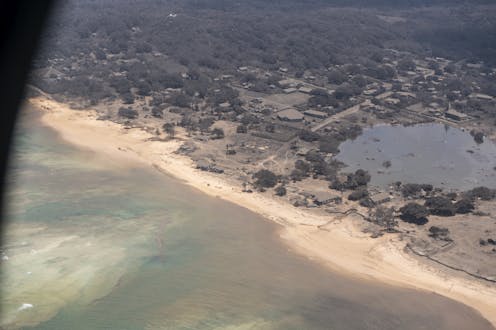
Since the catastrophic volcanic eruption on January 16, Tonga has been largely cut off from the world due to a break in the undersea cable that links Tonga with Fiji (and from there with the world). A complete fix may take weeks.
Aside from the distress and inconvenience this is causing, Tonga’s predicament demonstrates a more general vulnerability of our global communication system.
Over 95% of the world’s data travels along the 436 submarine cables – around 1.3 million kilometres long in total – that connect all continents except Antarctica. These cables carry data integral to the internet, communication, and financial and defence systems worldwide.
There are natural hazards, as the Tonga eruption so graphically demonstrated. But the greatest threat to submarine cables is from fishing. Despite the cables being clearly marked on maritime charts, about 70% of damage is caused accidentally by gear such as trawl nets, dredges, long lines and fish aggregation devices.
But there is also concern that the cables are increasingly vulnerable to terrorism and cyberwarfare by private and state actors. As the head of the UK’s armed forces warned very recently:
Russian submarine activity is threatening underwater cables that are crucial to communication systems around the world.
An outdated convention
Given their fundamental importance to modern global communication, then, it would be natural to assume the international rules protecting submarine cables have been revised to respond to new technology and new challenges.
Not so. The international legal regime for protecting and managing submarine cables has remained largely unchanged since 1884 when the Convention for the Protection of Submarine Telegraph Cables was adopted. It remains in force today, with 36 party states (including New Zealand and Australia, which acceded in 1888 and 1901 respectively).
Read more: Why the volcanic eruption in Tonga was so violent, and what to expect next
The convention makes it an offence to break or damage a submarine cable, wilfully or by culpable negligence (unless such action is necessary to save life). It also provides that only the state within which a vessel is registered (the “flag state”) can take action against its vessels and those on board.
If the owner of a cable breaks or damages another cable when laying or repairing their own, they must bear the cost of repairing the breakage or damage. Vessel owners who sacrifice an anchor, net or other fishing gear to avoid damaging a cable can receive compensation from the owner of the cable.
Who controls a cable?
These provisions go back to not long after the first international submarine communication cable was laid between Britain and France in 1850 – it was destroyed by a French fishing vessel within 24 hours.
By 1858, the age of submarine cables and international communication had begun with the laying of the first transatlantic cable connecting Britain and the US, although it failed after about a month and was replaced in 1866.
In 1902, the so-called “All Red” route linked New Zealand and Australia with Vancouver through the Pacific Ocean and on to Europe through the Trans-Canada and Atlantic lines.
In 1986, the first fibre optic cable was laid between the UK and Belgium, beginning the modern revolution in global communication.
Read more: The Tonga volcanic eruption has revealed the vulnerabilities in our global telecommunication system
The 19th-century principles governing undersea cables have since been incorporated into the modern law of the sea, codified by the 1982 United Nations Convention on the Law of the Sea (UNCLOS), ratified by 168 nations.
Under UNCLOS all states have a right to lay cables and pipelines on the seabed and continental shelf up to the 12 nautical mile limit. To run a cable to shore through another state’s territorial sea, a state needs the permission of the coastal state.
But beyond the territorial sea, the power of the coastal state to prevent or impose conditions on where a cable is laid is extremely limited. The 1884 convention rules relating to offences and liability have been incorporated into UNCLOS with minimal amendment.
Time for modern laws
There are a number of problems with the current rules. First, outside of the territorial sea, the only state that can take action against a vessel that breaks a cable is the vessel’s own flag state.
While some flag states are responsible and have adopted appropriate legislation – as New Zealand has done with the Submarine Cables and Pipelines Protection Act 1996 – many others have not.
Moreover, the state with an interest in the cable – through ownership or because the cable ultimately connects to its shore – is normally not able take action against a vessel damaging the cable.
Generally, the law does not address issues such as physical separation between different cables or their distance from other undersea activities such as mining. Nor does it cover maintaining consistent information on maritime charts, or co-ordination between industries and states.
The International Cable Protection Committee, a private organisation comprising 180 state and commercial members representing 97% of the world’s submarine telecom cables, issued a voluntary guide to best practice in 2021 that addressed some of these issues – but is this enough?
Given the potentially catastrophic impact on communications, the economy and defence of losing major cables to accident or nefarious activity, the answer is arguably no. The rules, largely unchanged since 1884, need modernising.
Authors: Karen Scott, Professor in Law, University of Canterbury

















