

Google AI


Modern Australian

will the big storm on Jupiter ever go away?

  • Written by: Lucyna Kedziora-Chudczer, Program Manager / Adjunct Research Fellow, Swinburne University of Technology

Will the big storm on Jupiter ever go away? — Edgar Nuttall, age 5, Brisbane

will the big storm on Jupiter ever go away?

Hi Edgar! Thank you for such a unique question.

Jupiter is the largest planet in our solar neighbourhood, and its weather is very wild. We have beautiful images of Jupiter which show striped, stormy clouds covering the whole planet.

In fact, Jupiter is covered with storms. Some are only small, but some are so big they could cover all of Earth.

The largest of these storms is the famous Great Red Spot — which I see you already know about. This spot is actually a cyclone, similar to hurricanes and cyclones here on Earth.

A close up of Jupiter, showing the Great Red Spot.
The Great Red Spot is a storm bigger than the Earth! Shutterstock

It is made of powerful winds blowing in circles, a bit like tea swirling in a cup when you stir it. These winds are more than five times faster than any hurricane winds on Earth.

The Great Red Spot is like the grandfather of Jupiter’s storms. It has been roaming for many, many years – but recently we’ve seen it get smaller.

Does that mean it will one day go away? Well, not necessarily.

Stormy stripes

Jupiter looks like a giant, stripy ball that spins very fast. The light-coloured stripes are clouds with rising air, while the dark-coloured stripes are clouds that are sinking.

When you see dark and light stripes next to each other on Jupiter, you’re actually seeing winds blowing in opposite directions. When this happens, they can spin up big cyclones, kind of like how pushing a beach ball with one hand and pulling it with other will make it spin.

Humans have been watching the Great Red Spot for at least 200 years and it has been blowing strong winds almost this whole time.

Like all storms, it can change from day to day. Sometimes it looks round, sometimes like an egg. Its colour can also change from brownish-red to pale red. Sometimes it looks almost white.

But recently, scientists have noticed the enormous cyclone shrinking. About 100 years ago, the Great Red Spot was almost three times larger than it is today.

Read more: Curious Kids: why are some planets surrounded by rings?

Why is it shrinking?

To understand why it’s shrinking, it helps to first understand why cyclones shrink (and eventually stop) on Earth.

On Earth, cyclones often form above deep, warm oceans before moving onto the hard land or cooler water. When a cyclone’s winds rub against the hard land, the winds slow down (and therefore the cyclone slows down).
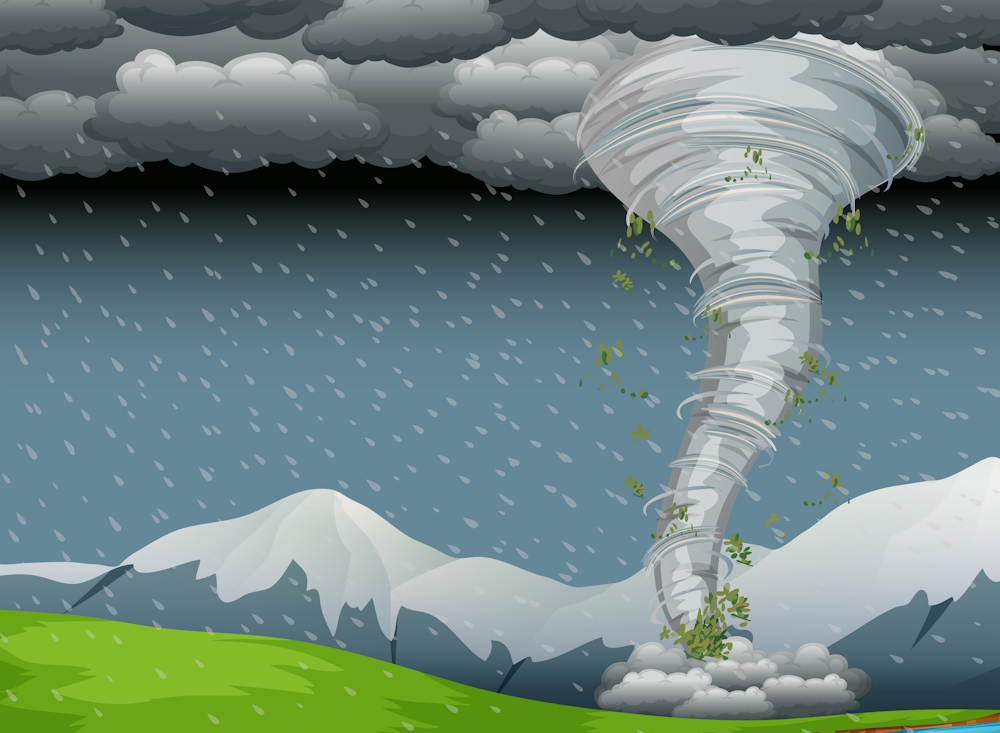
Cartoon depiction of cyclone over the land
On Earth, cyclones usually begin over large warm oceans, but slow down as they move into cooler areas or break up against the land. Shutterstock

Cyclones on Earth are also hit by other weather and winds around them, which can makes the cyclone “flake” away within a few days.

But Jupiter doesn’t have a hard, rocky surface like Earth. And even though the air in Jupiter’s clouds is freezing, the air towards the inside is very hot. This hot air gives storms plenty of energy to rage on for months, or even years.

So even while the Great Red Storm is shrinking, it can actually still get a bit taller as it does. And it has plenty of energy to keep spinning.

We can also see it “flaking” away at the edges as it slams into other storms and winds around it. But astronomers still don’t know if this will make it go away entirely. Some think it might one day break up into many smaller storms.

Recently, the Juno space probe (which has been flying around Jupiter since 2016) took many beautiful pictures of Jupiter’s storms while flying by the planet. We may learn something new from these images.

Until then, we may as well admire the Great Red Spot as it rages on.

The animation below shows the Juno space probe. You can spin it around to see it more clearly. On the top is the antenna. The big ‘wings’ are covered with solar panels which provide electricity for its different parts.

Authors: Lucyna Kedziora-Chudczer, Program Manager / Adjunct Research Fellow, Swinburne University of Technology

Read more https://theconversation.com/curious-kids-will-the-big-storm-on-jupiter-ever-go-away-180573

Why the Spring School Holidays Are a Great Time to Visit Coffs Harbour

The spring school holidays are a good time to spend a few days on the Coffs Coast. The weather is starting to warm up, there is plenty to do outdoor...

What to Do When an Older Car Is No Longer Worth Keeping in Melbourne

Ever looked at another repair quote and wondered whether your old car is still worth the trouble? It is a common turning point for Melbourne motoris...

Your Baby's First Year: A Local Guide to Feeding, Sleep, and When to Get Extra Support

Ask ten parents in a Brisbane mothers' group how their baby is feeding or sleeping, and expect ten different answers.  Someone's baby sleeps throug...

Kitchen and Laundry Makeover Ideas That Don't Require a Full Renovation

Full kitchen renos are expensive — and most people don't actually need one.  They need the kitchen to stop looking like it's stuck in 2009, or they...

How Technology Is Reshaping the Modern Australian Commercial Kitchen

The commercial kitchen has always been shaped by technology. Refrigeration changed how ingredients could be stored, modern ventilation transformed k...

The Number on a Roller Blind Fabric That Nobody Explains

Somewhere in the fabric book, next to the colour name, there is a percentage. Three per cent. Five per cent. Ten per cent. Nobody explains it, most c...

What’s Trending in Men’s Jewellery This Father’s Day!

Finding a Father’s Day gift that feels personal, stylish and genuinely wearable is not always easy. While socks and novelty mugs have traditionally ...

Road Signs: Understanding Their Role in Clear and Effective Signage

Effective signage and display hardware can help businesses communicate information, promote products and organise customer or visitor movement. Road...

Bottle Label Printing: Key Factors to Consider Before Your Next Packaging Run

Effective packaging begins with understanding the product, bottle material, artwork and production requirements when planning bottle label printing. H...

Planning a Long-Distance Move With Interstate Movers Melbourne

Moving between states involves more planning than a typical local relocation. Along with packing and transporting household belongings, you need to...

Understanding the Role of an I/O Controller in Industrial Automation

Modern industrial systems depend on accurate communication between sensors, machines and control systems. An I/O controller can help manage this commu...

How the Right Mining Hose Supports Demanding Operations

Mining environments place considerable demands on equipment used for material transfer, water management and processing. Hoses operating in these co...

Simple Ideas for Making Social Gatherings More Memorable

We have all been to those parties where everyone just stands around the kitchen island, staring at their phones, waiting for someone else to make a mo...

Outdoor Wall Lights: Improving Exterior Lighting Around Your Home

Lighting can influence how a room looks, feels and functions, so the right fitting should be selected according to both appearance and practical req...

Commercial Office Cleaning: Combining Routine Office Cleaning With Melbourne Service

Keeping a workplace clean requires a service that can accommodate everyday tasks as well as the particular needs of the business. Professional comme...

Caravan Sales in Queensland: How to Find the Right Caravan for Sale QLD

Caravan ownership is about more than having somewhere to sleep while travelling. For many Queenslanders, it is one of the best ways to explore regio...

What Sir Walter Buffalo Turf Actually Costs in 2026 (And Why Quotes Vary So Much)

Two quotes landed on a Hills District homeowner's kitchen table last spring for the exact same 80-square-metre backyard. One said $12 a metre. The o...

Nearly 1,300 NSW Hospital Beds Are Occupied By People Who Are Ready To Go Home

1,276 people in NSW hospitals have been medically cleared for discharge but remain in hospital because they're still waiting for NDIS or aged care sup...
















