

How NZ could become a world leader in decarbonisation using forestry and geothermal technology
- Written by: David Dempsey, Senior lecturer, University of Canterbury
Energy is the double-edged sword at the root of the climate crisis. Cheap energy has improved lives and underpinned massive economic growth. But because most of it comes from burning hydrocarbon fuels, we’re now left with a legacy of high atmospheric carbon dioxide (CO2) and an emissions-intensive economy.
But what if we could flip the energy-emissions relationship on its head? We would need a technology that both generates electricity and removes CO2 from the atmosphere.
The good news is this technology already exists. What’s more, New Zealand is perfectly positioned to do this “decarbonisation” cheaper than anywhere else on the planet.
And the timing couldn’t be better, with the government’s first Emissions Reduction Plan (released yesterday) calling for bold projects and innovative solutions.
We research how to burn forestry waste for electricity while simultaneously capturing the emissions and trapping them in geothermal fields. Since forests remove CO2 from the atmosphere as they grow, this process is emissions negative.
This also means a carbon “tax” can be turned into a revenue. With New Zealand’s CO2 price at an all-time high of NZ$80 per tonne, and overseas companies announcing billion-dollar funds to purchase offsets, now is time for cross-industry collaboration to make New Zealand a world leader in decarbonisation.
Bioenergy with carbon capture and storage
Artificial carbon sinks are engineered systems that permanently remove CO2 from the atmosphere.
Bioenergy with carbon capture and storage (BECCS) achieves this by trapping the CO2 from burned organic matter – trees, biowaste – deep underground. An added bonus is that the energy released during combustion can be used as a substitute for hydrocarbon-based energy.
Read more: As NZ gets serious about climate change, can electricity replace fossil fuels in time?
The Intergovernmental Panel on Climate Change (IPCC) has said climate mitigation pathways must include significant amounts of BECCS to limit global warming to 1.5℃. However, the technology is still new, with only a few plants around the world currently operating at scale.
Cost is a major barrier. New projects need expensive pipelines to move the CO2, and deep injection wells to store it underground. Because CO2 is more buoyant than water, there are also concerns that any gas stored underground might leak out over time.
This is where geothermal fields can help.
Geothermal systems for BECCS
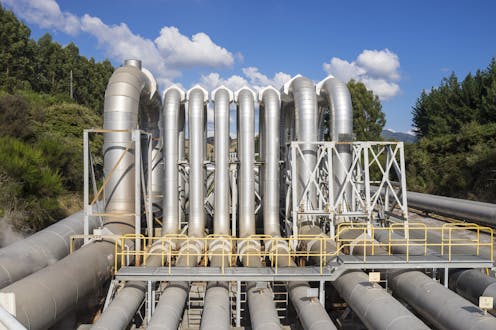
Geothermal is a reliable source of energy in New Zealand, supplying almost 20% of our electricity. We use deep wells to tap into underground reservoirs of hot water, which then passes through a network of pipes to a steam turbine that generates electricity.
Afterwards, the water is pumped back underground, which prevents the reservoir from “drying out”. New Zealand companies are world leaders at managing geothermal resources, and some are even experimenting with reinjecting the small amounts of CO2 that come up with the geothermal water.

Herein lies the opportunity. Geothermal systems already have the infrastructure needed for a successful BECCS project: pipelines, injection wells and turbines. We just need to figure out how to marry these two renewable technologies.
We propose that by burning forestry waste we can supercharge the geothermal water to higher temperatures, producing even more renewable power. Then, CO2 from the biomass combustion can be dissolved into the geothermal water – like a soda stream – before it is injected back underground.
Projects in Iceland and France have shown that dissolving CO2 in geothermal water is better than injecting it directly. It cuts the cost of new infrastructure (liquid CO2 compression is expensive) and means reinjection wells built for normal geothermal operation can continue to be used.
Unlike pure CO2 that is less dense than water and tends to rise, the reinjected carbonated water is about 2% heavier and will sink. As long as equal amounts of geothermal water are produced and reinjected, the CO2 will stay safely dissolved, where it can slowly turn into rocks and be permanently trapped.
How do the numbers stack up?
Our initial modelling shows that geothermal BECCS could have negative emissions in the order of -200 to -700 grams of CO2 per kilowatt hour of electricity (gCO2/kWh). Compared to about 400 gCO₂/kWh of positive emissions from a natural gas power plant, this is a dramatic reversal of the energy-emissions trade-off.
Applied to a geothermal system the size of Wairakei (160 megawatts), a single geothermal BECCS system could lock away one million tonnes of CO2 each year. This is equivalent to taking two hundred thousand cars off the road and, at current prices, would net tens of millions of dollars in carbon offsets.
These could be traded via the Emissions Trading Scheme to buy valuable time for industries that have been slow to decarbonise, such as agriculture or cement, to get down to net zero.
Even better, most of New Zealand’s geothermal fields are located near large forests with expansive forestry operations. Estimates put our forestry waste generation at around three million cubic meters each year. Rather than leaving it to rot, this could be turned into a valuable resource for geothermal BECCS and a decarbonising New Zealand.
We can start doing this now
According to the IPCC it is “now or never” for countries to dramatically decarbonise their economies. Geothermal BECCS is a promising tool but, as with all new technologies, there is a learning curve.
Teething problems have to be worked through as costs are brought down and production is scaled. New Zealand has a chance to get on that curve now. And the whole world will benefit if we do.
The success of geothermal BECCS will turn on new partnerships between New Zealand’s geothermal generators, manufacturers and the forestry sector. Forestry owners can help transition wood waste into a valuable resource and drive down gate costs.
Most importantly, geothermal operators can leverage their vast injection well inventories and detailed understanding of the underground to permanently lock up atmospheric carbon.
With the government tightening emissions budgets and investing billions in a Climate Emergency Response Fund, now is the perfect time to make geothermal BECCS work for Aotearoa New Zealand.
Authors: David Dempsey, Senior lecturer, University of Canterbury


















