

Electricity from the cold ocean depths could one day power island states
- Written by: Rosalind Archer, Professor, Griffith University

In the tropics, the deep sea is cold and the sea surface is very warm. That temperature difference can be harnessed and turned into electricity. If we can improve the technology, this method of producing power could be a godsend for island nations reliant on expensive and polluting diesel for their power.
For more than a century, researchers have explored the idea of ocean thermal energy conversion. There’s nothing fundamentally new to the idea of extracting power from temperature differences. In fact, the underlying technology is similar to the way coal, gas and geothermal power plants create electricity, by using vapour to spin a turbine.
The challenge is finding the right spot, where the temperature differences make it worthwhile. That means relatively close to the equator – think north of Papua New Guinea, the Philippines and off the coast of southern Japan.
At present, pilot plants are only able to generate a fraction of what a large wind turbine can. But on the positive side, ocean thermal plants can generate power 24 hours a day.

How does it work?
These power plants operate by running liquids with low boiling points, such as ammonia, through a closed loop. The heat from warm sea water (between 20 and 30℃) heats the liquid until it turns into vapour and can be used to spin a turbine. Then, the vapour is exposed to cold sea water (around 5℃), which turns it back into a liquid so the cycle can continue. To get this cold water, these plants have pipes stretching down 600 metres into the deep sea.
The benefits of the system are clear: it’s a closed loop, heated and cooled by heat exchangers with no discharge of the fluid to the ocean. And it’s available at all times, in contrast to the well known intermittency challenges of better developed renewable technologies like solar and wind.
Read more: Small tropical islands could become the world's first 100% renewable nations
The downside is at present, the technology isn’t ready for prime time. A pilot plant in Hawaii installed by Makai Ocean Engineering in 2015 has a capacity of 100 kilowatts. That’s 20–30 times less than a typical wind turbine when operating, or the equivalent of around 12 solar arrays on homes or small businesses in Australia.
The main technical challenge to overcome is getting access to the large volumes of cold seawater required. Makai’s pilot uses a pipe one metre in diameter which plunges 670 metres into the ocean depths.
To scale up to a more useful 100 megawatt plant, Makai estimates the pipe would have to be ten metres in diameter and go as deep as one kilometre. This kind of infrastructure is expensive, and must be built to withstand corrosion and cyclones.
If the plants are built offshore, the cost of transmission lines adds to overall expense. Makai estimates 12 commercial scale offshore plants could cover Hawaii’s total electricity needs.
If OTEC plants can be built large enough, the cost will come down. But there’s another challenge too. To get close to wind and solar’s cost – now as low as 1–2 cents per kilowatt hour – ocean thermal plants would need around four Niagara Falls worth of water flowing through the system at any one time.
Why is such a huge volume of water required? In short, a thermodynamic bottleneck. The physics of any energy conversion mean it’s impossible to convert all the heat energy into mechanical work like spinning the turbine. This efficiency issue is a real challenge for ocean thermal plants, where the energy conversion process has a relatively small temperature difference between warm and cool seawater. In turn, that means only a very small percentage of the heat energy in the seawater is converted to electricity.
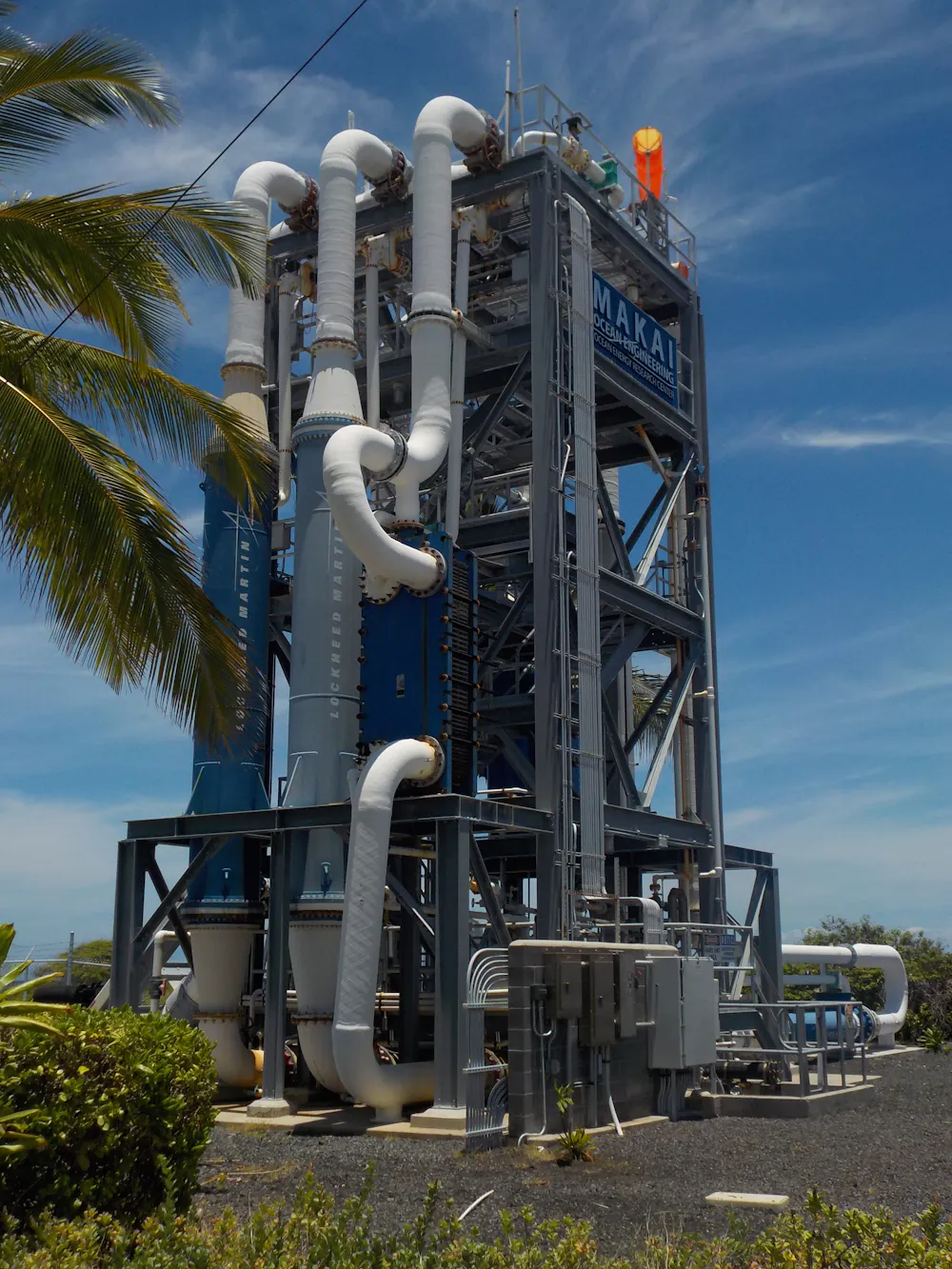 Makai’s Ocean Thermal Energy Conversion pilot plant in Hawaii can produce 100kw of power.
Wikimedia Commons, CC BY
Makai’s Ocean Thermal Energy Conversion pilot plant in Hawaii can produce 100kw of power.
Wikimedia Commons, CC BY
Could OTEC find a use despite the cost and technical challenges?
While these plants couldn’t compete with wind and solar in large mainland markets, they could have a role for the small island states dotting the Pacific and Caribbean, as well as islands far from the main grid, such as Norfolk Island or many of the smaller Indonesian islands.
Island nations, in particular, tend to have high retail electricity prices, low electricity demand and a reliance on imported diesel for electricity generation. Researchers from Korea and New Zealand have made the case that OTEC could be a viable source of baseload power for island states – but only after more pilot plants are built to help perfect the design of larger plants.
Read more: Many small island nations can adapt to climate change with global support
If I was tasked with helping an island state produce its own clean energy, I would first look at geothermal, a more mature technology with better economics. That’s because the areas most favourable for OTEC plants typically have significant potential for geothermal electricity, produced by drilling wells on land and using high temperature fluids from those wells.
Still, OTEC could play a useful role tackling several challenges at once. Take cooling. You can take the cool seawater and use as a form of air conditioning, as two resorts in French Polynesia are doing. You can also use this cool water in aquaculture to raise cold-water fish such as salmon, or as a way of keeping surface water cool during marine heatwaves threatening fish farming in New Zealand. It may even be possible to use OTEC plants to produce hydrogen as an export commodity in small island states.
To meet our urgent emission reduction goals, it is worth exploring all renewable energy options.
We shouldn’t write off OTEC just yet. At this stage, however, it’s hard to see how ocean thermal plants can become competitive with better established renewables, such as wind, solar and even geothermal, given the vast volumes of cold seawater required. File this under “has potential, but needs more work”.
Authors: Rosalind Archer, Professor, Griffith University


















