

NZ's first climate adaptation plan is a good start, but crucial questions about cost and timing must be answered
- Written by Anita Wreford, Professor Applied Economics, Lincoln University, New Zealand
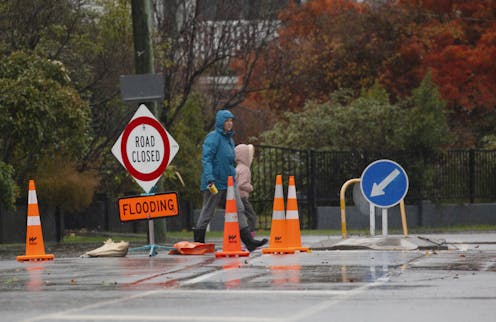
New Zealand’s national adaptation plan, launched last week, offers the first comprehensive approach to how communities can prepare for the inevitable impacts of a changing climate.
Having a plan is critical. Reactive and ad-hoc adaptation could create more problems on top of those already caused by climate change.
Based on priority risks identified in the national climate change risk assessment, the plan gives clearer direction around decision making for long-lived investments such as infrastructure and housing.
It provides more clarity for local government, for example by specifying which climate change scenario they should use when assessing risks to coastal areas from sea-level rise.
It also sets out actions to review the sharing of adaptation costs between local and national government – an urgent step which means councils can begin making realistic plans for their own local adaptation.
But some aspects of the plan lack strategy and structure. It is more a series of actions, some connected, others quite discrete, with many already happening anyway. The absence of Te Tiriti in the framing is concerning, as is the fact some of the main funding sources for adaptation research (such as the national science challenges) end in 2024.
Priorities for adaptation
The adaptation plan is legislated under the Climate Change Response (Zero Carbon) Amendment Act (2019) and is required to address risks identified in the earlier national risk assessment. This includes risks to coastal and native ecosystems, social cohesion, the economy and financial systems, and basic needs such as potable water.
The four goals that underpin the adaptation plan are essentially unarguable: reduce vulnerability to climate change impacts, enhance adaptive capacity, consider climate change in all decisions and strengthen resilience.
Four more specific priority areas are identified as:
enabling better risk-informed decisions
driving climate-resilient development in the right places
laying the foundations for a range of adaptation options, including managed retreat, and
embedding climate resilience across government policy.
The adaptation plan is structured around actions that relate either to system-wide issues or five “outcome areas”, which broadly align with the domains identified in the risk assessment. These are the natural environment; homes, buildings and places; infrastructure; communities; and the economy and financial system.
Lack of strategy
This all sounds relatively sensible so far. The principles guiding the plan are grounded in adaptation theory and concepts.
Yet the plan still lacks strategy and structured planning. It harnesses existing initiatives already underway, which makes practical sense but could make it difficult to maintain oversight of how adaptation is being implemented.
The plan rightly emphasises the need to continually evaluate the effectiveness of adaptation but it lacks a structured process, leaving it unclear how adaptation will be tracked over time. This limits the scope for how much we can learn from what works or doesn’t, and make adjustments accordingly.
Who will pay for adaptation?
The plan touches only superficially on the financing of adaptation, which is a major concern (although let’s not forget that not adapting will cost far more). The costs of managed retreat are increasingly (and justifiably) receiving attention but it remains uncertain who will be expected to pay.
Other important questions around costs and timing are not addressed directly, including how much more difficult and costly delayed adaptation would be. We need more guidance and direction for investments in an uncertain future, because many of the tools we currently use, such as cost benefit analysis, can’t handle uncertainty very well.
Two of the priority areas identified in the climate change risk assessment involve financial stability and the economy. The requirement for listed companies to begin identifying and disclosing their climate-related risk and how they are going to minimise it is an important first step.
The plan makes clear the government cannot bear all the costs of adaptation. However, the Intergovernmental Panel on Climate Change (IPCC) has emphasised there will be limits to effective adaptation, particularly if we fail globally to keep warming below 1.5℃ above pre-industrial temperatures.
When adaptation is not implemented effectively or is not sufficient to cope with the severity of climate change, some of the costs may fall back on the government. This might be directly through disaster relief funding or indirectly through job losses. How government at all levels will handle these costs remains unclear.
Unintended consequences
Another point missing in the adaptation plan is how the government will manage potential unintended consequences of private-sector adaptation and conflicts between groups.
For example, coastal defences such as sea walls or stop banks may protect one area but shift the problem along the coast or downstream. Increasing irrigation to cope with variable rainfall or drought could create conflicts between other water users and the environment.
However, an inter-departmental executive board will be tasked with providing transparency of implementation, improving coordination within central government and enabling accountability. This will be critical to the plan’s effectiveness and ultimately the resilience of Aotearoa New Zealand in a changing climate.
Authors: Anita Wreford, Professor Applied Economics, Lincoln University, New Zealand

















