

Modern Australian
The Times

One of the brightest stars in the sky is evolving and dying before our eyes

  • Written by Sara Webb, Postdoctoral Research Fellow, Centre for Astrophysics and Supercomputing, Swinburne University of Technology
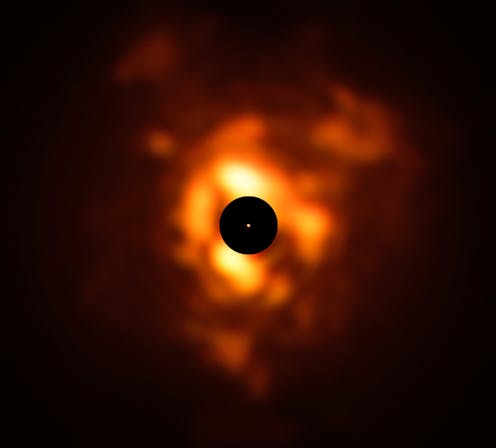
One of the brightest stars in the sky is evolving and dying before our eyes

Nothing lasts forever, including the stars in our night sky. One of the brighter and more notable stars in our sky is Betelgeuse, the bright red supergiant in the shoulder of Orion.

In late 2019, astronomers around the world grew giddy with excitement, because we saw this giant star get fainter than we’ve ever seen it before. Since Betelgeuse is at the end stages of its life, there was some speculation this might be a death rattle before the end.

But the cause of the “great dimming” wasn’t entirely clear until now. New preprint research awaiting peer review, led by Andrea Dupree from Harvard & Smithsonian Centre for Astrophysics, has used the Hubble Space Telescope to help uncover one of the biggest astronomical mysteries this century – the cause of Betelgeuse’s sudden strange behaviour.

Read more: Betelgeuse: star's weird dimming sparks rumours that its death is imminent

A star on the brink of death

From this latest research, it was discovered that in 2019 Betelgeuse likely underwent an enormous surface mass ejection (SME). An SME happens when a star expels large amounts of plasma and magnetic flux into the surrounding space.

We don’t fully understand what caused this SME, but if they have similar progenitors to the coronal mass ejections we’ve seen on our own Sun, they might be caused by the destabilisation of large-scale magnetic structures in the star’s corona.

Four panels of artistic drawing of Betelgeuse. First panel, a small burst on the surface of the star is seen. On the 2nd, the material has begun to leave the star, the 3rd shows the material dark as it cools, and the 4th is the star back to normal
Artist’s impression of the aftermath of the SME, with the mass cooling and forming a cloud of dust which dimmed the star for a short period of time. The plot below outlines the real and expected brightness changes of Betelgeuse during this time. Credits: NASA, ESA, Elizabeth Wheatley (STScI)

It is suspected that Betelgeuse lost a large part of its surface material in this remarkable event. In fact, the amount of material ejected is the single largest SME event we’ve ever seen on a star, in modern astronomy.

What is truly remarkable is that Betelgeuse ejected 400 billion times more mass than a typical event on other stars. This is multiple times the mass of the Moon, pushed out at incredible speeds.

Artist’s animation shows a close-up view of Betelgeuse’s irregular surface. The star’s dip in brightness was the result of a “dusty veil” that formed from material that emerged from the star, partially concealing its southern region. ESO/L. Calçada.

Stellar evolution in real time

Betelgeuse is much like an astronomical jack-in-the-box. Astronomers know that sooner or later it will “pop” and implode in a spectacular supernova, but we don’t know when. (We do know that when it does, it might even be visible in the daytime sky!)

Stars are born in many different sizes; some start small and become big, while others are born big. Betelgeuse is a red supergiant and would have started out smaller, before expanding its outer shells over tens of millions of years. Once large, red supergiants don’t have very long until they reach a point where their cores produce iron and can no longer sustain nuclear fusion.

We’ve seen the deaths of many thousands of distant stars before, in galaxies far, far away. But the allure to study the process in near real-time on our galactic doorstep is too good to pass up. In our stellar neighbourhood, Betelgeuse offers us the best chance for success.

A diagram showing various cosmic objects in orange, white, and yellow, on a galaxy backdrop
Stellar evolution of low-mass (left cycle) and high-mass (right cycle) stars, like Betelgeuse. Wikimedia/NASA's Goddard Space Flight Center, CC BY

We have pieced together the secret lives of stars by studying things like globular clusters, distant supernovae and stellar nebulas. From these, we can understand the birth, life and death of a star.

However, there are often gaps in between. Betelgeuse is giving us a glimpse into the “before” of a star’s end, the final tens of thousands of years before the big event – a mere eyeblink in astronomical terms.

Already from this latest result we are beginning to better understand how large stars like Betelgeuse lose mass through surface mass ejections as they age. As Dupree explains:

We’ve never before seen a huge mass ejection of the surface of a star… It’s a totally new phenomenon that we can observe directly and resolve surface details with Hubble. We’re watching stellar evolution in real time.

The night sky overlapped by a blue sky diagram, with a red circle indicating Betelgeuse
Wide-field view of the region of the sky where Betelgeuse is located, in the ‘right shoulder’ of Orion. ESO/N. Risinger (skysurvey.org), CC BY

Surprising aftermath

One of the most interesting things we’re seeing from Betelgeuse in the aftermath of its surface injury is a significant speed-up in its pulsation rate.

For more than 200 years, astronomers have faithfully tracked the brightening and dimming of Betelgeuse, using its very constant 400-day cycle.

The massive ejection of material may have disturbed the entire internal structure of the star, with inner layers possibly sloshing around and disrupting its typical pulsation rate.

Time will tell if it can recover to pre-ejection pulsation, as we continue to monitor the brightness of Betelgeuse closely.

Although we do not think Betelgeuse is ready to die just yet, we wouldn’t know it actually has until roughly 640 years later. Thanks to the constraints of the speed of light, everything we see in the cosmos is a glimpse back in time – even the stars in our night sky.

Read more: Stars that vary in brightness shine in the oral traditions of Aboriginal Australians

Authors: Sara Webb, Postdoctoral Research Fellow, Centre for Astrophysics and Supercomputing, Swinburne University of Technology


Read more https://theconversation.com/one-of-the-brightest-stars-in-the-sky-is-evolving-and-dying-before-our-eyes-188743

Bottle Label Printing: Key Factors to Consider Before Your Next Packaging Run

Effective packaging begins with understanding the product, bottle material, artwork and production requirements when planning bottle label printing. H...

Planning a Long-Distance Move With Interstate Movers Melbourne

Moving between states involves more planning than a typical local relocation. Along with packing and transporting household belongings, you need to...

Understanding the Role of an I/O Controller in Industrial Automation

Modern industrial systems depend on accurate communication between sensors, machines and control systems. An I/O controller can help manage this commu...

How the Right Mining Hose Supports Demanding Operations

Mining environments place considerable demands on equipment used for material transfer, water management and processing. Hoses operating in these co...

Simple Ideas for Making Social Gatherings More Memorable

We have all been to those parties where everyone just stands around the kitchen island, staring at their phones, waiting for someone else to make a mo...

Outdoor Wall Lights: Improving Exterior Lighting Around Your Home

Lighting can influence how a room looks, feels and functions, so the right fitting should be selected according to both appearance and practical req...

Commercial Office Cleaning: Combining Routine Office Cleaning With Melbourne Service

Keeping a workplace clean requires a service that can accommodate everyday tasks as well as the particular needs of the business. Professional comme...

Caravan Sales in Queensland: How to Find the Right Caravan for Sale QLD

Caravan ownership is about more than having somewhere to sleep while travelling. For many Queenslanders, it is one of the best ways to explore regio...

What Sir Walter Buffalo Turf Actually Costs in 2026 (And Why Quotes Vary So Much)

Two quotes landed on a Hills District homeowner's kitchen table last spring for the exact same 80-square-metre backyard. One said $12 a metre. The o...

Nearly 1,300 NSW Hospital Beds Are Occupied By People Who Are Ready To Go Home

1,276 people in NSW hospitals have been medically cleared for discharge but remain in hospital because they're still waiting for NDIS or aged care sup...

National Survey Launched to Measure Operational Impacts of Federal NDIS Policy Reforms

The effects of recent NDIS reforms are beginning to move beyond policy papers and into day to day service delivery. A new national survey is asking ...

Beyond the Nappy Cake: Baby Shower Gifts That Get Used

What new Australian parents unwrap, keep, and quietly thank you for months later. Six weeks after my daughter was born, I did an audit of the baby sh...

Parent-Advocates Are Reshaping Frontline Disability Service Delivery

Parents have always been part of the disability sector. They advocate, coordinate services, challenge decisions and often become the person holding ev...

Vista Cruises Enters "Two-Flagship Era" as Vista Aurora Completes Inaugural Voyage

Vista Aurora Sets Sail along the Yangtze. (Photo courtesy of the company)YICHANG, China — August 5, 2026 — Vista Aurora, a high-end interprovinc...

A Digital Preparation Checklist For International Medical Conferences

An international medical conference compresses many responsibilities into a few days. A delegate may need to present research, move between venues, ...

The Growing Popularity of Lab Grown Diamonds in Sydney and Hong Kong

The diamond industry has changed significantly in recent years as more buyers seek ethical, affordable, and sustainable alternatives to mined diamon...

Modern AI SEO Agency vs Traditional SEO: What’s the Difference

Search engine optimisation has changed dramatically over the past few years. Search engines have become smarter, user behaviour has evolved, and bus...

Caravan Travel for Modern Australian Getaways: Plan a Comfortable Holiday

A family road trip is one of the best ways to explore Australia together. And, travelling by caravan gives you the freedom to take your time, stop a...















