

Wildlife recovery spending after Australia's last megafires was 13 times less than the $2.7 billion needed
- Written by Michelle Ward, Postdoctoral research fellow, The University of Queensland
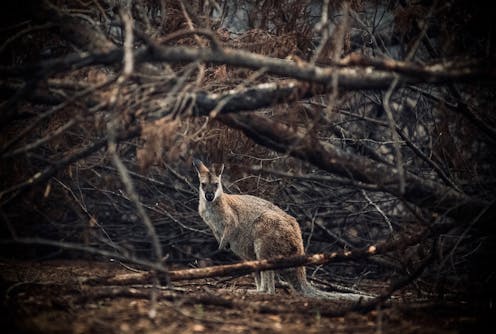
Few could forget the devastating megafires that raged across southeast and western Australia during 2019-20. As well as killing people and destroying homes and towns, the fires killed wildlife and burnt up to 96,000km² of animal habitat – an area bigger than Hungary.
Under climate change, megafires will become increasingly common. This is likely to leave many species needing help at the same time, over vast areas. So our new research, released today, devised a way for conservation scientists and others to determine which actions, and where, will best help wildlife recover.
We also put a price tag on these measures. We found about A$2.7 billion should have been spent across Australia in the year after the megafires to mitigate all threats to 290 severely affected threatened animal and plant species. This is almost 13 times the funding dedicated by the former federal Coalition government.
The paltry spending means many species severely harmed by the megafires were left in desperate trouble, potentially pushing some closer to extinction.
The fires killed wildlife and damaged up to 96,000km² of animal habitat. David MariuzThe first year is crucial
Many plant and animal species are especially vulnerable in the first year after a fire.
Fires can allow invasive weeds to invade and dominate burnt areas. This can hinder the ecosystem’s recovery, including making it more fire-prone.
Many native animals such as Kangaroo Island dunnart and long-footed potoroo rely on vegetation cover to avoid invasive predators such as feral cats and foxes. When fire removes this vegetation, native animals have nowhere to hide.
After a fire, any patches of unburnt vegetation are crucial for animals that survived. But invasive herbivores such as horses, deer, and pigs can graze on these food sources, leaving little for native wildlife.
For these reasons, the first year after a fire is usually the most important time to implement actions to help vulnerable species recover. Such actions can include:
- protecting habitat
- managing invasive plants and animals
- stopping native forest degradation associated with logging
- limiting damage from recreation activities
- managing disease.
Read more: Before and after: see how bushfire and rain turned the Macquarie perch's home to sludge
But in the immediate aftermath of a fire, how do conservation scientists and others decide which species to help, and how? Which locations should they prioritise? And how does all this interact with other threats to wildlife such as land clearing and feral predators?
To date, decision-makers around the world have largely used a method known as the “site richness” approach to prioritise conservation actions. This approach concentrates actions in locations where the greatest number of species can be recovered.
But this approach can mean some high-risk species may not get the help they need, while other less critical species receive disproportionately high assistance.
For example, research from China has showed relying entirely on this method meant species of woody plants found only across a small range – and therefore potentially vulnerable – missed out on conservation actions.
Our new approach
Our new research devised and assessed an alternative method. Known as the “complementarity” approach, it ensures conservation actions occur across the habitats of all threatened species. It involves combining data about:
- the distribution of species and threats
- fire extent and intensity
- a species’ risk of severe, irreversible decline after a fire.
From that, decisions can be made about which of the 22 conservation actions should be carried out first, and where. It prioritises locations where threats affect multiple species – making it more cost-effective to deal with them – and where actions at one site can be easily extended to nearby areas.
We then applied our framework to the 2019–2020 bushfires to identify the most at-risk species, the actions needed to save them, the best locations for these actions, and the costs.
Our approach identified 290 threatened species needing immediate conservation attention. They spanned mammals, birds, reptiles, frogs, insects, and plants.
Read more: After last summer's fires, the bell tolls for Australia’s endangered mountain bells
Each species required, on average, three conservation actions to mitigate threats. The top three were habitat protection (all species), fire suppression (57% of species) and invasive plant management (36% of species).
We then prioritised cost-effective actions after the fires, using our approach. We found actions should take place in 179 geographic areas, including the Snowy Mountains in New South Wales and Gippsland in Victoria.
Actions in these regions recovered the highest number of at-risk species – such as koalas, greater gliders and regent honeyeaters – for the least cost.
We found A$2.7 billion would be needed to mitigate all threats to 290 species in the year after the megafires.
But the previous federal government committed just $200 million to post-fire recovery actions. Some $50 million of this was delivered relatively quickly. But the remainder was to be delivered over two years from July 2020 – beyond the timeframe in which many species required urgent help.
Heeding the lessons
Our research shows the potential gains from alternative approaches to conservation after devastating fires. It also underscores the need for adequate government funding, delivered quickly, to help species most in need.
It’s worth remembering the loss of habitat from bushfires often compounds decades of land clearing. As Australia faces an ever-worsening bushfire risk, we urge Environment Minister Tanya Plibersek to prevent further loss of threatened species habitat.
Read more: 'Jewel of nature': scientists fight to save a glittering green bee after the summer fires

Authors: Michelle Ward, Postdoctoral research fellow, The University of Queensland

















