

the complex question of Taiwanese independence
- Written by Ben Saul, Challis Chair of International Law, Sydney Law School, University of Sydney
“Strategic ambiguity” – the policy that has underpinned the West’s defence of Taiwan for half a century or more – rests on another ambiguity: Taiwan’s status in international law. And that status matters because it could help us answer three questions:
does China have a legal right to restore control over its own territory by force?
do Taiwan and its allies have a legal right to resist such an attack?
-
might Taiwan even have the right to declare independence?
The islands we know as Taiwan have been inhabited for 30,000 years, including by successive waves of peoples from mainland China. Taiwan was subject to partial Dutch and Spanish colonisation from the early 17th century, was partly controlled by the remnants of the mainland Ming dynasty from 1661, then colonised by the mainland Qing dynasty from 1683. The main island was incorporated as a Chinese province in 1887.
After the first Sino-Japanese war of 1894–95, Taiwan was ceded by treaty to Japan. (At the time, and up until 1928, a country could legally acquire sovereignty over foreign territory by war or colonisation.) Then, after Japan’s defeat in 1945, the United Nations placed Taiwan under the control of the Republic of China. The ROC, founded in 1912, was led by the nationalist Kuomintang, a wartime ally of major Western countries.
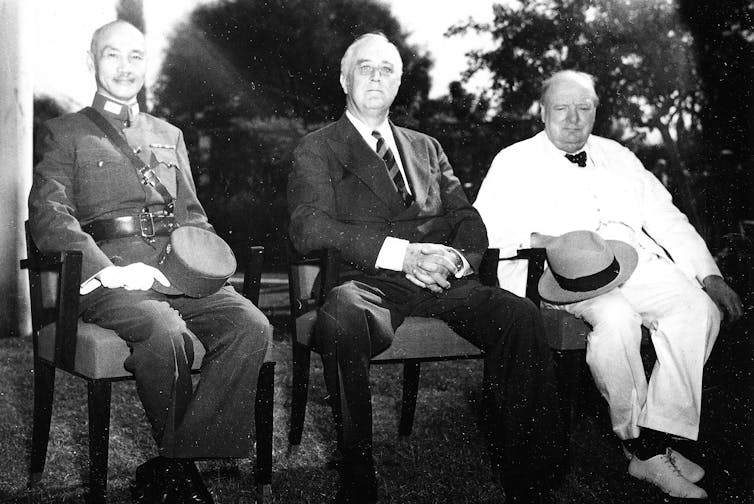
Japan renounced its claim to Taiwan under the 1951 San Francisco Peace Treaty, but neither that agreement nor any other resolved the future sovereignty of Taiwan. However, in the non-binding Cairo Declaration of 1943, the allied powers had agreed Taiwan would be returned to the ROC.
One China, two rival governments
The context changed again in 1949, when communist forces won the Chinese civil war and proclaimed the People’s Republic of China (PRC) as the successor state to the defeated ROC. Both the ROC, which had retreated to Taiwan, and the PRC claimed to be the single legal “state” and so the lawful government of all of China.
The ROC was accepted as a founding member of the United Nations in 1945 and treated as the representative of all China for the next quarter-century. In 1971, however, the UN General Assembly recognised the PRC as China’s “only legitimate representatives” at the UN and expelled the ROC representatives. The UN decision resolved which entity was competent to represent China as a UN member state but didn’t deal with sovereignty over Taiwan.
From the beginning, both the PRC and ROC claimed that Taiwan was part of “their” China. Despite never having governed Taiwan, the PRC maintains the same “one China” principle today. For many decades, the ROC also claimed all of China, despite having lost control of the mainland in 1949 and being expelled from the UN in 1971.
Since the 1990s, Taiwanese leaders have pragmatically accepted that mainland China is governed by the PRC, but Taiwan’s Constitution still formally claims all of China. Taiwan has also increasingly seen itself as a de facto independent country, separate from the mainland. Partly for fear of triggering a military response, Taiwan hasn’t formally declared itself to be a new, legally independent state.
International opinion
Since the shift at the UN in 1971, the United States and Australia have recognised the PRC as the sole legal government of “one China”. The US initially accepted that Taiwan was part of China, but later followed the Australian position of simply “acknowledging” the PRC’s sovereign claim to Taiwan.
The US, Australia and various other states have called for the dispute over statehood to be resolved peacefully by the governments in Beijing and Taipei. But that position is hard to reconcile with US legislation enabling sales of arms for Taiwan to use in its defence.
Most states haven’t recognised Taiwan as an independent state or lawful government. Instead, they have dealt pragmatically with Taiwan – through unofficial diplomacy, trade and environmental cooperation, or for other purposes – as an entity with a unique international legal status. While 139 countries recognise Palestine, for example, just 15 recognise Taiwan as a state.
Part of China?
Legally, Taiwan isn’t a state. But it satisfies many of the legal criteria of statehood by having a population, a defined territory and an independent, effective government. The fourth criterion, a capacity to enter into legal relations with other states, is more problematic, precisely because most other states don’t accept that Taiwan enjoys the legal rights of a state.
The rights Taiwan lacks include full diplomatic representation, the capacity to enter into multilateral treaties, and membership of international organisations like the UN. Decisively, though, an entity can’t be a state if the entity itself doesn’t claim to be a state. Taiwan does not make that claim.
Where does this leave Taiwan? Legally, five factors weigh in favour of Taiwan being part of China:
for more than 40 years, both the PRC and the ROC have agreed Taiwan is part of “one China” (while disputing rightful governance over it), and the ROC’s Constitution still says so
no foreign state (including Japan) has asserted any competing claim to Taiwan, let alone a better one
the allied powers and the UN entrusted Taiwan to the then government of China after the second world war
the UN (perhaps expediently) didn’t regard Taiwan as a colonised territory, subject to the right of self-determination, after 1945
few states (including the West) explicitly deny Taiwan is part of China, and most have acquiesced in the Chinese territorial claim.
One of Australia’s most distinguished international lawyers, the late James Crawford, former Judge of the International Court of Justice, likewise concluded Taiwan was Chinese territory, with governance disputed.
If Taiwan has been Chinese territory since 1945, it doesn’t matter that the PRC has never governed it. State sovereignty over territory is distinct from the capacity of a particular government to control that territory at a given point in time. In civil wars, insurgent forces often hold territory without affecting the state’s sovereignty.
Suppressing rebellion?
Indeed, this is the basis of China’s claim to be entitled to retake Taiwan by force: that it wishes to restore control over Chinese territory held by insurgents in an unfinished civil war. Governments normally have a right under international law to suppress rebellion in their territory, including by remnant forces of a defeated previous government. In this light, recent Chinese behaviour could not be seen as aggression, as so often depicted in the West, but as lawful enforcement of its rights.
Further, if Taiwan is part of China then other states have no lawful right to interfere in what is an internal matter. On this view, Taiwan, not being a state, has no right to self-defence against China’s efforts to restore order in its own territory, and other states would violate international law by assisting Taiwan to resist.
Countering this view are several powerful arguments:
unique disputes like this must be settled peacefully, not by force
de facto states like Taiwan also benefit from the international prohibition on the use of military force, and enjoy a de facto right of self-defence
Taiwan’s possible right to self-determination, discussed below, includes freedom from military repression.
These arguments sit uneasily with Chinese sovereignty over its own territory, and the Security Council - where China has a veto - has not supported these arguments (despite doing so in some other situations). But peace is arguably a higher value than formal territorial rights in this case.
However, no right exists under international law to protect non-state entities simply to “defend democracy” or “defend freedom”. No right of humanitarian intervention exists to respond to likely Chinese atrocities. And no right exists to interfere in foreign territorial disputes to contain an adversary, or for other geostrategic reasons.
Not part of China?
Some factors weigh against Taiwan being part of China.
The sovereignty issue was not formally settled in the postwar transition from Japanese rule, and allied strategic preferences don’t necessarily make good law. The UN didn’t regard Taiwan as a Japanese colony ripe to be decolonised through self-determination – though it probably should have – and instead let the allies give Taiwan to China to reward their ROC wartime ally. Most of the population was not then associated with the ROC, including the Austronesian indigenous peoples and millions of descendants of earlier Chinese settlers.
A more contemporary legal argument suggests that, even if Taiwan is legally part of China, its people now have a fresh right to exercise “remedial” self-determination. This right rests in their de facto independence from the mainland for over 70 years, their apparent desire to be ruled separately, and their distinctive identity.
On this view, they would be free to choose some form of accommodation with China, including the status quo, autonomy within China, or full independence – though China would likely reject all of these. From a progressive, human rights perspective, this is an appealing way forward. However, it is a legally controversial expansion of self-determination, which historically applied mainly to colonies. The law is not always just.
If Taiwan were to declare independence in the future, its success in becoming a state depends on whether it can maintain control over its territory and people, to the exclusion of China, and be accepted by the international community. Kosovo is an example of an entity still undergoing that process of separation from the former Yugoslavia, with just over half of other countries recognising it.
The risks of ambiguity
Strategic ambiguity, designed to maintain the status quo in Taiwan, is sometimes described as the least worst option (for Taiwan and the West, though not for China). Side-stepping the legal dispute has enabled the Taiwanese to prosper and, belatedly since the 1980s, democratise. It has served the Western strategic imperative of containing China. And it has enabled peace during a long postwar period of relative Chinese military weakness.
Read more: Taiwan's rocky road to independence and democracy
It isn’t surprising that China has become more assertive about its claimed rights. If Taiwan is legally part of China, the West’s desire to avoid settling the dispute according to uncertain international law – and its insistence on maintaining strategic and legal ambiguity – isn’t surprising either.
The problem is that legal disputes can’t be left to fester indefinitely without consequences (in the absence of a miraculous regime change in China). Eventually they must be settled either peacefully – according to law or by equitable negotiation – or by resort to (possibly illegal) war. Neither path is guaranteed to produce a result favourable to Taiwan or the West.
Strategic ambiguity may buy a little more time for peace, but also risks endangering peace in the long term.
Authors: Ben Saul, Challis Chair of International Law, Sydney Law School, University of Sydney
Read more https://theconversation.com/explainer-the-complex-question-of-taiwanese-independence-188584

















