

Warming oceans may force New Zealand's sperm and blue whales to shift to cooler southern waters
- Written by Frédérik Saltré, Research Fellow in Ecology for the ARC Centre of Excellence for Australian Biodiversity and Heritage, Flinders University
The world’s oceans are absorbing more than 90% of the excess heat and energy generated by rising greenhouse gas emissions.
But, as the oceans keep warming, rising sea temperatures generate unprecedented cascading effects that include the melting of polar ice, rising seas, marine heatwaves and ocean acidification.
This in turn has profound impacts on marine biodiversity and the lives and livelihoods of coastal communities, especially in island nations such as New Zealand.
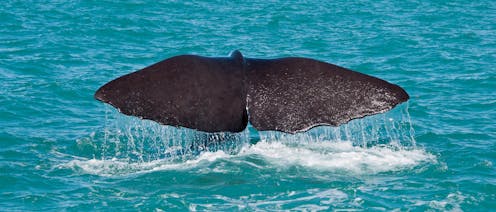
In our latest research, we focused on great whales – sperm and blue whales in particular. They are crucial for maintaining healthy marine ecosystems, but have limited options to respond to climate change: either adapt, die, or move to stay within optimal habitats.
We used mathematical models to predict how they are likely to respond to warming seas by the end of the century. Our results show a clear southward shift for both species, mostly driven by rising temperatures at the sea surface.
Computing the fate of whales
Data on the local abundance of both whales species are deficient, but modelling provides a powerful tool to predict how their range is likely to shift.
We used a combination of mathematical models (known as correlative species distribution models) to predict the future range shifts of these whale species as a response to three future climate change scenarios of differing severity, as outlined by the Intergovernmental Panel on Climate Change (IPCC).
We applied these models, using the whales’ present distributions, to build a set of environmental “rules” that dictate where each species can live. Using climate-dependent data such as sea-surface temperature and chlorophyll A (a measure of phytoplankton growth), as well as static data such as water depth and distance to shore, we applied these rules to forecast future habitat suitability.
We chose a scenario of “modest” response to cutting greenhouse gas emissions (the IPCC’s mitigation strategy RCP4.5), which is the most likely given the current policies, and a worst-case scenario (no policy to cut emissions, RCP8.5), assuming the reality will likely be somewhere between the two.
Our projections suggest current habitats in the ocean around the North Island may become unsuitable if sea-surface temperatures continue to rise.
These range shifts become even stronger with increasing severity of climate change. For sperm whales, which are currently abundant off Kaikōura where they support eco-tourism businesses, the predicted distribution changes are even more evident than for blue whales, depending on the climate change scenario.
While our results do not predict an overall reduction in suitable habitat that would lead to local extinctions, the latitudinal range shifts are nevertheless bound to have important ecological consequences for New Zealand’s marine ecosystems and the people who depend on them.
Read more: Sea creatures store carbon in the ocean – could protecting them help slow climate change?
How whales maintain ecosystems
Great whales are marine ecosystem engineers. They modify their habitats (or create new ones), to suit their needs. In fact, these activities create conditions that other species rely on to survive.
They engineer their environment on several fronts. By feeding in one place and releasing their faeces in another, whales convey minerals and other nutrients such as nitrogen and iron from the deep water to the surface, as well as across regions. This process, known as a “whale pump”, makes these nutrients available for phytoplankton and other organisms to grow.
This is very important because phytoplankton contributes about half of all oxygen to the atmosphere and also captures about 40% of all released carbon dioxide. By helping the growth of phytoplankton, whales indirectly contribute to the natural ocean carbon sink.
On top of this, each great whale accumulates about 33 tonnes of carbon dioxide in their body, which they take to the ocean floor when they die and their carcass sinks.
Read more: Bottoms up: how whale poop helps feed the ocean
Ultimately, the impact of warming oceans on whale distribution is an additional stress factor on ecosystems already under pressure from wider threats, including acidification, pollution and over-exploitation.
A way forward to help whales
Sperm whales are the largest toothed whales (odontocetes) and deep-diving apex predators. They primarily feed on squid and fish that live near the bottom of the sea.
Blue whales are baleen whales (mysticetes) and filter small organisms from the water. They feed at the surface on zooplankton, particularly dense krill schools along coastlines where cold water from the deep ocean rises toward the surface (so-called upwelling areas).
These differences in feeding habits lead to divergent responses to ocean warming. Blue whales show a more distinct southerly shift than sperm whales, particularly in the worst-case scenario, likely because they feed at the surface where ocean warming will be more exacerbated than in the deep sea.
Both species have important foraging grounds off New Zealand which may be compromised in the future. Sperm whales are currently occurring regularly off Kaikōura, while blue whales forage in the South Taranaki Bight.
Despite these ecological differences, our results show that some future suitable areas around the South Island and offshore islands are common to both species. These regions could be considered sanctuaries for both species to retreat to or expand their habitat in a warming world. This should warrant increased protection of these areas.
Authors: Frédérik Saltré, Research Fellow in Ecology for the ARC Centre of Excellence for Australian Biodiversity and Heritage, Flinders University

















