

Revelations from 17-million-year-old ape teeth could lead to new insights on early human evolution
- Written by Tanya M. Smith, Professor in the Australian Research Centre for Human Evolution & Griffith Centre for Social and Cultural Research, Griffith University
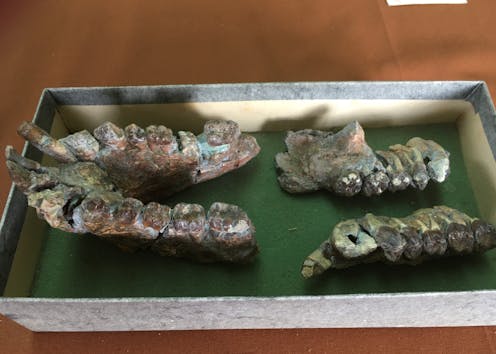
The timing and intensity of the seasons shapes life all around us, including tool use by birds, the evolutionary diversification of giraffes, and the behaviour of our close primate relatives.
Some scientists suggest early humans and their ancestors also evolved due to rapid changes in their environment, but the physical evidence to test this idea has been elusive – until now.
After more than a decade of work, we’ve developed an approach that leverages tooth chemistry and growth to extract information about seasonal rainfall patterns from the jaws of living and fossil primates.
We share our findings in a collaborative study just published in Proceedings of the National Academy of Sciences.
Teeth are environmental time machines
During childhood our teeth grow in microscopic layers similar to the growth rings found in trees. Seasonal changes in the world around us, such as droughts and monsoons, influence our body chemistry. The evidence of such changes is recorded in our teeth.
That’s because the oxygen isotope composition of drinking water naturally varies with temperature and precipitation cycles. During warm or dry weather, surface waters accumulate more heavy isotopes of oxygen. During cool or wet periods, lighter isotopes become more common.
These temporal and climatic records remain locked inside fossilised tooth enamel, which can maintain chemical stability for millions of years. But the growth layers are generally so small that most chemical techniques can’t measure them.
To get around this problem, we teamed up with geochemist Ian Williams at the Australian National University, who runs the world-leading Sensitive High Resolution Ion Microprobe (SHRIMP) facilities.
In our study, we collected detailed records of tooth formation and enamel chemistry from slices of more than two dozen wild primate teeth from equatorial Africa.
We also analysed two fossil molars from an unusual large-bodied ape called Afropithecus turkanensis that lived in Kenya 17 million years ago. Diverse groups of apes inhabited Africa during this period, roughly 10 million years before the evolution of our early ancestors, the hominins.
Diving into an ancient African landscape
Several aspects of our research are helpful for understanding the link between environmental patterns and primate evolution.
First, we observe a direct relationship between historic African rainfall patterns and primate tooth chemistry. This is the first test of a highly influential idea in archaeological and earth sciences applied to wild primates: that teeth can record fine details of seasonal environmental change.
We are able to document annual west African rainy seasons and identify the end of east African droughts. In other words, we can “see” the storms and seasons that occur during an individual’s early life.
And this leads into another important aspect. We provide the largest record of primate oxygen isotope measurements collected so far, from diverse environments in Africa that may have resembled those of ancestral hominins.
Lastly, we’ve been able to reconstruct annual and semi-annual climate cycles, and marked environmental variation, from information held within the teeth of the two fossil apes.
Our observations support the hypothesis that Afropithecus developed certain features to adapt to a seasonal climate and challenging landscape. For example, it had specialised dental traits for hard object feeding, as well as a longer period of molar growth compared with earlier apes and monkeys – consistent with the idea that it consumed more seasonally varied foods.
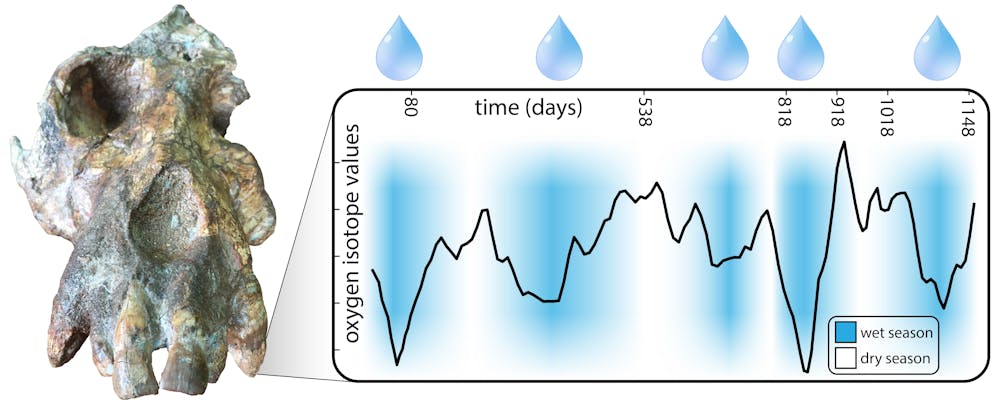
We conclude our work by comparing data from Afropithecus to earlier studies of fossil hominins and monkeys from the same region in Kenya. Our detailed microsampling shows just how sensitive tooth chemistry is to fine-scale climate variation.
Previous studies of more than 100 fossil teeth have missed the most interesting part of oxygen isotope compositions in teeth: the huge seasonal variation on the landscape.
Read more: What teeth can tell about the lives and environments of ancient humans and Neanderthals
Research potential closer to home
This novel research approach, coupled with our fossil ape findings and modern primate data, will be crucial for future studies of hominin evolution – especially in Kenya’s famous Turkana Basin.
For example, some researchers have suggested that seasonal differences in foraging and stone tool use helped hominins evolve and coexist in Africa. This idea has been hard to prove or disprove, in part because seasonal climatic processes have been hard to tease out of the fossil record.
Our approach could also be extended to animal remains from rural Australia to gain further insight into historic climate conditions, as well as the prehistoric environmental changes that shaped Australia’s unique modern landscapes.
Read more: Archaeology can help us prepare for climates ahead – not just look back
Authors: Tanya M. Smith, Professor in the Australian Research Centre for Human Evolution & Griffith Centre for Social and Cultural Research, Griffith University

















