

Did an accidental 'blood plague' in World of Warcraft help scientists model COVID better? The results are in
- Written by Jodie McVernon, Professor and Director of Doherty Epidemiology, The University of Melbourne

Way before COVID, in 2005 the World of Warcraft game developers accidentally introduced an extremely virulent highly contagious disease into this game which then spread to infect the whole fantasy world and caused a virtual pandemic.
As far removed as this may seem from the goings on in the real world, the spread of this virtual disease appeared to have potential relevance to understanding real world epidemics.
Disease modelling has played a crucial role during the COVID pandemic to help anticipate the spread of an entirely new infectious disease through the population.
Infectious disease models use mathematical equations to describe how infectious diseases, humans and the environment interact. Then we can scope out what’s likely to happen if we let an epidemic run its course or try out various public health intervention options to see their effect on transmission.
This approach lets us take a peek into an uncertain future to assess the likely impact of control strategies on disease outcomes.
Read more: Doherty modelling update provides the goalposts, but local insights will determine play
World of Warcraft and the corrupted blood plague
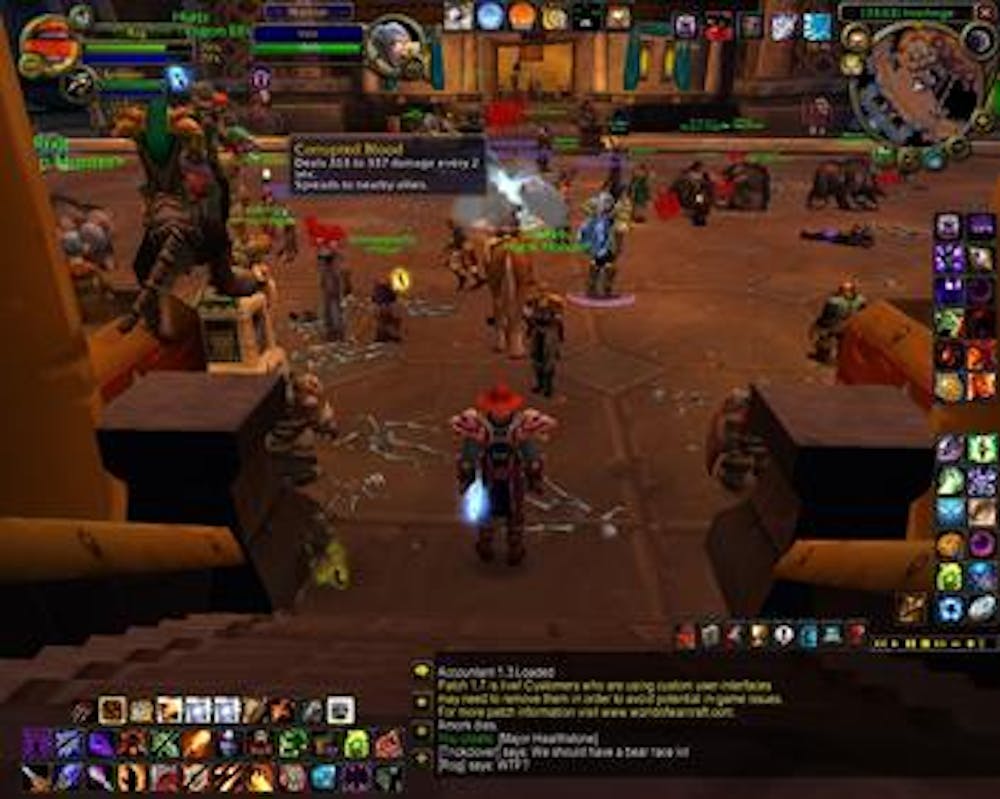
In the World of Warcraft online game, the disease that was introduced and spread widely throughout the virtual world was called Corrupted Blood.
This introduced disease was intended to be confined to a particular area of the virtual world, as a “debuff” spell used by the dungeon “boss” Hakkar the Soulflayer, to pose an additional challenge to players. Upon engaging the boss, players were stricken by the spell which would periodically sap their life.
However, to the surprise of the game developers, features of this virtual world, the nature of the introduced disease and the unanticipated behaviour of players led to rapid spread of this infection into the wider game. Players unknowingly transmitted infection to their animal companions, who were able to then infect other players in the wider game.
Developers didn’t predict panicked players would subsequently travel great distances to densely populated areas and spread illness there. Some players displayed altruistic behaviours, rushing to the aid of their friends and becoming infected. The disease spread widely and quickly.
There were also a number of individuals who intentionally spread disease for no obvious reason. A full-scale game wide pandemic ensued, with high rates of infection and death.
Given the extent to which players inhabited their virtual personas, this phenomenon led some researchers to speculate that gamifying infectious disease epidemics might be a way to gain insights into human behaviour during a pandemic.
Data derived from observing the actions of players in the virtual realm in response to an introduced virtual disease threat could be fed into real world disease models, they suggested, to better account for the unpredictability of human behaviour.
Indeed, many of the behavioural drivers of infectious spread identified in the game outbreak have also played an important role in the spread of COVID.
The key issue is that, despite the sophistication of disease modelling, the biggest source of uncertainty in these models comes from trying to factor in human behaviour.
Disease modelling and COVID
The COVID pandemic has highlighted just how complex and varied our responses to infectious disease threats are. Differences in social cohesion, trust in governments and political priorities can drive these responses.
Some high-income countries, like the United States and the United Kingdom, that were expected to be well placed to respond to the pandemic performed poorly. Other lower income countries, like Vietnam and Thailand, performed exceptionally well despite having fewer resources. To make things even more complex, as the pandemic has continued to unfold, public perceptions have been changing too.
So, how do we gather the data needed to model human behaviour better?
Since early 2020, many countries have implemented behavioural surveys in real time as a way of understanding attitudes and behavioural response to the pandemic, including cooperation with social measures mandated or recommended by authorities.
What have we learned about COVID from World of Warcraft?
Have virtual epidemics been used to inform infectious disease models and make them more “realistic”?
Despite some initial excitement about using observed player behaviour in virtual fantasy worlds to enhance epidemic models, we have not seen such data being used in any meaningful way.
Despite the parallels between player interactions in virtual worlds and the real world, online behaviour varies in significant ways and may still be too far removed from reality to be of any practical use. Most notably, the potential for limitless experiences in online games is very different to the real world. Despite theoretical interest, the idea really hasn’t taken off.
Read more: Why are people stockpiling toilet paper? We asked four experts
While behavioural data from virtual worlds may not be of sufficient relevance to inform real world disease models, the need to predict human behaviour better remains very important. The pandemic showed us how unpredictable our responses are.
A prime example of this was the rush to hoard toilet paper . No one would have anticipated this phenomenon before the pandemic, and it was totally irrational, but it was replicated throughout the world. While this is a somewhat obscure example, what it highlights is the unpredictability of human behaviour. There is no doubt that if we can better understand human behaviour and feed this into our disease models we will be better placed to predict disease outcomes and the impacts of public health interventions.
Unfortunately, in the real world we don’t have the luxury the game developers of World of Warcraft had. When they couldn’t stop the spread of the corrupted blood disease, they just performed a game reset to end the pandemic and get back to life as normal. If only!
Authors: Jodie McVernon, Professor and Director of Doherty Epidemiology, The University of Melbourne

















