

Not all of us have access to safe drinking water. This clever rainwater collector can change that
- Written by Md Abdul Alim, Associate lecturer, Western Sydney University
Access to clean drinking water is fundamental to our health and wellbeing, and a universal human right. But almost 200,000 Australians are still forced to use water contaminated with unsafe levels of various chemicals and bacteria. The situation is especially dire in remote areas.
To tackle this issue, we have developed an integrated rainwater harvesting unit at Western Sydney University (WSU).
This simple system can produce safe drinking water for households and communities in remote areas. It’s cheap, easy to use, and could improve the lives of thousands of people.
Far from city life
In large Australian cities, we are used to turning on the tap – clean, plentiful water is always there, coming from the central water supply. We also take for granted the use of potable water for other uses, such as car washing, gardening and laundry.
But in rural and remote Australia, communities must develop private water supply systems to get safe drinking water from other sources. These can be rainwater, groundwater, surface water and “carted water” – treated water from a supplier.
Among these sources, harvested rainwater is considered to be the second-safest option after mains supply, according to the private water supply risk hierarchy chart. So, many residents in rural and remote Australia are using rainwater for their needs.
But rainwater isn’t always safe to drink without adequate treatment, as it can be contaminated from various sources, including air pollution, runoff chemicals, animal droppings, and more.
Read more: Bushfires threaten drinking water safety. The consequences could last for decades
Unknown water quality
In Australia, roughly 400 remote or regional communities don’t have access to good quality drinking water, and 40% of those are Indigenous communities.
According to a 2022 drinking water quality report by Australian National University researchers, at least 627,736 people in 408 rural locations have drinking water that doesn’t meet at least one of the standards set by the Australian Drinking Water Guidelines.
Although the 2022 United Nations Sustainable Development Goals progress report declares that 100% of the Australian population has access to safe and affordable drinking water, it seems this report excluded about 8% of the population living in regional and remote areas.
The issue could be even more widespread due to lack of adequate testing.
Read more: Your drinking water could be saltier than you think (even if you live in a capital)
Better options are available
Our low-cost rainwater harvesting unit can produce safe drinking water that meets Australian guidelines, particularly maintaining Escherichia coli and nitrate levels below the recommended limits.
Most importantly, the system is integrated, which means it both collects rainwater, and treats it to be safe for household use.
The system is sustainable, uses locally available materials (such as gravel, sand, charcoal, limestone and stainless steel wire mesh or even cheesecloth), needs minimal maintenance, and is simple to operate. Communities can be trained to use these water systems regardless of technological skill level.
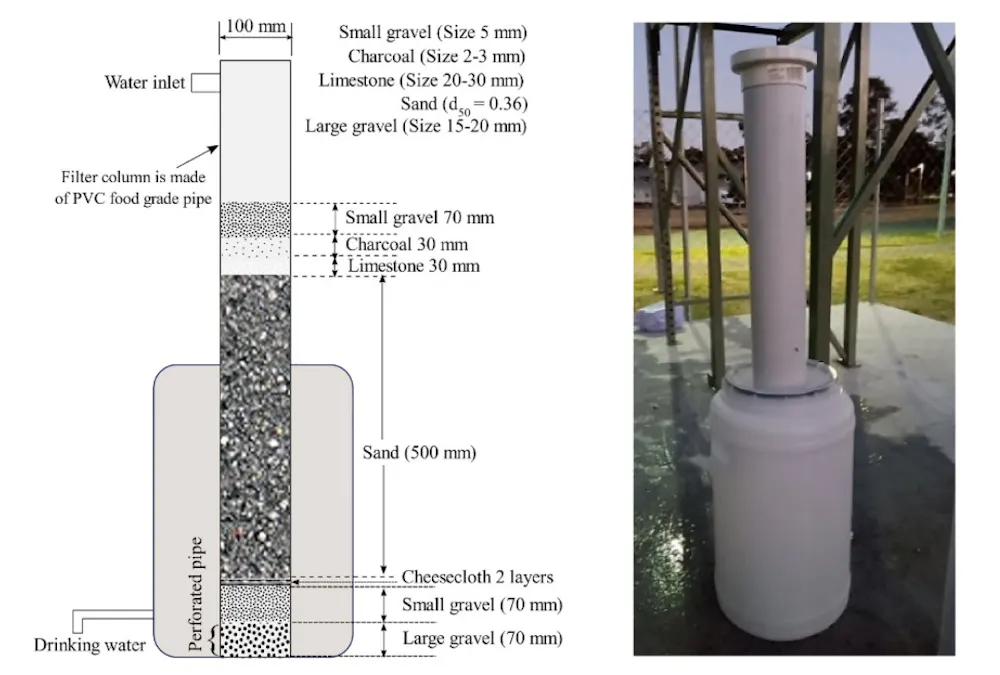
It’s also affordable. The cost of the drinking water produced through this system would be just over 1 cent per litre, according to a recent technical and financial feasibility analysis.
Ready to use, with improvements on the way
Despite their simplicity, these rainwater filter systems don’t even have to be confined to individual households – we can scale them up so entire communities can benefit.
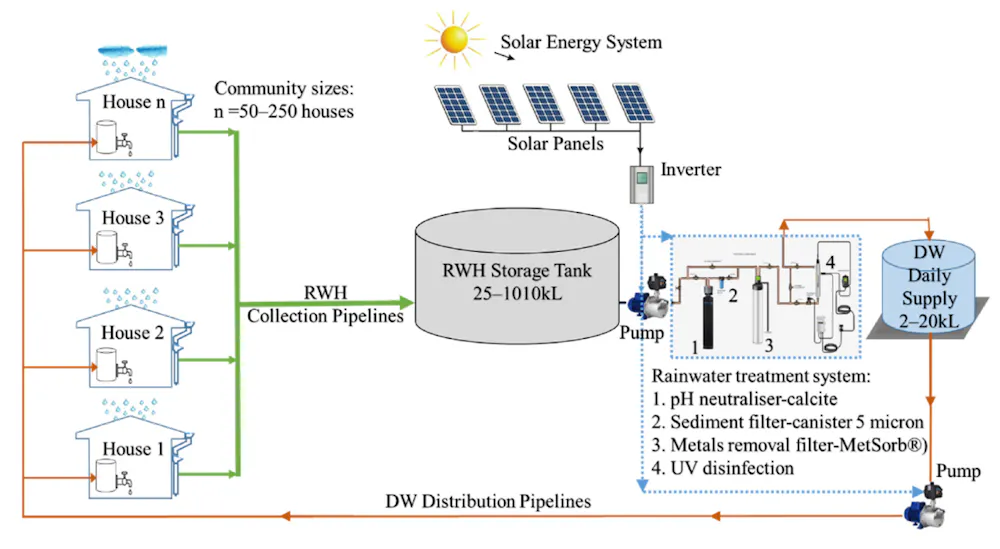 An example of scaling the integrated rainwater collecting system to community level.
Author provided
An example of scaling the integrated rainwater collecting system to community level.
Author provided
A case study has proved this in both developed and developing countries. Our collaborators in Bangladesh made the first move to adopt this technology, supplying safe drinking water to student accommodation at the Khulna University of Engineering & Technology.
We are also working on improvements. For example, we are building an automated system that can monitor the water quality from the unit regularly and adjust disinfectant dosing to keep it safe for drinking. We’re also developing a method for the system to sense when the filter materials need cleaning, and even start this process automatically.
In Australia, there is a clear need to improve water quality in remote communities. Adopting our simple rainwater filtering system would help communities to produce safe drinking water at minimum cost, and the WSU team is ready to work with local shire councils and groups from different remote communities to transfer the knowledge.
Read more: Getting clean drinking water into remote Indigenous communities means overcoming city thinking
Authors: Md Abdul Alim, Associate lecturer, Western Sydney University

















