

what was Bob Hawke's 1983 National Economic Summit about?
- Written by Frank Bongiorno, Professor of History, ANU College of Arts and Social Sciences, Australian National University
This article is part of The Conversation’s series looking at Labor’s jobs summit. Read the other articles in the series here.
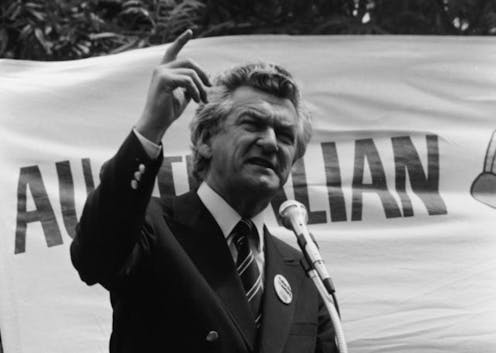
The Albanese government’s Jobs and Skills Summit this week owes something to Hawke government precedent and inspiration. Held in in April 1983 in what is now Old Parliament House, the National Economic Summit enacted one of the slogans of the campaign that had recently carried Bob Hawke’s Labor Party to victory in a federal election: “Bringing Australia Together.” The National Economic Summit was all about “consensus”, another buzzword of the day.
The implied point of contrast was with the outgoing prime minister, Malcolm Fraser, seen as a divisive figure since the Whitlam dismissal of 1975. “Consensus” was also a contrast with the confrontational industrial relations of Fraser’s time in government. In 1981 alone, a bad year for industrial relations, over four million working days were lost through workplace disputes. By the time Hawke came to office, unemployment, inflation and interest rates were all in double-digits. The economy was in recession. The country was in drought.
In February 1983, before the election, the Labor opposition and the Australian Council of Trade Unions (ACTU) had signed the Prices and Incomes Accord. Its basic concept was that unions would agree to wage restraint in return for social and economic benefits – a “social wage”. Labour governments in Britain had experimented with such a compact in the 1970s, with disappointing results for the unions that signed up to it. Still, in Australia the accord had widespread support, including on the left of the union movement.
The National Economic Summit was an effort by the Hawke government to turn the accord into a tripartite agreement also involving employers. And amid a sea of men in suits, he largely succeeded.
The economic journalist Max Walsh thought Hawke was “justified in seeing the summit as a stunning political success”. In contrast with government and unions, business leaders were divided. Some wanted future wage increases to be disconnected from the inflation rate, and to be limited to improvements in productivity. Others were more willing to play ball.
The ACTU vice-president, Simon Crean, warned that in the absence of support for centralised wage determination, there would be a push by individual unions for wage increases – and they were likely to succeed. It was the kind of thing a union leader could say when his members still had serious industrial clout. That is not an asset the current ACTU leadership has at its disposal.
The young ACTU secretary, Bill Kelty, his hair “everywhere”, emerged as the summit’s star. The ACTU would practice wage restraint and accept higher taxes, he promised. Geoffrey Barker of The Age thought the ACTU leaders had “taken all the points as public performers”.
Read more: What can unions and the Albanese government offer each other at the jobs summit?
Business bosses soon saw that, in the face of such an assault of sweet reasonableness, they would need to be more conciliatory. Sir Keith Campbell, who had chaired a ground-breaking enquiry into the financial system for the Fraser government, said things that were music to the ears of the ACTU and new Labor government. He told the summit that unemployment and inflation should be fought together.
In the United States and the United Kingdom, governments of the right and central bankers were pursuing a policy of fighting inflation first, thereby throwing millions out of work. The National Economic Summit endorsed a different approach, at the same time as it provided cover for the Hawke government in moving away from election promises and what were then considered traditional Labor policies such as higher wages and higher spending.
It also seems remarkable today that in his opening address, Hawke could declare those present as “the representatives of the Australian people”. His critics were unimpressed. Some thought the summit an exercise in “state corporatism”, a threat to “representative democracy”. There was no place at the table for the sick, poor or old, for women, ethnic groups or Aboriginal people, or for consumers.
Peter Beilharz, in the Marxist journal Arena, saw the summit as committed
to the principle that those who do not work productively should be maintained by the state, but are to be effectively excluded from political processes.
By the following year, he had joined with another academic of the left, Rob Watts, in arguing (in the magazine Australian Society) that Hawke’s leadership had
produced, at best, a right-wing Labor government and, at worst, a Tory government whose policies are indistinguishable from those of its predecessors.
The summit, some complained, had accepted the continuation of high unemployment, and it marginalised ideas for stimulatory spending or investment in high-tech industry, such as advocated by the new science minister Barry Jones.
The Albanese government is unlikely to attract similar criticisms. Its summit will have greater diversity than that of 1983. The nation has its economic problems, but unemployment is low and neither the sense of crisis nor of malaise is anywhere near as deep as forty years ago.
The National Economic Summit was intended to lower public expectations of government. Anthony Albanese has shown interest in modestly raising them in the wake of years of declining political trust. At the very least, his summit continues the orderly, systematic and constructive approach to governing that stands in stark contrast to the confirmed style of his predecessor.
Authors: Frank Bongiorno, Professor of History, ANU College of Arts and Social Sciences, Australian National University

















