

NZ's inaction on turtle bycatch in fisheries risks reputational damage -- and it's pushing leatherbacks closer to extinction
- Written by Matthew Hall, Senior Researcher, Environmental Law Initiative and Visiting Scholar, Faculty of Law, Te Herenga Waka — Victoria University of Wellington
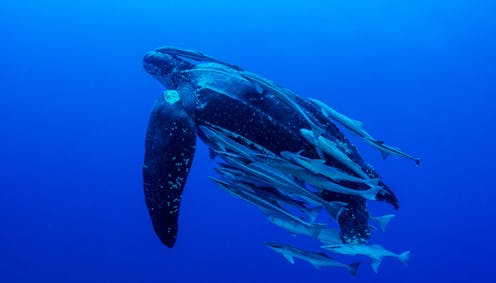
Hundreds of endangered sea turtles have been caught in New Zealand’s commercial fisheries since 2002, according to a recent report released by the Department of Conservation (DOC).
At least 80% are leatherback turtles, most likely from their western Pacific subpopulation which is considered critically endangered. The captures occur overwhelmingly in the surface longline fishery off the east coast of the North Island between January and April.
Although this DOC report is recent, the authors make it clear the underlying data have been known to the New Zealand government for years.
The lack of action to reduce the turtle bycatch risks damaging the reputation of New Zealand’s seafood industry.
The DOC report summarises observer and fisher data. It found 50 leatherback turtles were reported during 2020-2021.
Reporting of bycatch species by fishing vessels is known to under-represent actual capture numbers and observers are only onboard a small percentage of the time.
A 2021 report for the Ministry for Primary Industries (MPI) extrapolated data from vessels with observers across the rest of the fishing fleet and estimated that the average number of turtles caught across the New Zealand fleet each year ranges between 23 to 127.
Read more: How a new app helps fishing boats avoid endangered species
Threat to turtles
To put these bycatch numbers in perspective, the estimated population of western Pacific leatherback turtles is as low as 1,000 nesting females per year.
All sea turtle species found in New Zealand waters – leatherback, green, hawksbill, loggerhead and olive ridley – are listed on the International Union for Conservation of Nature (IUCN) red list of threatened species, but the leatherback western Pacific subpopulation is listed as critically endangered, due to a large and continuing drop in population size.
Read more: Dolphins, turtles and birds don’t have to die in fishing gear – skilled fishers can avoid it
The DOC report cites other studies of what happens to turtles once they’ve been caught on a fishing line. About 5% are dead on capture, but many will die later from their injuries.
One study concluded 27% of turtles hooked externally or with line left attached die after release. This increases to 42% for those hooked in the mouth or ingesting the hook. Leatherback turtles are thought to suffer a slightly higher mortality rate than other turtle species.
The US government authority on marine management, the National Oceanic and Atmospheric Administration (NOAA), acknowledges the impact on turtles from fishing bycatch. It states:
The primary threat to sea turtles is their unintended capture in fishing gear which can result in drowning or cause injuries that lead to death or debilitation.
New Zealand lacks bycatch mitigation measures
New Zealand currently has no mandatory mitigation measures to prevent the bycatch of turtles. DOC has a protected species liaison programme that issues guidance to fishers, but the measures are voluntary and unenforceable.
In fact, New Zealand has an exemption from the Western and Central Pacific Fisheries Commission (WCPFC) mitigation measures on the basis of a low rate of turtle bycatch.
However, as the DOC report details, a rate is a questionable way to decide whether mitigation measures should apply – total numbers are what matter to the turtle population. Regardless, the DOC report also suggests that New Zealand has frequently breached the rate below which the exemption applies.
The turtle bycatch figures provided by New Zealand at a recent WCPFC meeting in August paint a different picture to the DOC and MPI reports described here. Only turtle captures from when an observer was onboard are included.
Observer coverage in these fisheries in New Zealand is low – at only 5.8%, according to a 2016 DOC report. The same report also recommends a review of observer coverage as it is essentially in the wrong time and place to monitor turtle captures.
US mitigation and legislation
The lack of mitigation in New Zealand contrasts strikingly with other countries. For example, Hawai'i has reduced its turtle bycatch by 90% using a suite of measures, including hook and bait restrictions, a total fishery cap (16 leatherbacks), individual vessel limits, 100% observer coverage, oceanographic modelling to predict turtle location and closure of high-risk areas.
The US doesn’t focus solely on what happens in its own fisheries. Laws exist in the US in part to protect their own fishers from being undercut by seafood products from countries with lower environmental standards. The intention of these laws is to lift the performance of countries wanting to use US ports or to sell their seafood products in the US market.
One such law is currently being tested by the environmental organisation Sea Shepherd in relation to Māui dolphins. The group is challenging the US government under the Marine Mammals Protection Act (US) for its failure to ban seafood imports from New Zealand fisheries known to affect Māui dolphins.
Another law, the High Seas Driftnet Fishing Moratorium Protection Act is relevant as well. It requires NOAA to identify countries whose fishing vessels catch protected marine life shared with the US and whose measures are less protective than those of the US.
NOAA undertakes a three-step process of identification, consultation and certification that can result in denial of US port access and potential import restrictions on fish or fish products.
The US takes a particular interest in the bycatch of turtles. US researchers have estimated that without concerted conservation measures Pacific leatherbacks could be extinct by the end of this century. Last year, NOAA identified Mexico and 28 states that fish for tuna under the International Commission for the Conservation of Atlantic Tunas for not having measures “comparable in effectiveness to those of the US to reduce or end the bycatch” of sea turtles.
Read more: Scientists at work: Helping endangered sea turtles, one emergency surgery at a time
New Zealand has traditionally prided itself on having a world-leading fisheries management system. But unless it takes fast and concerted mitigation action on a par with that found in the US, the New Zealand government is placing itself at significant legal and reputational risk.
The fate of the Pacific leatherback turtle also hangs in the balance.
Authors: Matthew Hall, Senior Researcher, Environmental Law Initiative and Visiting Scholar, Faculty of Law, Te Herenga Waka — Victoria University of Wellington

















