

Reactions to Marin and Albanese show how women's alcohol consumption is treated differently from men's
- Written by Amy Pennay, Research Fellow, La Trobe University
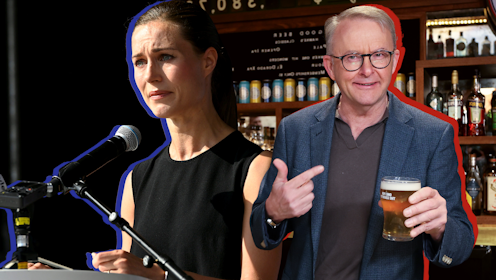
Gendered expectations around alcohol are far from equal. Safety suggestions around alcohol and even the way that alcohol is marketed are very much dependent on gendered use and expectations.
Even the perception of the “appropriateness” of drinking is often viewed though a gendered lens. This has been demonstrated recently by reactions to social drinking by two prime ministers: Sanna Marin from Finland and Australia’s Anthony Albanese.
Read more: Women's alcohol consumption catching up to men: why this matters
A tale of two prime ministers
Marin was castigated both within Finland and abroad after a video of her partying with friends was posted online earlier this month. Critics slammed her behaviour as “unfitting of a prime minister” and she was accused of acting like a “ladette”. She subsequently had to take a drug test in what she said was “for her own legal protection” amid calls for her to step down.
In Australia a few days later, Albanese was spotted at a Gang of Youths concert in Sydney drinking a beer.
The reaction to Albanese’s drinking went viral as well - for completely different reasons. He was cheered by the crowd and the harder he chugged the beer, the louder the cheers.
To date, there has been no outrage. No calls for Albanese to do a drug test or to step down.
Why would similar behaviour by two world leaders be treated so differently?
Gender double standards
The wildly disparate reactions have sparked a conversation around gender double standards.
In Australia, drinking alcohol itself has long been a gendered activity. Women were not permitted in pubs in Australia until the 1960s.
Alcoholic beverages are even marketed at men and women differently. Ads for beer drinking emphasise masculinity, while wine drinking is associated with femininity. Studies have shown that middle-aged men and women drink for different reasons, with men more likely to see drinking as a reward for hard work and women more likely to drink in response to stresses or to wind down.
Read more: 'Oh well, wine o’clock': what midlife women told us about drinking – and why it's so hard to stop
When it comes to young adults and public intoxication, men’s drinking tends to be associated with public disorder, while women’s drinking is often associated with promiscuity and sexual vulnerability.
Alcohol and ‘acceptable’ behaviour
But one of the clearest ways gender is implicated in drinking is in notions of “acceptable behaviour”.
We know that men’s drinking tends to be seen as more acceptable than women’s drinking. This includes greater acceptability of heavy drinking and public drunkenness among men.
Women are also subject to greater criticism for intoxicated images of them on social media. Women drinkers are criticised even more harshly if they are mothers of young children – a double standard that doesn’t seem to carry across to fathers.
In fact, gender expectations can mean that men are judged more harshly if they choose not to drink. That is, men are expected to drink.
While drinking is common among both men and women in Australia, men are more likely to drink, and to drink more heavily than women. However, the acceptability of men’s drinking and its association with traditional forms of masculinity creates double standards.
Debate terms
Terms such as “hegemonic masculinities” and “appropriate femininities” are often used in debates about men’s and women’s drinking.
Hegemonic masculinity refers to patterns of behaviour that allow men’s dominance over women to continue. Appropriate femininities refer to traits that are traditionally conceived of as feminine, such as passivity, caring, nurturing and self-control.
These terms are important because differences in the way women and men are represented when drinking reflects broader societal gendered norms.
In our recent research drawing on interviews with young people aged 16-19 in Australia, the UK, Denmark, and Sweden, we reported how drinkers and states of intoxication were described in gendered terms. Examples for men included ‘"predatory", “violent” and “rowdy”, while for women terms used were “childish”, “bitchy” and “hysterical”. Clearly even among young people, some gendered stereotypes around alcohol persists.
The future of drinking
What is perhaps a silver lining to our research is that the young people in our studies expressed displeasure at displays of drinking that drew on the gendered norms described above. They talked about drinking less than the generations before them and objected to intoxication being linked to “toxic masculinities” or emotional and vulnerable femininities.
They also talked about non-drinking or moderate drinking as a way to reshape and challenge normative gendered drinking practices. Swedish research has shown that young men have new ways of “doing masculinity” (for example, through sport or gaming), putting less pressure on them to drink heavily to fit in.
Although young people are challenging some of the gender double standards and expectations that come with alcohol, mainstream media often punish women’s drinking more than men, as reflected in the disparate treatment of Marin and Alanese’s drinking escapades.
While their drinking practices outside of working hours have no bearing on their professional capabilities, the last few weeks have shown that gendered drinking stereotypes remain and have a significant impact.
Authors: Amy Pennay, Research Fellow, La Trobe University

















