

Modern Australian
The Times

In a world first, NASA's DART mission is about to smash into an asteroid. What will we learn?

  • Written by Steven Tingay, John Curtin Distinguished Professor (Radio Astronomy), Curtin University
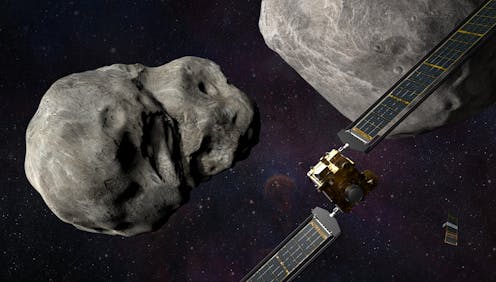
In a world first, NASA's DART mission is about to smash into an asteroid. What will we learn?

On September 26 at 11.15pm UTC, NASA’s DART mission (Double Asteroid Redirection Test) will be the first to deliberately and measurably change the motion of a significant body in our Solar System. In other words, it will smash into an asteroid.

The mission will provide the first test of a technique that could be used in the future – to redirect any asteroids we detect on a collision course with Earth.

A binary pair of space rocks

DART was launched on November 24, 2021, its destination a pair of asteroids in orbit around each other, 11 million kilometres from Earth.

The larger asteroid in the pair is called Didymos and is 780 metres in diameter. The smaller asteroid, just 160 metres wide, is called Dimorphos. The two orbit each other at a distance of 1.18 kilometres, and one orbit takes close to 12 hours.

Schematic of DART approaching the asteroids Didymos and Dimorphos.
DART is expected to alter the orbit of the smaller asteroid. NASA/Johns Hopkins APL

These asteroids pose no risk to Earth and have been chosen as the target for DART partly due to that fact. But also, importantly, because the asteroids form a binary pair, it will be possible for astronomers on Earth to assess the results of the impact.

As the asteroids orbit each other, the sunlight reflected off them increases and decreases, varying systematically over the 12-hour cycle of the orbit. Astronomers using powerful telescopes from Earth can monitor this variation and see how it changes, from before to after the collision.

Read more: An asteroid impact could wipe out an entire city – a space security expert explains NASA's plans to prevent a potential catastrophe

The physics is simple, the mission is not

The physics sounds simple, and it is. Hit one thing with another thing to change its motion. But the mission execution is very complicated. When DART reaches the asteroids, it will be 11 million kilometres from Earth after a 10 month journey. The spacecraft has to use autonomous targeting, using images of the asteroids it acquires as it approaches.

DART needs to recognise the asteroids by itself, automatically lock onto Dimorphos, and adjust its trajectory to hit it. This is all while moving at a speed of nearly 24,000 kilometres per hour!

The results of the impact, while reasonably straightforward to measure, are difficult to predict. The size, shape, and composition of Dimorphos, and exactly where DART hits and how hard, will affect the outcome.

All these factors are uncertain to some degree. Comprehensive computer simulations of the impact have been undertaken, and the comparisons of the simulations, predictions, and measured results will be the main outcomes of the DART mission.

As well as the measurements from telescopes on Earth, an up-close view of the impact itself will be possible, from an Italian Space Agency CubeSat (a small type of satellite) called LICIACube that was deployed from a spring-loaded box aboard the craft on 11 September. LICIACube will follow along and photograph the collision and its aftermath.

A large, circular device in a hangar space
The Lowell Discovery Telescope, located in northern Arizona, one of the facilities that will measure the impact of the DART collision. Lowell Observatory

The results will tell us a lot about the nature of asteroids and our ability to change their motions. In the future, this knowledge could be used to plan planetary defence missions that seek to redirect asteroids deemed to be a threat to the Earth.

Read more: Don't look up: several asteroids are heading towards Earth – here's how we deal with threats in real life

What is the level of threat?

An asteroid as small as 25 metres in diameter could produce injuries from an airburst explosion if it hit the atmosphere over a populated area. It is estimated that 5 million such objects exist in our Solar System and that we have discovered approximately 0.4% of them. Such a hit is estimated to occur once every 100 years. While quite frequent, the overall risk is low and the impact risk is relatively low too.

However, it is predicted there are 25,000 objects in the Solar System the size of Dimorphos, 39% of which are known, that hit Earth every 20,000 years. Such an object would cause mass casualties if it hit a populated area.

A chart showing different sizes of asteroids and their relative risk
Asteroid statistics and the threats posed by asteroids of different sizes. NASA

Asteroids that could challenge the existence of human civilisation are in the 1 km plus size category, of which there are less than a thousand in the Solar System; they might hit Earth only every 500,000 years. We have already found 95% of these objects.

So, potential asteroid collisions with Earth range from the frequent but benign to the very rare but catastrophic. The DART tests are being undertaken in a very relevant and interesting size range for asteroids: those greater than 100 metres.

If DART is successful, it may set the scene for future missions that target asteroids, to nudge them out of the way of collisions with Earth. When an asteroid is a long way from Earth, only a small nudge is required to get it out of our way, so the earlier we can identify asteroids that are a potential threat, the better.

In the near future, the well-worn premise of so many “an asteroid is coming, we need to deflect it!” movies may well become a reality.

Read more: Mystery crater potentially caused by relative of dinosaur-killing asteroid

Authors: Steven Tingay, John Curtin Distinguished Professor (Radio Astronomy), Curtin University

Read more https://theconversation.com/in-a-world-first-nasas-dart-mission-is-about-to-smash-into-an-asteroid-what-will-we-learn-189391

What’s Trending in Men’s Jewellery This Father’s Day!

Finding a Father’s Day gift that feels personal, stylish and genuinely wearable is not always easy. While socks and novelty mugs have traditionall...

Road Signs: Understanding Their Role in Clear and Effective Signage

Effective signage and display hardware can help businesses communicate information, promote products and organise customer or visitor movement. Road...

Bottle Label Printing: Key Factors to Consider Before Your Next Packaging Run

Effective packaging begins with understanding the product, bottle material, artwork and production requirements when planning bottle label printing. H...

Planning a Long-Distance Move With Interstate Movers Melbourne

Moving between states involves more planning than a typical local relocation. Along with packing and transporting household belongings, you need to...

Understanding the Role of an I/O Controller in Industrial Automation

Modern industrial systems depend on accurate communication between sensors, machines and control systems. An I/O controller can help manage this commu...

How the Right Mining Hose Supports Demanding Operations

Mining environments place considerable demands on equipment used for material transfer, water management and processing. Hoses operating in these co...

Simple Ideas for Making Social Gatherings More Memorable

We have all been to those parties where everyone just stands around the kitchen island, staring at their phones, waiting for someone else to make a mo...

Outdoor Wall Lights: Improving Exterior Lighting Around Your Home

Lighting can influence how a room looks, feels and functions, so the right fitting should be selected according to both appearance and practical req...

Commercial Office Cleaning: Combining Routine Office Cleaning With Melbourne Service

Keeping a workplace clean requires a service that can accommodate everyday tasks as well as the particular needs of the business. Professional comme...

Caravan Sales in Queensland: How to Find the Right Caravan for Sale QLD

Caravan ownership is about more than having somewhere to sleep while travelling. For many Queenslanders, it is one of the best ways to explore regio...

What Sir Walter Buffalo Turf Actually Costs in 2026 (And Why Quotes Vary So Much)

Two quotes landed on a Hills District homeowner's kitchen table last spring for the exact same 80-square-metre backyard. One said $12 a metre. The o...

Nearly 1,300 NSW Hospital Beds Are Occupied By People Who Are Ready To Go Home

1,276 people in NSW hospitals have been medically cleared for discharge but remain in hospital because they're still waiting for NDIS or aged care sup...

National Survey Launched to Measure Operational Impacts of Federal NDIS Policy Reforms

The effects of recent NDIS reforms are beginning to move beyond policy papers and into day to day service delivery. A new national survey is asking ...

Beyond the Nappy Cake: Baby Shower Gifts That Get Used

What new Australian parents unwrap, keep, and quietly thank you for months later. Six weeks after my daughter was born, I did an audit of the baby sh...

Parent-Advocates Are Reshaping Frontline Disability Service Delivery

Parents have always been part of the disability sector. They advocate, coordinate services, challenge decisions and often become the person holding ev...

Vista Cruises Enters "Two-Flagship Era" as Vista Aurora Completes Inaugural Voyage

Vista Aurora Sets Sail along the Yangtze. (Photo courtesy of the company)YICHANG, China — August 5, 2026 — Vista Aurora, a high-end interprovinc...

A Digital Preparation Checklist For International Medical Conferences

An international medical conference compresses many responsibilities into a few days. A delegate may need to present research, move between venues, ...

The Growing Popularity of Lab Grown Diamonds in Sydney and Hong Kong

The diamond industry has changed significantly in recent years as more buyers seek ethical, affordable, and sustainable alternatives to mined diamon...
















