

Modern Australian
The Times

DNA cracks a century-old mystery about New Zealand's only extinct freshwater fish

  • Written by Lachie Scarsbrook, DPhil Student, University of Oxford
DNA cracks a century-old mystery about New Zealand's only extinct freshwater fish

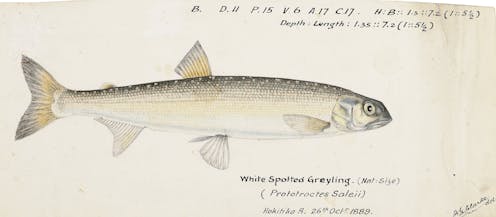
In 1923, Te Rangi Hīroa (Sir Peter Buck) documented the last confirmed capture of a special fish – the upokororo or New Zealand grayling.

More than two decades later, the upokororo received full governmental protection, but it was too late. No further sightings were ever confirmed. In 1986, the upokororo was officially listed as extinct.

The upokororo disappeared so quickly that it’s mostly unknown to Western science. But almost a century after the last living upokororo was seen, we are now using ancient DNA to finally provide some answers.

Our research reveals the upokororo’s ancient origins, going back 15 to 23 million years, and a link to its Australian cousins.

From fertiliser to phantom

Historical accounts show the upokororo was once very common in rivers across the country. In the 1800s, cartloads were caught and traded for use as fertiliser and food.

But then it disappeared, likely as a result of a combination of factors – pollution, overfishing, disease and predation by introduced trout.

A historic image showing men catching fish.
A funnel-shaped net is set to capture upokororo in the Waiapu River. Alexander Turnball Library CC BY-NC 4.0, Author provided

Despite its abundance in the past, only a small handful of preserved upokororo still exist in museums today. This is one reason we know so little about this curious fish.

A second reason is that many of these specimens have been treated with formaldehyde, a chemical that preserves the form of the fish but plays havoc with their DNA.

Fishy frontiers

The DNA in specimens “fixed” with chemicals like formaldehyde gets broken up into small pieces and stuck together. Over time, the DNA becomes more and more damaged.

This is a big challenge for researchers who want to study species like the upokororo and a major reason why extinct fish are understudied compared to other extinct species.

A formalin-fixed specimen fo a New Zealand grayling.
An example of a formalin-fixed New Zealand grayling, caught in the Clutha River (1874). Otago Museum CC BY 4.0, Author provided

Fortunately, new methods have recently been developed that help to isolate and analyse small damaged fragments of DNA. This means genetic analysis of many “wet preserved” specimens like those of the upokororo is now possible for the first time.

Such genetic information can provide new insights into the origin and identity of extinct species.

Read more: How did ancient moa survive the ice age – and what can they teach us about modern climate change?

Whakapapa of the upokororo

Based on the general appearance of the upokororo, scientists have usually considered it to be a close relative of the Australian grayling. The Australian grayling is part of a family of fish that includes Stokell’s smelt and the New Zealand smelt, which are both still found in rivers across Aotearoa.

New DNA data confirmed the Australian grayling is the closest living relative of the upokororo, but only a distant cousin at best. Genetic comparisons showed the common ancestor of the two species lived more than 15 million years ago.

An ancient origin for the upokororo agrees well with the discovery of fossil grayling ear bones in lake sediments from Saint Bathans in Central Otago.

Palaeontologists sieving for fossils in the Manuherikia River, near Saint Bathans.
Palaeontologists sieving for fossils in the Manuherikia River, near Saint Bathans. Fossils from this location are between 16 and 19 million years old. Nicrawlence/Wikipedia, CC BY-ND

Genetic and fossil data together suggest the ancestors of the upokororo arrived in Aotearoa following the birth of the Alpine Fault. Before that time, present-day Aotearoa was mostly beneath the ocean, during the height of the Oligocene “drowning” 27 to 22 million years ago.

While baby upokororo could live in salt water, adults needed brackish or fresh water. The emergence of Aotearoa from beneath the waves would have created new habitats for the upokororo.

Read more: 'I will miss them if they are gone': stingrays are underrated sharks we don't know enough about

Back from the brink?

Some scientists have previously put forward a controversial idea. Could the Australian grayling be released into rivers in New Zealand to fill the ecological gap left by the extinction of the upokororo?

That probably wouldn’t be a good plan. Millions of years of independent evolution mean the niches filled by the Australian grayling and upokororo were likely very different.

If we can’t replace the upokororo, is it possible that they’re still out there somewhere in a remote waterway, waiting to be re-discovered? It wouldn’t be unprecedented. Takahē were thought to be extinct before a small population was re-discovered in the Murchison Mountains in 1948.

An image of a river, overlain with fish.
Could the New Zealand grayling be hiding out in remote waterways, such as the West Coast’s Buller River? Peter James Quinn, Author provided

Genetic data provide a new tool in the search for survivors. Environmental DNA in water samples from remote catchments can now be compared routinely to known DNA from the upokororo. Perhaps one day this will lead to a positive match that indicates the location of survivors.

Fish populations are in sharp decline globally. Lessons learned from past extinctions, like that of the upokororo, can help us preserve fish species for future generations. Hopefully we can heed the lessons from the past.

Authors: Lachie Scarsbrook, DPhil Student, University of Oxford

Read more https://theconversation.com/from-fertiliser-to-phantom-dna-cracks-a-century-old-mystery-about-new-zealands-only-extinct-freshwater-fish-187928

What’s Trending in Men’s Jewellery This Father’s Day!

Finding a Father’s Day gift that feels personal, stylish and genuinely wearable is not always easy. While socks and novelty mugs have traditionall...

Road Signs: Understanding Their Role in Clear and Effective Signage

Effective signage and display hardware can help businesses communicate information, promote products and organise customer or visitor movement. Road...

Bottle Label Printing: Key Factors to Consider Before Your Next Packaging Run

Effective packaging begins with understanding the product, bottle material, artwork and production requirements when planning bottle label printing. H...

Planning a Long-Distance Move With Interstate Movers Melbourne

Moving between states involves more planning than a typical local relocation. Along with packing and transporting household belongings, you need to...

Understanding the Role of an I/O Controller in Industrial Automation

Modern industrial systems depend on accurate communication between sensors, machines and control systems. An I/O controller can help manage this commu...

How the Right Mining Hose Supports Demanding Operations

Mining environments place considerable demands on equipment used for material transfer, water management and processing. Hoses operating in these co...

Simple Ideas for Making Social Gatherings More Memorable

We have all been to those parties where everyone just stands around the kitchen island, staring at their phones, waiting for someone else to make a mo...

Outdoor Wall Lights: Improving Exterior Lighting Around Your Home

Lighting can influence how a room looks, feels and functions, so the right fitting should be selected according to both appearance and practical req...

Commercial Office Cleaning: Combining Routine Office Cleaning With Melbourne Service

Keeping a workplace clean requires a service that can accommodate everyday tasks as well as the particular needs of the business. Professional comme...

Caravan Sales in Queensland: How to Find the Right Caravan for Sale QLD

Caravan ownership is about more than having somewhere to sleep while travelling. For many Queenslanders, it is one of the best ways to explore regio...

What Sir Walter Buffalo Turf Actually Costs in 2026 (And Why Quotes Vary So Much)

Two quotes landed on a Hills District homeowner's kitchen table last spring for the exact same 80-square-metre backyard. One said $12 a metre. The o...

Nearly 1,300 NSW Hospital Beds Are Occupied By People Who Are Ready To Go Home

1,276 people in NSW hospitals have been medically cleared for discharge but remain in hospital because they're still waiting for NDIS or aged care sup...

National Survey Launched to Measure Operational Impacts of Federal NDIS Policy Reforms

The effects of recent NDIS reforms are beginning to move beyond policy papers and into day to day service delivery. A new national survey is asking ...

Beyond the Nappy Cake: Baby Shower Gifts That Get Used

What new Australian parents unwrap, keep, and quietly thank you for months later. Six weeks after my daughter was born, I did an audit of the baby sh...

Parent-Advocates Are Reshaping Frontline Disability Service Delivery

Parents have always been part of the disability sector. They advocate, coordinate services, challenge decisions and often become the person holding ev...

Vista Cruises Enters "Two-Flagship Era" as Vista Aurora Completes Inaugural Voyage

Vista Aurora Sets Sail along the Yangtze. (Photo courtesy of the company)YICHANG, China — August 5, 2026 — Vista Aurora, a high-end interprovinc...

A Digital Preparation Checklist For International Medical Conferences

An international medical conference compresses many responsibilities into a few days. A delegate may need to present research, move between venues, ...

The Growing Popularity of Lab Grown Diamonds in Sydney and Hong Kong

The diamond industry has changed significantly in recent years as more buyers seek ethical, affordable, and sustainable alternatives to mined diamon...
















