

How philosophy turned into physics – and reality turned into information
- Written by Peter Evans, Lecturer, The University of Queensland

The Nobel Prize in physics this year has been awarded “for experiments with entangled photons, establishing the violation of Bell inequalities and pioneering quantum information science”.
Read more: Nobel prize: physicists share prize for insights into the spooky world of quantum mechanics
To understand what this means, and why this work is important, we need to understand how these experiments settled a long-running debate among physicists. And a key player in that debate was an Irish physicist named John Bell.
In the 1960s, Bell figured out how to translate a philosophical question about the nature of reality into a physical question that could be answered by science – and along the way broke down the distinction between what we know about the world and how the world really is.
Quantum entanglement
We know that quantum objects have properties we don’t usually ascribe to the objects of our ordinary lives. Sometimes light is a wave, sometimes it’s a particle. Our fridge never does this.
When attempting to explain this sort of unusual behaviour, there are two broad types of explanation we can imagine. One possibility is that we perceive the quantum world clearly, just as it is, and it just so happens to be unusual. Another possibility is that the quantum world is just like the ordinary world we know and love, but our view of it is distorted, so we can’t see quantum reality clearly, as it is.
In the early decades of the 20th century, physicists were divided about which explanation was right. Among those who thought the quantum world just is unusual were figures such as Werner Heisenberg and Niels Bohr. Among those who thought the quantum world must be just like the ordinary world, and our view of it is simply foggy, were Albert Einstein and Erwin Schrödinger.
At the heart of this division is an unusual prediction of quantum theory. According to the theory, the properties of certain quantum systems that interact remain dependent on each other – even when the systems have been moved a great distance apart.
In 1935, the same year he devised his famous thought experiment involving a cat trapped in a box, Schrödinger coined the term “entanglement” for this phenomenon. He argued it is absurd to believe the world works this way.
The problem with entanglement
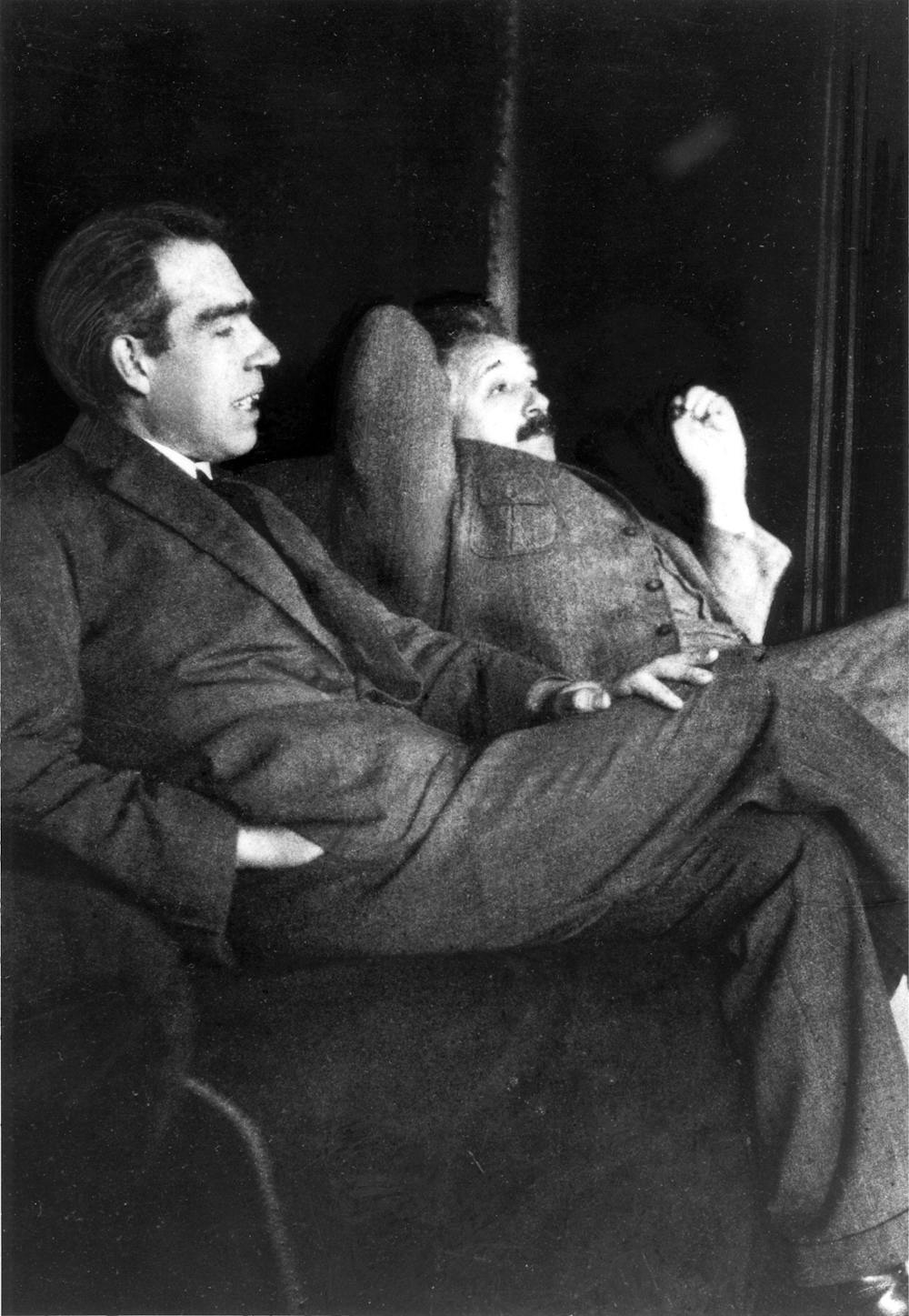
If entangled quantum systems really remain connected even when they are separated by large distances, it would seem they are somehow communicating with each other instantaneously. But this sort of connection is not allowed, according to Einstein’s theory of relativity. Einstein called this idea “spooky action at a distance”.
Again in 1935, Einstein, along with two colleagues, devised a thought experiment that showed quantum mechanics can’t be giving us the whole story on entanglement. They thought there must be something more to the world that we can’t yet see.
But as time passed, the question of how to interpret quantum theory became an academic footnote. The question seemed too philosophical, and in the 1940s many of the brightest minds in quantum physics were busy using the theory for a very practical project: building the atomic bomb.
It wasn’t until the 1960s, when Irish physicist John Bell turned his mind to the problem of entanglement, that the scientific community realised this seemingly philosophical question could have a tangible answer.
Bell’s theorem
Using a simple entangled system, Bell extended Einstein’s 1935 thought experiment. He showed there was no way the quantum description could be incomplete while prohibiting “spooky action at a distance” and still matching the predictions of quantum theory.
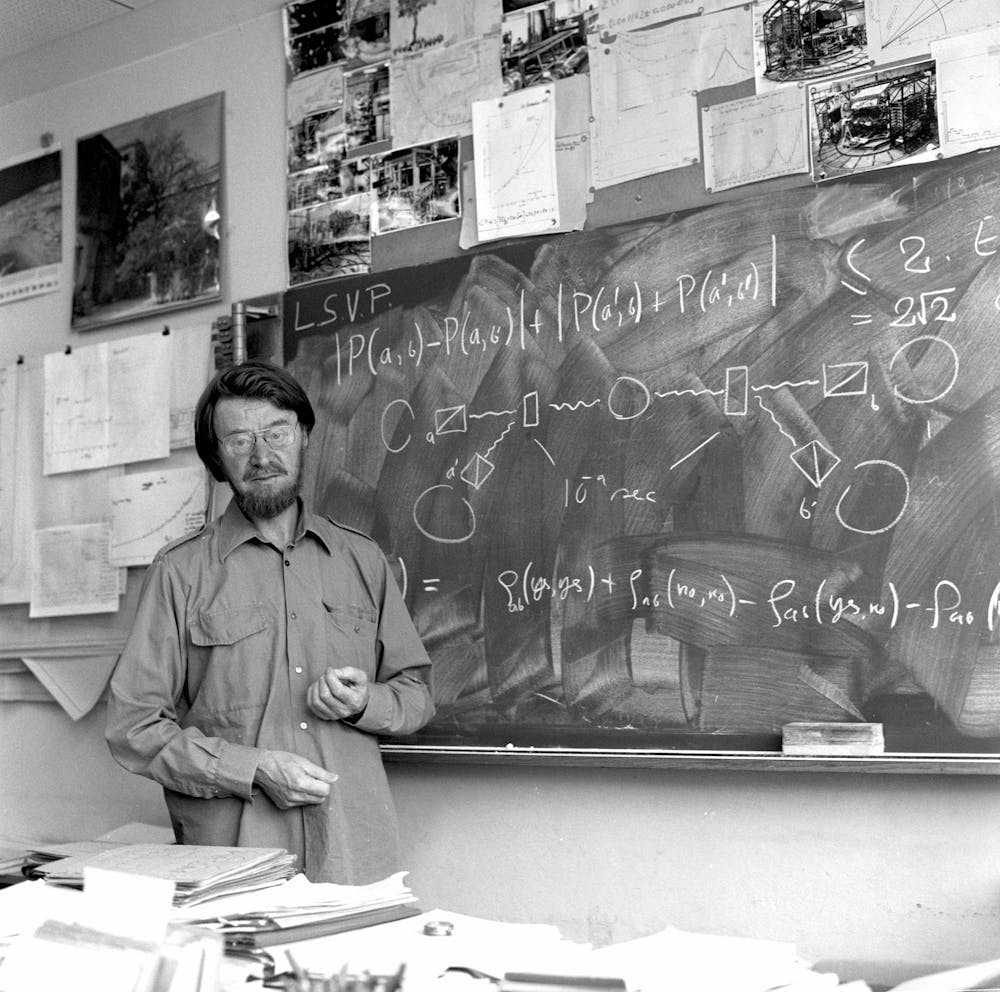 John Bell in his office at CERN in Switzerland.
CERN
John Bell in his office at CERN in Switzerland.
CERN
Not great news for Einstein, it seems. But this was not an instant win for his opponents.
This is because it was not evident in the 1960s whether the predictions of quantum theory were indeed correct. To really prove Bell’s point, someone had to put this philosophical argument about reality, transformed into a real physical system, to an experimental test.
And this, of course, is where two of this year’s Nobel laureates enter the story. First John Clauser, and then Alain Aspect, performed the experiments on Bell’s proposed system that ultimately showed the predictions of quantum mechanics to be accurate. As a result, unless we accept “spooky action at a distance”, there is no further account of entangled quantum systems that can describe the observed quantum world.
So, Einstein was wrong?
It is perhaps a surprise, but these advances in quantum theory appear to have shown Einstein to be wrong on this point. That is, it seems we do not have a foggy view of a quantum world that is just like our ordinary world.
But the idea that we perceive clearly an inherently unusual quantum world is likewise too simplistic. And this provides one of the key philosophical lessons of this episode in quantum physics.
It is no longer clear we can reasonably talk about the quantum world beyond our scientific description of it – that is, beyond the information we have about it.
As this year’s third Nobel laureate, Anton Zeilinger, put it:
the distinction between reality and our knowledge of reality, between reality and information, cannot be made. There is no way to refer to reality without using the information we have about it.
This distinction, which we commonly assume to underpin our ordinary picture of the world, is now irretrievably blurry. And we have John Bell to thank.
Read more: Better AI, unhackable communication, spotting submarines: the quantum tech arms race is heating up
Authors: Peter Evans, Lecturer, The University of Queensland


















