

The end of coal-fired power is in sight, even with private interests holding out
- Written by Bruce Mountain, Director, Victoria Energy Policy Centre, Victoria University
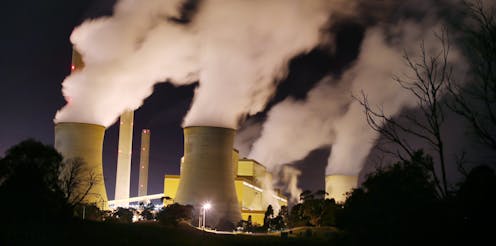
If future historians pick a point in time when Australia comprehensively turned its back on coal-fired generation, they may well point to AGL’s decision to bring forward the closure of Loy Yang A, the cheapest (excluding emission costs) power generator in the energy market spanning eastern Australia.
AGL announced on September 29 that Loy Yang A will close in 2035, ten years earlier than previously planned.
The day before, the Queensland government announced it would decommission or repurpose all its coal generators by 2035. (It owns five of the state’s eight coal-fired plants, and has a joint-venture holding in another.)
Origin Energy announced in February it would bring forward the closure of the biggest coal-fired electricity generator in New South Wales, Eraring, from 3032 to 2025.
So the big coal-generation owners in the National Energy Market (which covers eastern Australia but not Western Australia and the Northern Territory) have made their intentions clear. The era of coal-fired generation is rapidly drawing to a close.
The questions now are: what forms of electricity generation will replace coal, how much will it cost, and who will pay?
Has coal generation been profitable?
Summary answers to the first two questions are easy. The future is renewable energy, storage and more transmission. More than A$100 billion of capital expenditure will be needed.
The last question (who will pay) is affected by past policy choices – particularly the privatisation of state-owned generation assets, and subsequent market regulation.
Read more: Up to 90% of electricity from solar and wind the cheapest option by 2030: CSIRO analysis
Loy Yang A, along with Victoria’s other coal and gas generators, was built in the 1980s by a government corporation and sold off in the late 1990s by the Kennett government. AGL bought a one-third share in 2004, and became the sole owner in 2012.
Since 1998 (the start of the National Electricity Market), I estimate Loy Yang A has produced earnings before interest, depreciation and amortisation (EBITDA) - a widely accepted measure of profit used by economists - of $10 billion.
I’ve calculated this using on market revenues and cost information published by the Australian Energy Market Operator. Over the same period, the power station has produced about 486 million tonnes of carbon emissions (about equal to Australia’s annual total).
For all four of the Victoria’s brown-coal generators privatised in the 1990s – Loy Yang A and B, Hazelwood and Yallourn – I estimate a total EBITDA of $23 billion on revenues of $62 billon, since 1998.
This is a 38% profit margin – an extraordinary return for shareholders from assets developed by a government corporation, and which required no great innovation or brilliance to operate.
Where did all the money go?
This $23 billion is also more than the proceeds of the privatisation of the four power stations once owned by the State Electricity Commission of Victoria.
Now AGL says the full cost of decarbonising electricity supply to its customers is $20 billion. Investment analyst UBS reckons AGL can only afford $2 billion) without harming shareholder value (profitability). By implication, the other $18 billion will need to be found elsewhere.
Privatisation of Victoria’s electricity assets delivered what was thought of at the time as handsome rewards for taxpayers.
But it turns out it’s the shareholders who come out far ahead. And they pocketed their profits instead of ploughing them back into cleaner alternatives.
They might argue that ploughing their profits back into new renewable generation would have threatened the health of their golden geese. This is evidence of a broken market. The coal generators felt no pressure to reinvest because they were confident that others could not threaten their rivers of cash.
This is not to say government ownership is necessarily better. Private capital in energy production is valuable, not least because there are many other demands on the public purse. When markets work in the interests of customers, they stimulate innovation and efficiency.
But the efficient use of private capital requires effective competition.
What went wrong? There are various views on this. I nominate competition policy that permitted excessive market concentration. There was insufficient competitive tension to check investors’ avarice. Often gullible and ideological regulators made matters worse.
Read more: How did Victoria cut emissions by almost 30% - while still running mostly on coal?
As we begin the new era, these policy and regulatory failures must not be repeated. If public confidence in private investment in energy supply is to be restored, new ways of harnessing private capital must be found.
This might mean big changes from the way things have worked for the past two decades. Policy-makers should be mindful to ensure the owners of the coal generators do not get a second bite of the cherry.
Authors: Bruce Mountain, Director, Victoria Energy Policy Centre, Victoria University

















