

Women-led protests in Iran gather momentum
- Written by Tony Walker, Vice-chancellor's fellow, La Trobe University
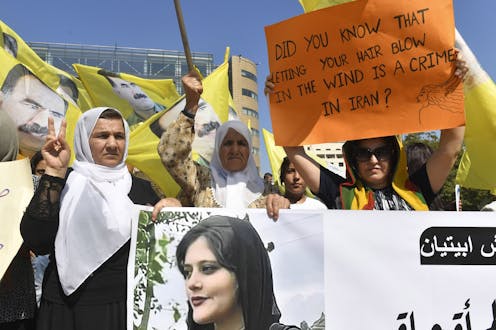
As protests in Iran drag on into their fourth week over the violent death in custody of Mahsa Amini, a young Kurdish woman, there are two central questions.
The first is whether these protests involving women and girls across Iran are different from upheavals in the past, or will simply end the same way with the regime stifling a popular uprising.
The second question is what can, and should, the outside world do about extraordinarily brave demonstrations against an ageing and ruthless regime that has shown itself to be unwilling, and possibly unable, to allow greater freedoms?
The symbolic issue for Iran’s protest movement is a requirement, imposed by morality police, that women and girls wear the hijab, or headscarf. In reality, these protests are the result of a much wider revolt against discrimination and prejudice.
Put simply, women are fed up with a regime that has sought to impose rigid rules on what is, and is not, permissible for women in a theocratic society whose guidelines are little changed since the overthrow of the Shah in 1979.
Women are serving multi-year jail sentences for simply refusing to wear the hijab.
Two other issues are also at play. One is the economic deprivation suffered by Iranians under the weight of persistent sanctions, rampant inflation and the continuing catastrophic decline in the value of the Iranian riyal.
The other issue is the fact Mahsa Amini, the 22-year-old whose death sparked the protests, was a Kurd.
The Kurds, who constitute about 10% of Iran’s 84 million population, feel themselves to be a persecuted minority. Tensions between the central government in Tehran and Kurds in their homeland on the boundaries of Iraq, Syria and Turkey are endemic.
Another important question is where all this leaves negotiations on the revival of the Joint Comprehensive Plan of Action (JCPOA). The JCPOA had been aimed at freezing Iran’s nuclear weapons ambitions. Former President Donald Trump recklessly abandoned the 2015 agreement in 2018.
Read more: The Iran nuclear talks are resuming, but is there any trust left to strike a deal?
The Biden administration, along with its United Nations Security Council partners plus Germany, had been making progress in those negotiations, but those efforts are now stalled, if not frozen.
The spectacle of Iranian security forces violently putting down demonstrations in cities, towns and villages across Iran will make it virtually impossible in the short term for the US and its negotiating partners to negotiate a revised JCPOA with Tehran.
Russia’s use of Iranian-supplied “kamikaze” drones against Ukrainian targets will have further soured the atmosphere.
How will the US and its allies respond?
So will the US and its allies continue to tighten Iranian sanctions? And to what extent will the West seek to encourage and support protesters on the ground in Iran?
One initiative that is already underway is helping the protest movement to circumvent regime attempts to shut down electronic communications.
Elon Musk has announced he is activating his Starlink satellites to provide a vehicle for social media communications in Iran. Musk did the same thing in Ukraine to get around Russian attempts to shut down Ukrainian communications by taking out a European satellite system.
However, amid the spectacle of women and girls being shot and tear-gassed on Iranian streets, the moral dilemma for the outside world is this: how far the West is prepared to go in its backing for the protesters.
It is one thing to express sympathy; it is another to take concrete steps to support the widespread agitation. This was also the conundrum during the Arab Spring of 2010 that brought down regimes in US-friendly countries like Egypt and Tunisia.
It should not be forgotten, in light of contemporary events, that Iran and Russia propped up Syria’s Assad regime during the Arab Spring, saving it from a near certain end.
In this latest period, the Middle East may not be on fire, as it was a decade or so ago, but it remains highly unstable. Iran’s neighbour, Iraq, is effectively without a government after months of violent agitation. The war in Yemen is threatening to spark up again, adding to uncertainties in the Gulf.
Read more: 3 ways these latest Iran demonstrations are different to past protests
In a geopolitical sense, Washington has to reckon with inroads Moscow has been making in relations with Gulf States, including, notably, Saudi Arabia.
The recent OPEC Plus decision to limit oil production constituted a slap to the US ahead of the mid-term elections in which fuel prices will be a potent issue.
In other words, Washington’s ability to influence events in the Middle East is eroding, partly as a consequence of a disastrous attempt to remake the region by going to war in Iraq in 2003.
A volatile region
Among the consequences of that misjudgement is the empowerment of Iran in conjunction with a Shia majority in Iraq. This should have been foreseen.
So quite apart from the waves of protest in Iran, the region is a tinderbox with multiple unresolved conflicts.
In Afghanistan, on the fringes of the Middle East, women protesters have taken the lead in recent days from their Iranian sisters and have been protesting against conservative dress codes and limitations on access to education under the Taliban.
This returns us to the moral issue of the extent to which the outside world should support the protests. In this, the experience of the “green” rebellion of 2009 on Iran’s streets is relevant.
Then, the Obama administration, after initially giving encouragement to the demonstrations, pulled back on the grounds it did not wish to jeopardise negotiations on a nuclear deal with Iran or undermine the protests by attaching US support.
Officials involved in the administration, who are now back in the Biden White House, believe that approach was a mistake. However, that begs the question as to what practically the US and its allies can do to stop Iran’s assault on its own women and girls.
What if, as a consequence of Western encouragement to the demonstrators, many hundreds more die or are incarcerated? What is the end result, beyond indulging in the usual rhetorical exercises such as expressing “concern” and threatening to ramp up sanctions that hurt individual Iranians more than the regime itself?
The bottom line is that irrespective of what might be the desired outcome, Iran’s regime is unlikely to crumble. It might be shaken, it might entertain concerns that its own revolution that replaced the Shah is in danger of being replicated, but it would be naïve to believe that a rotting 43-year-old edifice would be anything but utterly ruthless in putting an end to the demonstrations.
This includes unrest in the oil industry, in which workers are expressing solidarity with the demonstrators. The oil worker protest will be concerning the regime, given the centrality of oil production to Iran’s economy.
However, a powerful women’s movement has been unleashed in Iran. Over time, this movement may well force a theocratic regime to loosen restrictions on women and their participation in the political life of the country. That is the hope, but as history has shown, a ruthless regime will stop at little to re-assert its control.
Authors: Tony Walker, Vice-chancellor's fellow, La Trobe University

















