

Your home, office or uni affects your mood and how you think. How do we know? We looked into people's brains
- Written by Isabella Bower, Research Fellow and PhD Candidate, Deakin University

Think of a time when you felt vulnerable. Perhaps you were in a hospital corridor, or an exam hall, about to be tested. Now, focus on the building you were in. What if, without you knowing, the design of that space was affecting you?
We study environmental psychology, a growing field of research investigating the relationship between humans and the external world. This includes natural, and human-made environments, such as buildings.
Researchers could just ask people what they feel when inside a building – how pleasant or unpleasant they feel, the intensity of that feeling, and how in control they feel.
But we use neuroscience to see how the brain is stimulated when inside a building. The idea is for people to one day use that information to design better buildings – classrooms that help us concentrate, or hospital waiting rooms that reduce our anxiety.
Read more: Build me up: how architecture can affect emotions
Why study buildings this way?
We spend at least 80% of our lives inside buildings. So it is critical we understand whether the buildings we occupy are affecting our brain and body.
Buildings – hospitals, schools, offices, homes – are often complex. They can have various contents (fixtures, fittings and objects), levels of comfort (such as the light, sound, and air quality). Other people occupy the space.
There are also a range of design characteristics we can notice inside a building. These include colour (wall paint, chair colour), texture (carpet tiles, timber gym floor), geometry (curved walls or straight, angular ones), and scale (proportions of height and width of a room).
Read more: We can use colour to communicate how we feel – here's how
What did we do?
We wanted to see what effect changing some of these characteristics had on the brain and body.
So we asked participants to sit in the middle of a virtual-reality (VR) room for 20 minutes.
We designed the room with a door (to show height) and chair (to show depth), keeping it empty of other cues that might influence people. We modelled the room using dimensions set by the local building code.
Other studies have compared complex environments, which are more realistic to everyday life. But we chose to use a simple VR room so we could understand the impact of changing one characteristic at a time.
To measure brain activity, we used a technique called electroencephalography. This is where we placed electrodes on the scalp to measure electrical activity as brain cells (neurons) send messages to each other.
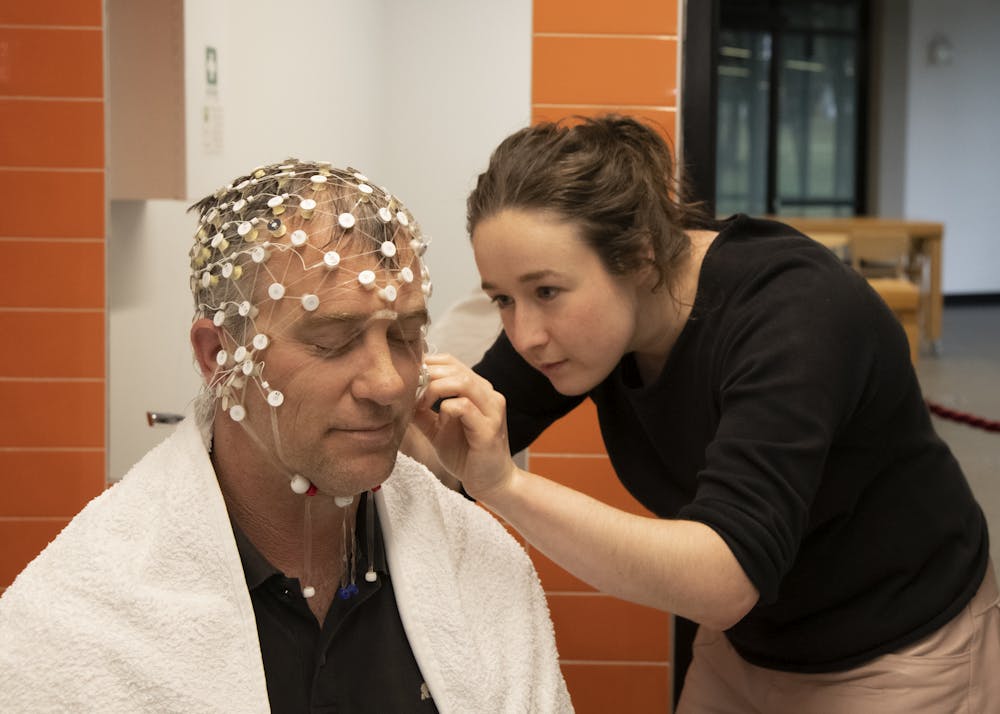
We also monitored the body by measuring heart rate, breathing and sweat response. This could reveal if someone could detect a change to the environment, without being consciously aware of that change.
Lastly, we asked participants to report their emotions to understand if this matched their brain and body responses.
Read more: Buildings have their own microbiomes – we're striving to make them healthy places
What did we find?
We published a series of studies looking at the impact of room size and colour.
Making the room bigger resulted in brain activity usually linked to attention and cognitive performance. This is the type of brain activity we would see if you were doing a crossword, your homework or focusing on a tricky report you were writing for work.
A blue room resulted in brain activity associated with emotional processing. This is the pattern we’d typically see if you were looking at something that you felt positive about, such as a smiling face, or a scenic sunset.
Changing the size and colour of a room also changed brain network communication. This is when different parts of the brain “talk” to one another. This could be communication between parts of the brain involved in seeing and attention, the type of communication needed when viewing a complex scene, such as scanning a crowded room to spot a friend.
The rooms also changed the participants’ autonomic response (their patterns of breathing, heart activity and sweating).
Your brain and body give away what you feel and think about different rooms, even if you can’t tell us yourself.Despite these brain and body responses, we found no change in what participants told us about their emotions in each of these different conditions.
This suggests the need to shift from just asking people about their emotions to capturing effects they may not be consciously perceive or comprehend.
What does this mean for designing buildings?
This work tells us that characteristics of buildings have an impact on our brains and our bodies.
Our next steps include testing whether a larger room affects brain processes we use in everyday life. These include working memory (which we’d use to remember our shopping list) and emotion recognition (how we recognise what different facial expressions mean).
This will enable us to understand if we can design spaces to optimise our cognitive performance.
We also want to understand the implications on a wider population, including people who may be experiencing poor mental health, or diagnosed with an underlying condition where the environment may have a larger impact on their response.
This will help us to understand if we can change our built environment for better health and performance.
Read more: Prisons and asylums prove architecture can build up or break down a person's mental health
Why is this important?
Architects have long claimed buildings affect our emotion. But there has been a lack of brain-based evidence to back this.
We hope our work can help shape building planning and design, to support the brain processes and emotions we might require under different circumstances.
Authors: Isabella Bower, Research Fellow and PhD Candidate, Deakin University

















