

Oversized plumbing is adding millions to Australian building costs, thanks to a standard dating back to the 1940s
- Written by James Gong, Senior Lecturer in Water Engineering, Deakin University
Outdated plumbing standards are leading to oversized systems and inflated costs for Australian apartment buildings. Their plumbing systems are required to handle demand for water that’s more than three times the actual recorded peak demand, our newly published research shows.
The “designed peak demand” as laid out in the Australian plumbing standard dictates the design and scale of the water services in apartment buildings. The large discrepancy between designed and actual demand in most of these buildings means the water system is much larger than needed, adding to both construction and maintenance costs.
One case study of a 13-storey apartment building estimated A$120,000 could have been saved in building costs if actual peak demand were used for the plumbing design. With hundreds of apartment buildings built in Australia every year, updated standards could save many millions of dollars.
Even more of a problem is that oversized systems don’t work as designed. This leads to plumbing defects that account for a high proportion of strata insurance claims and cost the Australian economy about $200 million a year.
We can improve plumbing systems using more accurate estimates of peak demand. However, it’s not simply a matter of reducing the size of pipes and pumps. This may create other damaging problems such as noisy vibrations in the pipes known as water hammer.
Updating the standard requires work to develop a modern and accurate process of sizing plumbing systems.
Plumbing standards and practices are outdated
The Australian plumbing standard provides a solution for sizing water services to comply with the Plumbing Code of Australia. Based on the number of apartments, the solution estimates the probable maximum water demand – the “designed peak demand”. The pipe size is then determined based on a desired range for how fast the water flows and water pressure at times of peak use.
This approach is based on the “Barrie Book”. It was developed using the British plumbing code in the mid-1970s. The British and many other international plumbing codes are based on pioneering work by Roy B. Hunter in the US, which was published in 1940.
Hunter monitored the use of water fixtures in two hotel buildings at times of high demand. He used the data to determine each type of fixture’s probability of use at these times. Knowing the fixture flow rate and number of fixtures, the probable total demand can be determined.
We are much more water-efficient today
The over-estimation for buildings today is not a reflection on Hunter’s work. It is a result of changes in our water use and advances in plumbing technology.
In Australia, the Water Efficiency Labelling and Standards adopted in response to the Millennium Drought have largely driven changes in fixture flow rates and water use. For example, consumption in our two biggest cities has dropped by between a quarter and a third this century.
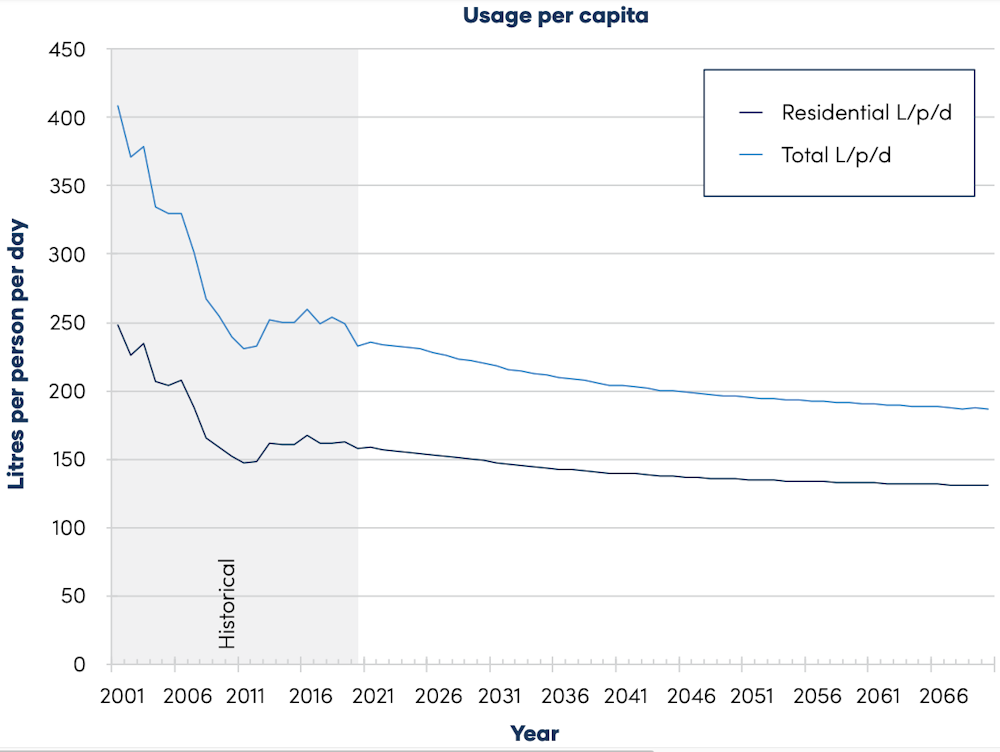
In Melbourne, residents used an average of 248 litres per person per day (L/p/d) in 2001. By 2020 it was 158 L/p/d.
In Sydney, demand fell from about 270 L/p/d to 200 L/p/d over the same period.
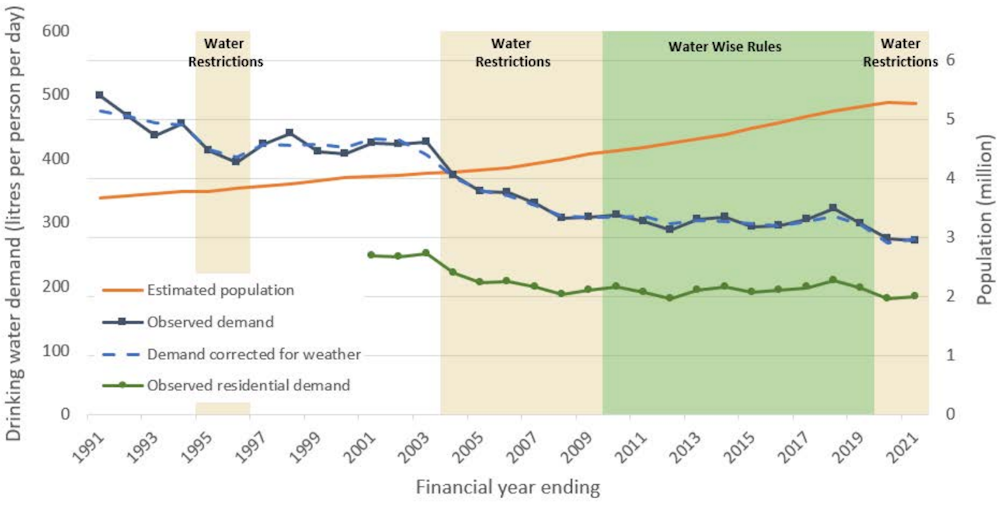 Total daily demand and residential usage of drinking water per person in Sydney from 1991-2021.
Water Conservation Report 2020-2021/Sydney Water, Author provided
Total daily demand and residential usage of drinking water per person in Sydney from 1991-2021.
Water Conservation Report 2020-2021/Sydney Water, Author provided
Oversized systems are costly
A case study of a 13-storey residential building with around 120 apartments found the pipe size would have been 40mm instead of 100mm if designed for actual peak demand. This could save $120,000 in building costs. This suggests very large savings could be made across the construction sector.
For the hot water system, the smaller pipe could reduce heat loss by 30-40%, saving another $2,000 a year in energy costs.
Pumps that are oversized as a result of overestimating peak demand are less energy-efficient and cost more. They start and stop more often, to “throttle down” water flow, which reduces the life of the pump. Pressure surges can also create water hammer.
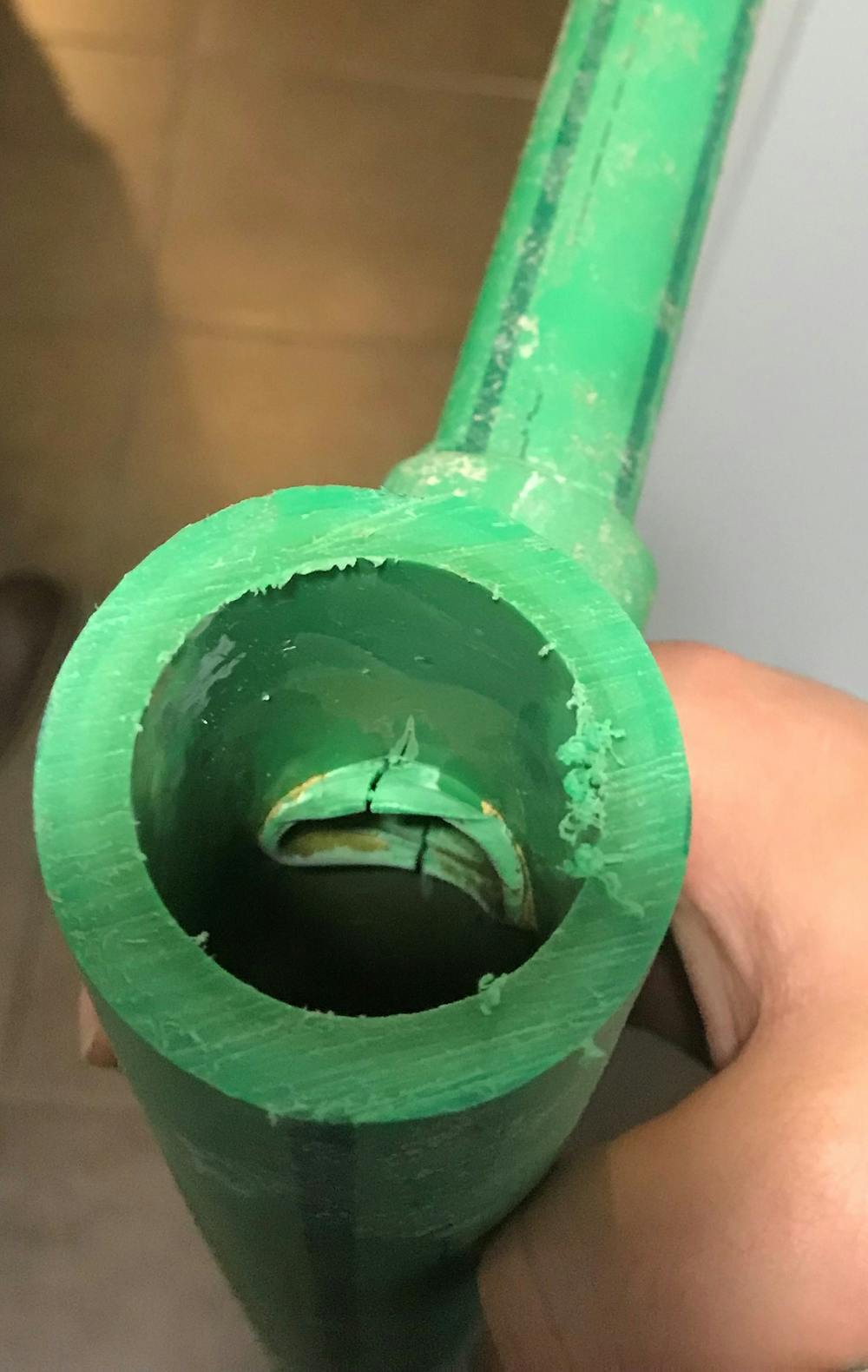 Building water pipes with cracks at the joint.
Image: James Gong
Building water pipes with cracks at the joint.
Image: James Gong
To deliver a given amount of water, wider pipes have lower flow velocities than narrower pipes, so oversized pipes may rarely experience self-cleansing velocities. These relatively high flows flush out trapped air and particulates that can cause pipe walls to wear out faster. Long-term low flows also promote the growth of biofilms and bacteria, which can result in corrosion and discoloured water.
Repeated water hammer, combined with other factors such as water chemistry, can lead to plumbing systems failing prematurely. When this happens after a building developer’s defects and liability period expires (usually within two years for non-structural defects), home owners are left liable for a hidden design problem.
A 2021 strata insurance report listed “water damage including leaks” and “burst water pipe” among the top four most common causes of claims in Australia. The combined claim costs were estimated at over $500 million from 2016-2020, based on a review of some 49% of all strata schemes in Australia. This equates to an annual nation-wide cost of $200 million.
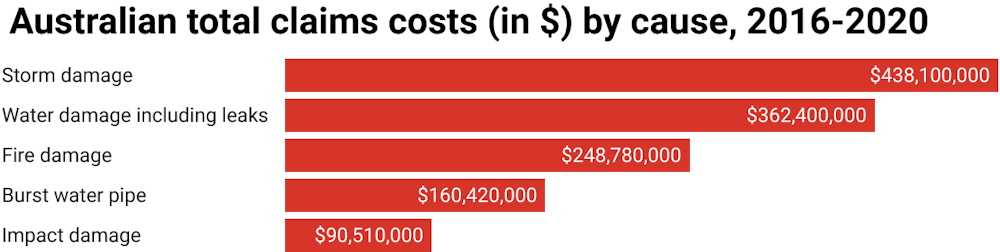 Chart: The Conversation. Data: N. Johnston, A data-driven holistic understanding of strata insurance in Australia and New Zealand/Strata Community Association, CC BY
Read more:
Dealing with apartment defects: a how-to guide for strata owners and buyers
How can we improve plumbing design?
Deakin researchers are developing methods to estimate peak demand more accurately for multi-level residential buildings. Digital water meters have provided a rich dataset that shows how Australians use water indoors.
With more accurate estimates of peak demand, pipe sizes would reduce significantly using the existing standardised approach. However, smaller pipes may experience more severe water hammer and higher risk of pipe erosion and corrosion due to higher flow.
Future plumbing design has to consider a wide range of flow conditions. Most times the flow is much lower than the expected peak demand, but it can change quickly. Modelling can help us understand how systems perform under various conditions.
Capturing the dynamics of the flow, pressure, temperature and energy use is a challenge that requires further research. Australian plumbing standards and practices need a systematic update that goes beyond peak demand.
Authors: James Gong, Senior Lecturer in Water Engineering, Deakin University
Chart: The Conversation. Data: N. Johnston, A data-driven holistic understanding of strata insurance in Australia and New Zealand/Strata Community Association, CC BY
Read more:
Dealing with apartment defects: a how-to guide for strata owners and buyers
How can we improve plumbing design?
Deakin researchers are developing methods to estimate peak demand more accurately for multi-level residential buildings. Digital water meters have provided a rich dataset that shows how Australians use water indoors.
With more accurate estimates of peak demand, pipe sizes would reduce significantly using the existing standardised approach. However, smaller pipes may experience more severe water hammer and higher risk of pipe erosion and corrosion due to higher flow.
Future plumbing design has to consider a wide range of flow conditions. Most times the flow is much lower than the expected peak demand, but it can change quickly. Modelling can help us understand how systems perform under various conditions.
Capturing the dynamics of the flow, pressure, temperature and energy use is a challenge that requires further research. Australian plumbing standards and practices need a systematic update that goes beyond peak demand.
Authors: James Gong, Senior Lecturer in Water Engineering, Deakin University 
















