

Modern Australian
The Times

Koalas, parrots, frogs and orchids share our cities. Their fate depends on protecting each one's habitat, not just 30% of all land

  • Written by Simon Kilbane, Senior Lecturer, Landscape Architecture, Deakin University
Koalas, parrots, frogs and orchids share our cities. Their fate depends on protecting each one's habitat, not just 30% of all land

The global 30x30 target aims to protect 30% of the planet by 2030 to secure its biodiversity. This involves legal protection for land and sea areas designated as national parks and nature reserves. Australia has joined more than 100 countries in this bold initiative.

However, if we are to adequately protect all species, we must acknowledge we never start with a blank slate. As a major academic review of fragmented ecosystems observed:

“Conservation managers must work with the remnants and virtually never have the opportunity to design a reserve network before an area is fragmented.”

The areas we choose to protect must include ecosystems where biodiversity is under pressure from human land uses. Australia’s urban areas still have a surprisingly high level of biodiversity.

Our major cities are home to almost 380 threatened species. They range from the western ringtail possum, koala and grey-headed flying fox to the orange-bellied parrot, red-crowned toadlet and several orchids. Indeed, 39 endangered species are found only in our cities and towns.

These urban areas also include threatened ecological communities such as the banksia woodlands of the Swan coastal plain in Perth and blue gum high forest of the Sydney region.

So, what does the 30x30 target mean for our cities and how we protect their biodiversity?

Small toad with red markets on the head, legs and rump
The distinctive red-crowned toadlet is found only in the Sydney Basin bioregion. Wikimedia Commons, CC BY

Read more: The 39 endangered species in Melbourne, Sydney, Adelaide and other Australian cities

Many areas are poorly protected

To protect biodiversity it’s not enough to simply protect 30% of land in general. Australia’s National Reserve System prescribes a comprehensive, adequate and representative approach. This divides the country into 89 distinct bioregions and 419 subregions.

The latest data suggest that simply achieving 30% protection for all these areas will be difficult.

As the maps below show (dark green areas have 30% or more protection), Australia meets this target in only 29 of its 89 bioregions, and 96 of 421 subregions. Is this is an improvement from a decade ago when a modest target of 10% protected area had been achieved in only 57 of 89 ecoregions?

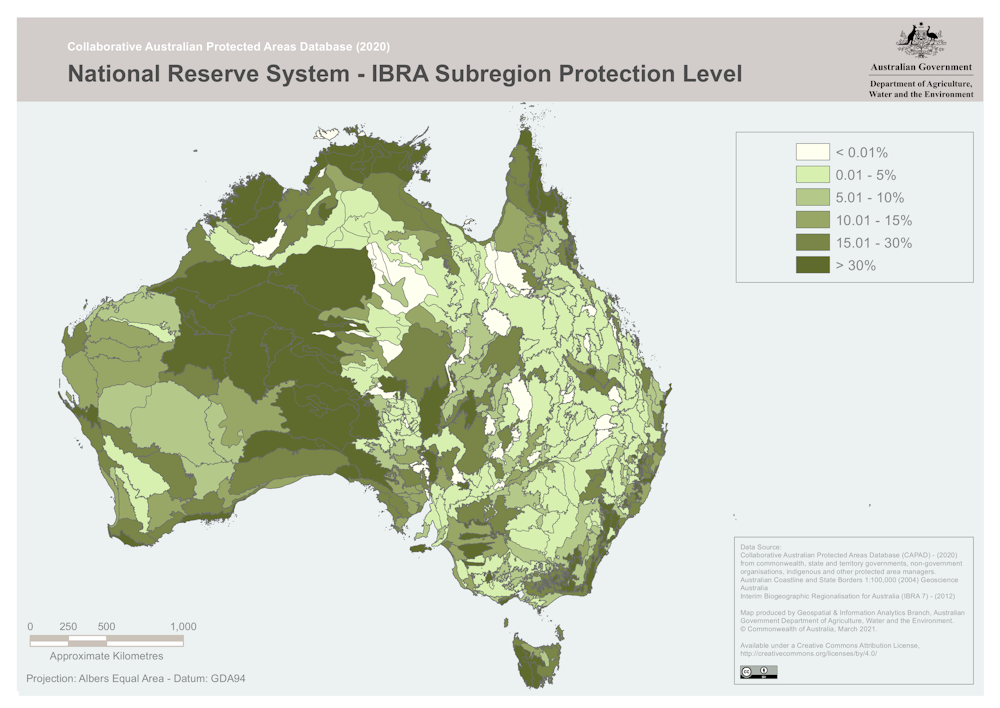
Map of Australia showing level of protection of bioregions
Source: Department of Climate Change, Energy, the Environment and Water Map of Australia showing level of protection of subregions Source: Department of Climate Change, Energy, the Environment and Water Even the 30% target may not be adequate. And yet achieving it will be difficult in the face of worldwide challenges such as climate change, invasive species and the issues of resourcing and managing an ever-expanding network. Read more: Protecting 30% of Australia's land and sea by 2030 sounds great – but it's not what it seems How do we protect urban biodiversity? Adequately protecting biodiversity in the cities and towns where most Australians live will be especially difficult. For example, a cursory look at protected area data for Sydney, situated across one bioregion, Sydney Basin, suggests good progress, with 40.99% of its area protected. However, at the level of its subregions, the picture is different. Pittwater (31.62%), Yengo (58.55%) and Woollemi (71.81%) have high levels of protection. But look at how little land is protected in the subregions that sit entirely within Sydney proper – only 3.13% for Cumberland. The most urbanised subregions of the Sydney Basin bioregion have minimal protected areas. Map by Simon Kilbane using Commonwealth data The picture is similar across all of Australia’s urban areas. To achieve comprehensive, adequate and representative protection of our biodiversity, we are going to have to think differently. How can we better plan our urban landscapes, or perhaps retrofit these areas, to provide habitat for our imperilled species? Read more: Labor's plan to save threatened species is an improvement – but it's still well short of what we need 5 approaches to protecting biodiversity Here are five approaches drawn from practice around Australia and the world that could help. 1. A philosophical reframing Biodiversity protection should not just occur in remote regions. It’s an issue closer to home. Urban and commercial development directly threatens 56 of Australia’s 255 flora and fauna species on the IUCN Red List of Threatened Species. 2. Green infrastructure Green infrastructure can create a network of urban forest, foreshores and creek lines, parks and open spaces. In this way, we can reconnect fragmented habitat patches. This interconnected network has both ecological and human-related benefits. Bolstered by a healthy groundswell of public and policy support – who wouldn’t want more green space? – there’s a growing momentum to reshape our cities. Notable initiatives include the Perth Biodiversity Project, the Sydney Green Grid and Melbourne’s Urban Forest Strategy. The benefits for ecosystems come from water retention and flood management and increasing plant cover – so important for reducing urban heat island impacts. People’s mental health and wellbeing benefit from spending time in these green areas. Evidence even suggests greener streets and suburbs have higher real estate values. Read more: Here's how to design cities where people and nature can both flourish 3. Creative conservation choices Finding conservation candidates in urban areas requires imagination and creativity. Why not consider disused industrial lands, cemeteries, poorly frequented golf courses, our roof tops and the ubiquitous suburban nature strips? If we radically reconfigured or “rewilded” our streets and gardens we could create more urban habitat. More diverse and local plantings and “backyards for wildlife”-type schemes seem a safe bet. Read more: Yes, the state of the environment is grim, but you can make a difference, right in your own neighbourhoood 4. Rethinking our idea of urban development The above options are the lowest-hanging fruit. What would happen if we radically rethought our profit-driven development model of suburbanisation? We could create a better balance between the habitats of humans and all the other species we share our cities with – as a matter of ecological justice. We might need to use collaborative tools and scenario planning to visualise possible impacts and benefits. This will help us better combine thinking about people, place and ecology. 5. Fostering ecological literacy Starting with learning from how Australia’s lands have been managed through traditional ecological knowledge, we need to foster a deeper appreciation of the nature that exists under our noses. Incorporating ecological knowledge into education from as early as possible will build ecological literacy This might then temper our desire for exotic plantings. We might even have second thoughts about cat or dog ownership given their impacts: Australia’s 3.8 million pet cats kill up to 390 million animals every year. It will take a monumental effort to rethink our country and our cities to preserve their biodiversity. Australia has just begun a worthwhile but difficult journey. Authors: Simon Kilbane, Senior Lecturer, Landscape Architecture, Deakin University

Read more https://theconversation.com/koalas-parrots-frogs-and-orchids-share-our-cities-their-fate-depends-on-protecting-each-ones-habitat-not-just-30-of-all-land-192176

What’s Trending in Men’s Jewellery This Father’s Day!

Finding a Father’s Day gift that feels personal, stylish and genuinely wearable is not always easy. While socks and novelty mugs have traditionall...

Road Signs: Understanding Their Role in Clear and Effective Signage

Effective signage and display hardware can help businesses communicate information, promote products and organise customer or visitor movement. Road...

Bottle Label Printing: Key Factors to Consider Before Your Next Packaging Run

Effective packaging begins with understanding the product, bottle material, artwork and production requirements when planning bottle label printing. H...

Planning a Long-Distance Move With Interstate Movers Melbourne

Moving between states involves more planning than a typical local relocation. Along with packing and transporting household belongings, you need to...

Understanding the Role of an I/O Controller in Industrial Automation

Modern industrial systems depend on accurate communication between sensors, machines and control systems. An I/O controller can help manage this commu...

How the Right Mining Hose Supports Demanding Operations

Mining environments place considerable demands on equipment used for material transfer, water management and processing. Hoses operating in these co...

Simple Ideas for Making Social Gatherings More Memorable

We have all been to those parties where everyone just stands around the kitchen island, staring at their phones, waiting for someone else to make a mo...

Outdoor Wall Lights: Improving Exterior Lighting Around Your Home

Lighting can influence how a room looks, feels and functions, so the right fitting should be selected according to both appearance and practical req...

Commercial Office Cleaning: Combining Routine Office Cleaning With Melbourne Service

Keeping a workplace clean requires a service that can accommodate everyday tasks as well as the particular needs of the business. Professional comme...

Caravan Sales in Queensland: How to Find the Right Caravan for Sale QLD

Caravan ownership is about more than having somewhere to sleep while travelling. For many Queenslanders, it is one of the best ways to explore regio...

What Sir Walter Buffalo Turf Actually Costs in 2026 (And Why Quotes Vary So Much)

Two quotes landed on a Hills District homeowner's kitchen table last spring for the exact same 80-square-metre backyard. One said $12 a metre. The o...

Nearly 1,300 NSW Hospital Beds Are Occupied By People Who Are Ready To Go Home

1,276 people in NSW hospitals have been medically cleared for discharge but remain in hospital because they're still waiting for NDIS or aged care sup...

National Survey Launched to Measure Operational Impacts of Federal NDIS Policy Reforms

The effects of recent NDIS reforms are beginning to move beyond policy papers and into day to day service delivery. A new national survey is asking ...

Beyond the Nappy Cake: Baby Shower Gifts That Get Used

What new Australian parents unwrap, keep, and quietly thank you for months later. Six weeks after my daughter was born, I did an audit of the baby sh...

Parent-Advocates Are Reshaping Frontline Disability Service Delivery

Parents have always been part of the disability sector. They advocate, coordinate services, challenge decisions and often become the person holding ev...

Vista Cruises Enters "Two-Flagship Era" as Vista Aurora Completes Inaugural Voyage

Vista Aurora Sets Sail along the Yangtze. (Photo courtesy of the company)YICHANG, China — August 5, 2026 — Vista Aurora, a high-end interprovinc...

A Digital Preparation Checklist For International Medical Conferences

An international medical conference compresses many responsibilities into a few days. A delegate may need to present research, move between venues, ...

The Growing Popularity of Lab Grown Diamonds in Sydney and Hong Kong

The diamond industry has changed significantly in recent years as more buyers seek ethical, affordable, and sustainable alternatives to mined diamon...
















