Modern Australian
The Times

What can we expect from this latest COVID wave? And how long is it likely to last?

  • Written by James Wood, Associate Professor, epidemiological modelling of infectious diseases, UNSW Sydney
What can we expect from this latest COVID wave? And how long is it likely to last?

Australia is now mid-way into its fourth wave of COVID in the Omicron era, driven by a rich soup of Omicron descendants. Unlike previous waves, where a single new variant of SARS-CoV-2 variant such as BA.2 or BA.5 was responsible, we have had an explosion of new variants such as XBB.1, BQ.1.1 and BR.2.1.

Read more: From Centaurus to XBB: your handy guide to the latest COVID subvariants (and why some are more worrying than others)

However, despite this apparent diversity, these new variants all follow a similar script, where the same set of changes have evolved independently across multiple variants. This is called convergent evolution.

These changes make the virus better at infecting people with immunity to existing variants. Since mid-October, the subvariants’ ability to escape immunity from vaccination and/or previous infection has been potent enough to cause a new wave in Australia.

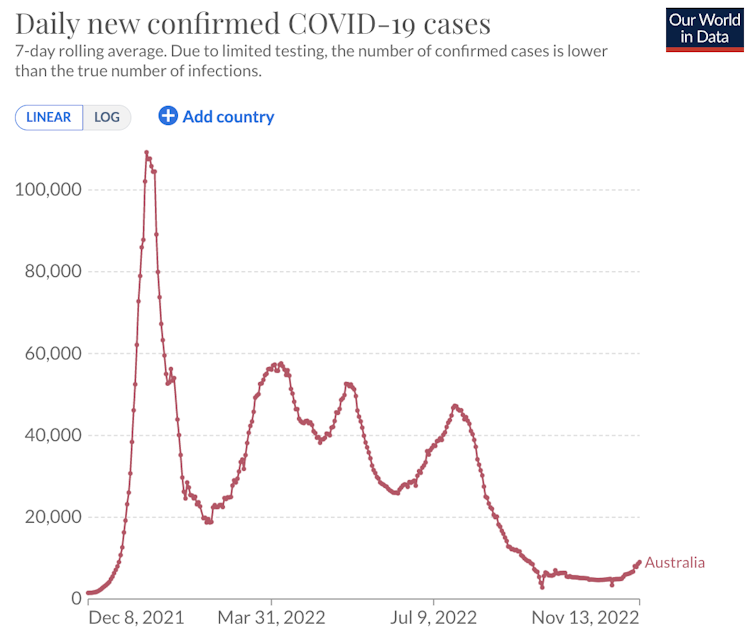
The graph below shows the series of 2022 waves, with the original Omicron the first wave, followed by the double-bump BA.2 (where Western Australia had different timing), the winter BA.5 wave, and now a new upswing in November.

Johns Hopkins University CSSE COVID-19 Data, CC BY In some good news, this wave is likely to be a shorter and smaller version of the BA.5 wave. Here’s why. Cases are rising rapidly In Australia, the wave is already growing rapidly, with indicators such as recorded cases and hospital occupancy showing significant increases in multiple states over the last two weeks. New South Wales reports on the trend in the underlying variants, with a clear shift since early October. Removal of mandatory reporting and isolation has led to fewer rapid antigen tests (RATs) being reported. So we may only be recording a smaller fraction of all community infections now than in previous waves. Read more: Previous COVID infection may not protect you from the new subvariant wave. Are you due for a booster? In the graph below, I’ve used the EpiNow2 R package (an open-source estimation and forecasting tool) to calculate the trend in the effective reproduction number (Rt) using NSW case data since early September. Rt represents the average number of people that a single COVID case infects at a given point in time. Epidemics decline when Rt is less than 1, while epidemic growth becomes likely once Rt is above 1 and is increasingly steep as Rt rises. This is now substantially above 1 in New South Wales: Trend in the effective reproduction number (Rt) in NSW as estimated from PCR case series (produced using the EpiNow2 R package). Will the wave peak by Christmas? Lessons from Singapore I think the most likely outcome is the wave will peak by Christmas. In my own work for NSW Health, I am currently projecting a peak in NSW for the first week of December. But these predictions are uncertain because it is still difficult to estimate the level of protection against infection in our population, despite impressive near real-time laboratory science that is helping to characterise this. Fortunately, despite the challenges with modelling, the recent Singapore wave can guide our expectations. Caused by XBB.1, this wave was short and sharp, peaking around October 18 and then dropping back almost to pre-wave levels by November 12. Read more: XBB and BQ.1: what we know about these two omicron 'cousins' Singapore has also seen a significant increase in hospitalisations, primarily in people aged above 70. However cumulative cases, admissions and deaths are tracking to be about half those of their BA.5 wave, with no signs of increased severity. Despite the ability of XBB.1 to evade vaccination and/or previous infection, in Singapore people with prior Omicron infections were about 75% less likely to test positive in this wave than in people without recorded prior infections. Singapore has also had quite a similar COVID pandemic experience to Australia in terms of restrictions, vaccination and infection waves. One exception is that mask-wearing remains more prevalent in Singapore. People wear masks on a Singapore train Singaporeans are more likely to wear masks than Australians. Shutterstock We should, however, expect some differences. Australia has about six times the resident population of Singapore with widely separated population centres. This might mean the wave duration across Australia is one to two weeks longer. Australia also has a higher proportion of the population above 75, a large fraction of whom haven’t had COVID this year and therefore won’t have hybrid immunity (from both vaccination and prior infection). This could result in more hospital admissions and deaths per capita than in Singapore. But in general, the Singapore wave supports the prediction this fourth Australian wave of 2022 will peak in early December and fall back below current levels by Christmas. Is this the new normal? What can we expect in the years to come? Beyond this year, I’m encouraged by the shift in pattern from single variants causing waves to the evolving variant soup. This evolution has been very rapid recently but there are signs this may slow considerably in 2023. Firstly, the rate at which mutations occur is proportional to how much virus is circulating. The enormous number of COVID infections across this year mean that in 2022 this change has happened quickly but with each wave getting smaller, this rate of change should slow. The recent variant soup evolution may also be a positive sign. The different variants in the soup have all gained a transmission advantage following the same immune-escape strategy. The set of relevant mutations were in fact predicted in advance by researchers at the University of Washington. If you are infected with one of these new variants, you should also have strong protection to the rest of the soup. The absence of big mutational jumps in dominant variants suggests SARS-CoV2, the virus that causes COVID, may now be entering a period of slower, more continuous evolution. This is what we see for seasonal influenza. COVID has been full of surprises but the evidence suggests we could see SARS-CoV-2 infections fall below our recent trough levels in 2023 and the beginning of a more seasonal pattern to COVID waves. Read more: Why haven't I had COVID yet? Authors: James Wood, Associate Professor, epidemiological modelling of infectious diseases, UNSW Sydney

Read more https://theconversation.com/what-can-we-expect-from-this-latest-covid-wave-and-how-long-is-it-likely-to-last-194444

What’s Trending in Men’s Jewellery This Father’s Day!

Finding a Father’s Day gift that feels personal, stylish and genuinely wearable is not always easy. While socks and novelty mugs have traditionall...

Road Signs: Understanding Their Role in Clear and Effective Signage

Effective signage and display hardware can help businesses communicate information, promote products and organise customer or visitor movement. Road...

Bottle Label Printing: Key Factors to Consider Before Your Next Packaging Run

Effective packaging begins with understanding the product, bottle material, artwork and production requirements when planning bottle label printing. H...

Planning a Long-Distance Move With Interstate Movers Melbourne

Moving between states involves more planning than a typical local relocation. Along with packing and transporting household belongings, you need to...

Understanding the Role of an I/O Controller in Industrial Automation

Modern industrial systems depend on accurate communication between sensors, machines and control systems. An I/O controller can help manage this commu...

How the Right Mining Hose Supports Demanding Operations

Mining environments place considerable demands on equipment used for material transfer, water management and processing. Hoses operating in these co...

Simple Ideas for Making Social Gatherings More Memorable

We have all been to those parties where everyone just stands around the kitchen island, staring at their phones, waiting for someone else to make a mo...

Outdoor Wall Lights: Improving Exterior Lighting Around Your Home

Lighting can influence how a room looks, feels and functions, so the right fitting should be selected according to both appearance and practical req...

Commercial Office Cleaning: Combining Routine Office Cleaning With Melbourne Service

Keeping a workplace clean requires a service that can accommodate everyday tasks as well as the particular needs of the business. Professional comme...

Caravan Sales in Queensland: How to Find the Right Caravan for Sale QLD

Caravan ownership is about more than having somewhere to sleep while travelling. For many Queenslanders, it is one of the best ways to explore regio...

What Sir Walter Buffalo Turf Actually Costs in 2026 (And Why Quotes Vary So Much)

Two quotes landed on a Hills District homeowner's kitchen table last spring for the exact same 80-square-metre backyard. One said $12 a metre. The o...

Nearly 1,300 NSW Hospital Beds Are Occupied By People Who Are Ready To Go Home

1,276 people in NSW hospitals have been medically cleared for discharge but remain in hospital because they're still waiting for NDIS or aged care sup...

National Survey Launched to Measure Operational Impacts of Federal NDIS Policy Reforms

The effects of recent NDIS reforms are beginning to move beyond policy papers and into day to day service delivery. A new national survey is asking ...

Beyond the Nappy Cake: Baby Shower Gifts That Get Used

What new Australian parents unwrap, keep, and quietly thank you for months later. Six weeks after my daughter was born, I did an audit of the baby sh...

Parent-Advocates Are Reshaping Frontline Disability Service Delivery

Parents have always been part of the disability sector. They advocate, coordinate services, challenge decisions and often become the person holding ev...

Vista Cruises Enters "Two-Flagship Era" as Vista Aurora Completes Inaugural Voyage

Vista Aurora Sets Sail along the Yangtze. (Photo courtesy of the company)YICHANG, China — August 5, 2026 — Vista Aurora, a high-end interprovinc...

A Digital Preparation Checklist For International Medical Conferences

An international medical conference compresses many responsibilities into a few days. A delegate may need to present research, move between venues, ...

The Growing Popularity of Lab Grown Diamonds in Sydney and Hong Kong

The diamond industry has changed significantly in recent years as more buyers seek ethical, affordable, and sustainable alternatives to mined diamon...