

VAR and peace? Why tech-assisted refereeing won't do away with disputed decisions at the World Cup
- Written by Stan Karanasios, Associate professor, The University of Queensland
The football teams of 32 nations are gathered in Qatar for the quadrennial FIFA World Cup. Some 5 billion people around the world are expected to tune in to watch matches over the course of the month-long tournament.
These enormous audiences will be ready to applaud great play – and to howl ferociously when a referee’s decision goes against their team. To ensure the tough decisions are fair and accurate, FIFA (the Fédération Internationale de Football Association, the sport’s global governing body) has invested not only in the best human referees but also in the latest and greatest in technological tools.
Video replays and other tools can help cut down on blatant mistakes and human oversights, but will they ever eradicate errors entirely?
We are researchers who study how organisations use technology, and we’re not so sure. In the messy and complex world of football, human judgement – with all its fallibility – will always reign supreme.
What is the video assistant referee (VAR)?
The video assistant referee (VAR) system uses a team of people watching multiple angles of match video to help referees make tough decisions. It was used at the 2018 FIFA World Cup and since then in many competitions all over the world.
At this year’s World Cup, the VAR team can get involved in only four types of situation involving goals and other match-changing events.
Read more: Why is the Qatar FIFA World Cup so controversial?
The VAR team continuously watches for clear and obvious errors related to those situations. When they spot such an error (or an incident that has been missed) they will let the referee know.
The VAR team also has access to extra tools to assess whether a ball has fully crossed the goal line, as well as a semi-automated system that tracks players and the ball to determine whether any player is offside.
Grey areas
Technologies such as these can be powerful tools, and they are being applied more heavily across all areas of sport. However, they will always be in tension with the inherent complexity of real-world incidents on the pitch.
Handball decisions in football are one example that is open to interpretation regardless of the technology. Video alone can’t truly determine whether there was contact between the ball and the player’s arm below the shoulder, which constitutes a handball.
Read more: Why Maradona's 'Hand of God' goal is priceless -- and unforgettable
In a game earlier this year, Manchester City’s Rodri appeared to handle the ball but the VAR team and match referee did not award a foul because there was not conclusive evidence. After the game, however, the refereeing body Professional Game Match Officials Limited admitted there had been an error.
These controversies are less common in more clear-cut contexts. Similar technologies used in tennis are rarely disputed, as the ball is either “in” or “out” – there is no grey area.
Interpretation and doubt
The application of VAR in subjective contexts raises questions about who is correct, what is the truth, and how to interpret information.
For instance, when a referee calls a foul and the VAR team recommends they review their decision, the referee may see something they missed and should have considered. This is how the system is meant to work.
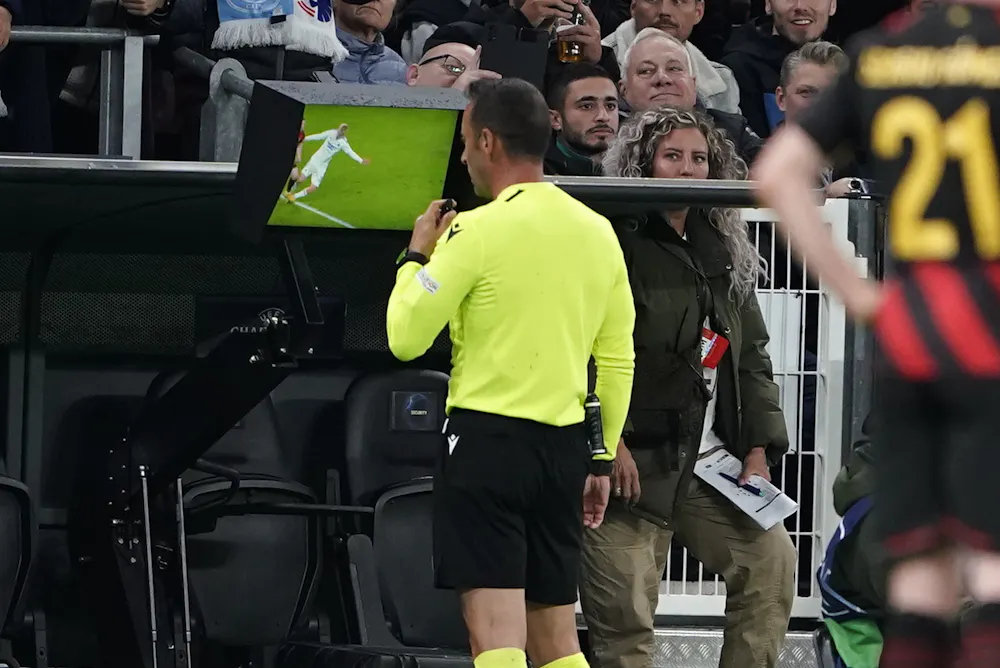
However, the review may also lead the referee to doubt their initial decision, because many incidents are open to interpretation and remain subjective.
At the World Cup, there will be four people on the VAR team. This means there are as many VAR officials as there are officials monitoring the game in person.
Matters of context
In some situations, the VAR team may offer a snippet of slow-motion footage to a referee (usually only seconds long) – which can lack context and miss the nuance of the situation at hand.
In September, a goal was scored in an English Premier League game between Newcastle United and Crystal Palace – and the VAR team immediately asked the referee to review an incident that had occurred just prior to the goal. The ref reviewed a snippet of footage, interpreted it as a foul against the goalkeeper by an attacking player, and disallowed the goal.
Read more: Goal! Or is it? How technology – and not just VAR – is changing sport
However, the snippet didn’t show that the attacker had himself been pushed by a defender, which was why he collided with the goalkeeper. The Professional Game Match Officials Limited later accepted the decision was wrong, but still the goal did not count.
Incidents such as these show how lack of context can result in incorrect decision reversals, because the replay is not necessarily a faithful representation of the action.
Tech problems
In addition to the human component, technology has its fair share of issues.
In an Italian Serie A game between Juventus and Salernitana in September, a goal was disallowed on the basis of a VAR decision – but it turned out the VAR cameras had left a crucial player out of the frame, and the goal should have stood.
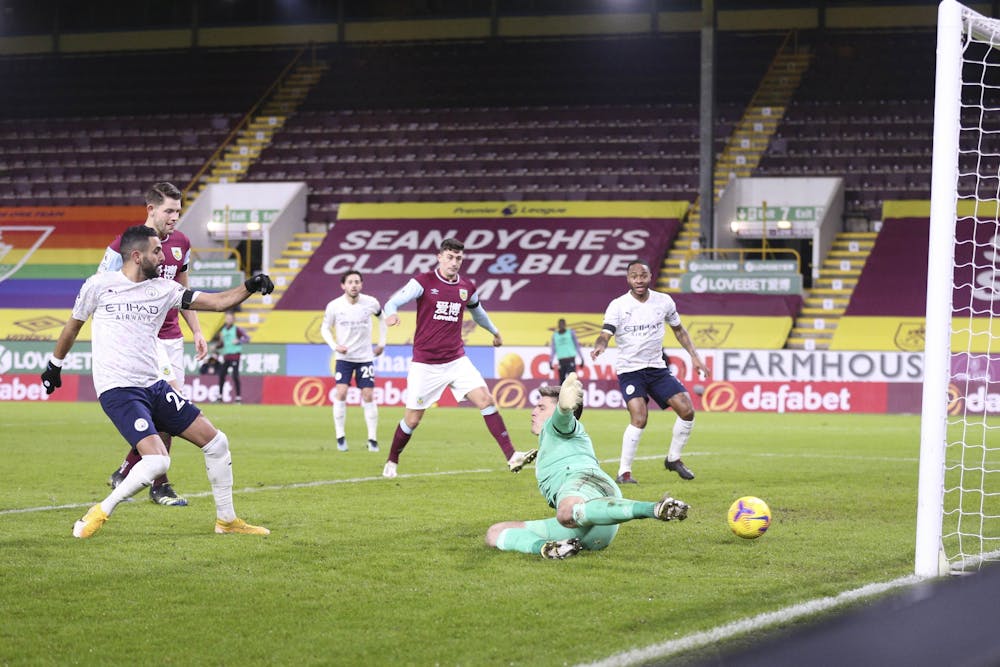 It’s not uncommon for a goal to be disallowed by a VAR decision – and most of the time it’s correct.
Alex Pantling / EPA
It’s not uncommon for a goal to be disallowed by a VAR decision – and most of the time it’s correct.
Alex Pantling / EPA
Another notorious technology failure occurred in a 2020 Premier League game between Aston Villa and Sheffield United: the ball crossed the goal line but, because the goal-line cameras were obstructed by players, it failed to register with the goal decision system. The match officials, not receiving the automatic notification they expected if a goal had been scored, did not award the goal.
What these examples show is that technology struggles to offer answers to inherently messy and subjective matters.
Reality is up for grabs
So, during this World Cup, when a player makes the most of contact in the box and everyone turns to VAR and the referee to make the right decision over whether to give a penalty, it is worth acknowledging that VAR may only provide partial help. Any 50–50 call is debatable, and reality is up for grabs!
These decisions don’t take place in a vacuum. There is an intense interplay between the unfolding of the game (some games are more physical than others), players and coaches (protesting and trying to influence decisions), passionate spectators cheering and protesting, and team dynamics between the referees on the field and the VAR team.
At the World Cup repercussions for errors will be high and the spotlight will shine heavily on VAR. And yet again, a few controversies are likely to overshadow the correct decisions.
Authors: Stan Karanasios, Associate professor, The University of Queensland

















