

Modern Australian
The Times

It's time to add climate change and net-zero emissions to the RBA's top 3 economic goals

  • Written by Toby Phillips, Public Policy Researcher, University of Oxford
It's time to add climate change and net-zero emissions to the RBA's top 3 economic goals

Increasingly, climate change is at the centre of government decision-making.

This year’s federal budget devoted pages to an examination of the fiscal impact of climate change; Treasury has established a climate change modelling unit; and it’ll be front and centre of next year’s intergenerational report.

Yet it is still nowhere near the centre of the deliberations of Australia’s Reserve Bank – one of the nation’s most important economic decision-making institutions.

The Reserve Bank’s enabling legislation is the Reserve Bank Act 1959. That 63-year old legislation requires the bank to make decisions that are directed to the “greatest advantage of the people of Australia” in three specific areas:

  • the stability of the currency of Australia

  • the maintenance of full employment in Australia

  • the economic prosperity and welfare of the people of Australia

The first objective is interpreted in an agreement signed by the treasurer as aiming to get “inflation between 2% and 3%, on average over time”.

The second and third aren’t clearly defined in the agreement, leaving most of the focus on the first.

Climate given second-order status

While it is beyond doubt that the third objective – “economic prosperity and welfare of the people of Australia” – includes a liveable climate and a sustainable environment, not spelling this out relegates climate and sustainability to second-order status as the bank makes decisions.

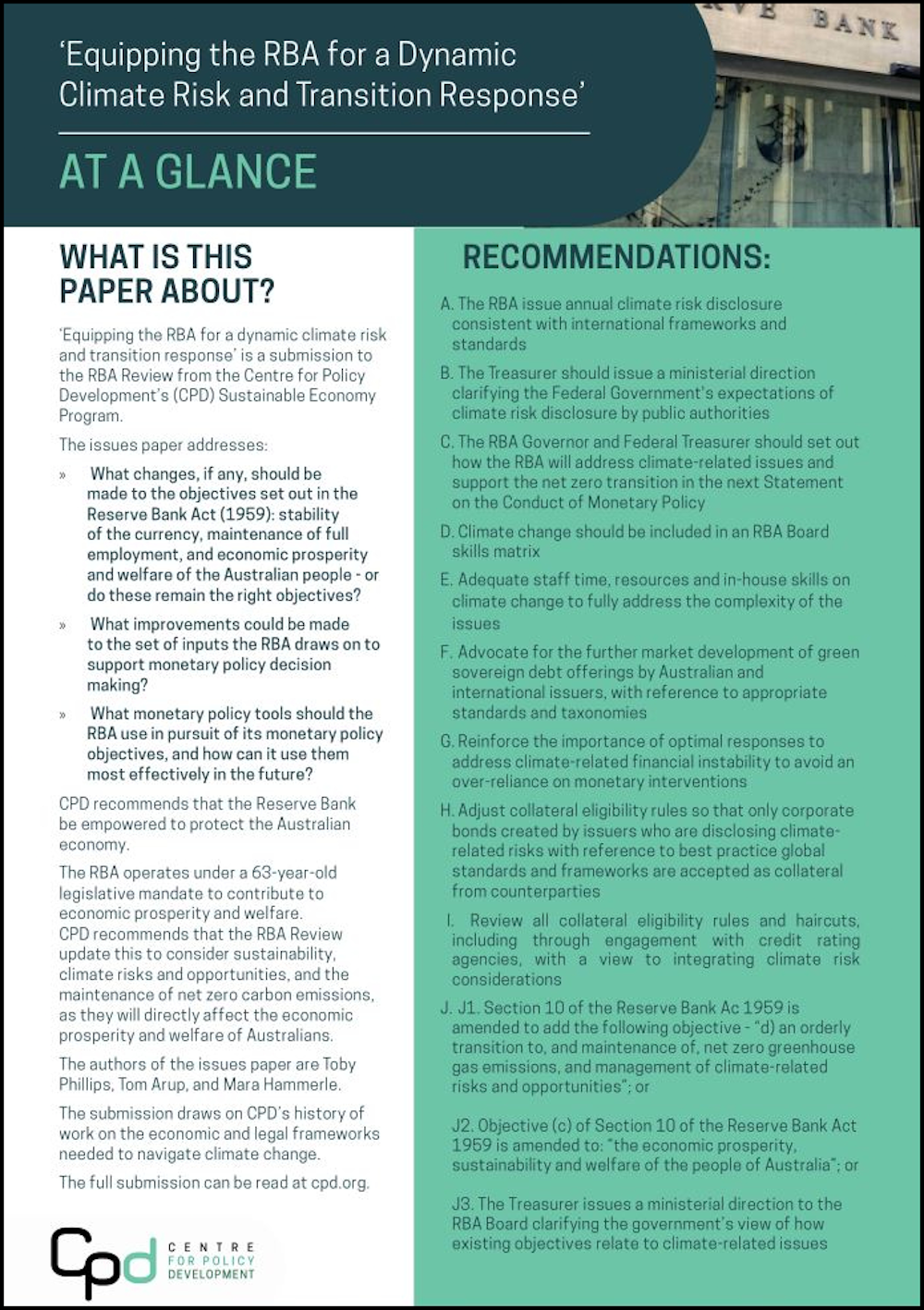
In a submission to the independent review of the bank, set up by the treasurer and due to report in March, I put forward an argument for adding a fourth objective along with my colleagues from the Centre for Policy Development:

  • an orderly transition to, and maintenance of, net-zero greenhouse gas emissions, and management of climate-related risks and opportunities

Should that be seen as too much of a change, we suggest a fallback: adding the word “sustainability” to the existing third objective, making it refer to

  • the economic prosperity, sustainability and welfare of the people of Australia

In addition, our submission asks the government to include in its written directions to the bank a statement setting out the government’s view of the ways in which the bank’s objectives relate to climate change.

What’s the climate got to do with the bank?
Centre for Policy Development Climate change is a first-order financial stability issue and will be the dominant economic theme of this century, due to both the scale of likely damage and the opportunities in the transition to net-zero. The bank needs to build out a more sophisticated toolkit for dealing with the impacts of this transition. The bank’s primary tool – the interest rate – is particularly good at sending signals to the “demand” side of the economy, but climate risks are more likely to present supply-side inflationary shocks. This means an obsessive focus on short-term inflation without considering the transition could be self-defeating, as it might encourage the continued use of fossil fuels even as they play an increasingly less stable and more inflationary role in the economy. One way this could play out would be a decision by the bank to push up interest rates in response to inflation caused by high fossil fuel prices. In turn, this could make it more expensive to invest in renewable energy – the very thing that would decouple prices from fossil fuels. Beyond setting interest rates, a less public part of the Reserve Bank’s role is maintaining liquidity in the financial system by lending to private banks against collateral, some of which includes corporate bonds. The bank can insist on climate risk reporting The international task force on climate-related financial disclosures – which reports to the Bank for International Settlements, of which Australia’s Reserve Bank is a member – is pushing for the standardised reporting of corporate climate risks. If Australia’s Reserve Bank insisted on this from firms whose corporate bonds it held as collateral (as the European Central Bank is planning to), it would help spread awareness of accounting for the importance of accounting for climate risks throughout the financial system. The bank could go further and consider the impact of climate-related risks on expected default rates when assessing the creditworthiness of assets used as collateral, preferencing corporate debt from companies with credible transition plans. The effects of this repricing would ripple through the financial system. Read more: Why it's not anti-environmental to be in favour of economic growth It could even decide to preference government debt from “green sovereigns” (foreign states or Australian states whose activities involve little climate risk) over those of less-green sovereigns by offering differentiated interest rates. In 2019 the Centre for Policy Development hosted a landmark address in which then Reserve Bank Deputy Governor Guy Debelle emphasised the importance of an orderly climate transition to financial stability, saying: decisions that are taken now can have significant effects on future climate trends and can limit or eliminate the ability to mitigate the effect of those trends The Reserve Bank, Australia’s oldest and arguably most important public financial regulator, has the ability to help smooth the transition. An early step would be to update the bank’s 1950s rules, and put beyond doubt that climate change is one of its 21st century responsibilities. Authors: Toby Phillips, Public Policy Researcher, University of Oxford

Read more https://theconversation.com/its-time-to-add-climate-change-and-net-zero-emissions-to-the-rbas-top-3-economic-goals-194068

What’s Trending in Men’s Jewellery This Father’s Day!

Finding a Father’s Day gift that feels personal, stylish and genuinely wearable is not always easy. While socks and novelty mugs have traditionall...

Road Signs: Understanding Their Role in Clear and Effective Signage

Effective signage and display hardware can help businesses communicate information, promote products and organise customer or visitor movement. Road...

Bottle Label Printing: Key Factors to Consider Before Your Next Packaging Run

Effective packaging begins with understanding the product, bottle material, artwork and production requirements when planning bottle label printing. H...

Planning a Long-Distance Move With Interstate Movers Melbourne

Moving between states involves more planning than a typical local relocation. Along with packing and transporting household belongings, you need to...

Understanding the Role of an I/O Controller in Industrial Automation

Modern industrial systems depend on accurate communication between sensors, machines and control systems. An I/O controller can help manage this commu...

How the Right Mining Hose Supports Demanding Operations

Mining environments place considerable demands on equipment used for material transfer, water management and processing. Hoses operating in these co...

Simple Ideas for Making Social Gatherings More Memorable

We have all been to those parties where everyone just stands around the kitchen island, staring at their phones, waiting for someone else to make a mo...

Outdoor Wall Lights: Improving Exterior Lighting Around Your Home

Lighting can influence how a room looks, feels and functions, so the right fitting should be selected according to both appearance and practical req...

Commercial Office Cleaning: Combining Routine Office Cleaning With Melbourne Service

Keeping a workplace clean requires a service that can accommodate everyday tasks as well as the particular needs of the business. Professional comme...

Caravan Sales in Queensland: How to Find the Right Caravan for Sale QLD

Caravan ownership is about more than having somewhere to sleep while travelling. For many Queenslanders, it is one of the best ways to explore regio...

What Sir Walter Buffalo Turf Actually Costs in 2026 (And Why Quotes Vary So Much)

Two quotes landed on a Hills District homeowner's kitchen table last spring for the exact same 80-square-metre backyard. One said $12 a metre. The o...

Nearly 1,300 NSW Hospital Beds Are Occupied By People Who Are Ready To Go Home

1,276 people in NSW hospitals have been medically cleared for discharge but remain in hospital because they're still waiting for NDIS or aged care sup...

National Survey Launched to Measure Operational Impacts of Federal NDIS Policy Reforms

The effects of recent NDIS reforms are beginning to move beyond policy papers and into day to day service delivery. A new national survey is asking ...

Beyond the Nappy Cake: Baby Shower Gifts That Get Used

What new Australian parents unwrap, keep, and quietly thank you for months later. Six weeks after my daughter was born, I did an audit of the baby sh...

Parent-Advocates Are Reshaping Frontline Disability Service Delivery

Parents have always been part of the disability sector. They advocate, coordinate services, challenge decisions and often become the person holding ev...

Vista Cruises Enters "Two-Flagship Era" as Vista Aurora Completes Inaugural Voyage

Vista Aurora Sets Sail along the Yangtze. (Photo courtesy of the company)YICHANG, China — August 5, 2026 — Vista Aurora, a high-end interprovinc...

A Digital Preparation Checklist For International Medical Conferences

An international medical conference compresses many responsibilities into a few days. A delegate may need to present research, move between venues, ...

The Growing Popularity of Lab Grown Diamonds in Sydney and Hong Kong

The diamond industry has changed significantly in recent years as more buyers seek ethical, affordable, and sustainable alternatives to mined diamon...

















