

Ethnic community media can play a key role in a crisis – but it needs our support
- Written by Wilfred Yang Wang, Lecturer in Media & Communications Studies, The University of Melbourne

The recent Who Gets to Tell Australian Stories? report on diversity in Australian newsrooms revealed some grim, but unsurprising figures. The report found most television news and current affairs presenters on major Australian free-to-air networks are Anglo-Celtic. So too were most senior network news editors.
One part of this problem is a lack of representation of Asian people in Australian mainstream newsrooms.
Despite (or perhaps because of) this, ethnic media outlets have proved indispensable to Australia’s media landscape. For example, the first two years of the pandemic showed the crucial role ethnic media outlets can play keeping Australians informed in a crisis.
So what now? How can ethnic media be supported to continue to inform Australians, and how might mainstream media need to change to better serve these communities? Drawing on our research on Chinese and Sri Lankan communities in Australia, here are some possible paths ahead.
Read more: How can we stop fake election news spreading in migrant communities?
Older migrants are online and looking for information
Our research focused on older people, who are often assumed to be not particularly active online. But that’s not the case.
Older Australians have embraced digital technologies and research has shown many older Asian migrants use digital media. This is certainly true among older members of Chinese and Sri Lankan communities we spoke with.
Our interviews with older Chinese and Sri Lankan migrants in Melbourne revealed nearly all had more than one digital device. Nearly all used social media to connect with friends and family in Australia and abroad.
Most didn’t get news and information from mainstream media outlets, with the exception of SBS’s in-language radio programs. But many didn’t know these programs also distribute news content on Facebook (in Sinhala and Chinese), WeChat (in Mandarin) and Telegram (in Cantonese). Our participants instead frequently accessed news from community Facebook groups, WhatsApp groups and WeChat news accounts.

During the early part of the pandemic, many actively sought news and health information about COVID through traditional and digital news platforms. But our participants reported it was ethnic community media that played a central role keeping these Australians informed. These included media outlets such as Today Media and YeeYi Australia on WeChat, and Sri Lankan online community news media outlets such as Pahana and Aus News Lanka on Facebook.
All our Sri Lankan interviewees spoke fluent English and used Facebook, but felt Australian mainstream media did not satisfy their news needs. Instead, they preferred media sources attuned to their cultural contexts, which often included narrative and storytelling forms of reportage.
The ABC and The Australian have started to offer news services in Chinese (ABC also has Indonesian and Pidgin). But they tend to distribute these daily news updates via Facebook and Twitter. None of our Chinese participants used these platforms. Both ABC and The Australian have WeChat accounts but they are not updated daily. Only SBS Mandarin uses WeChat to provide daily updates about news and current affairs.
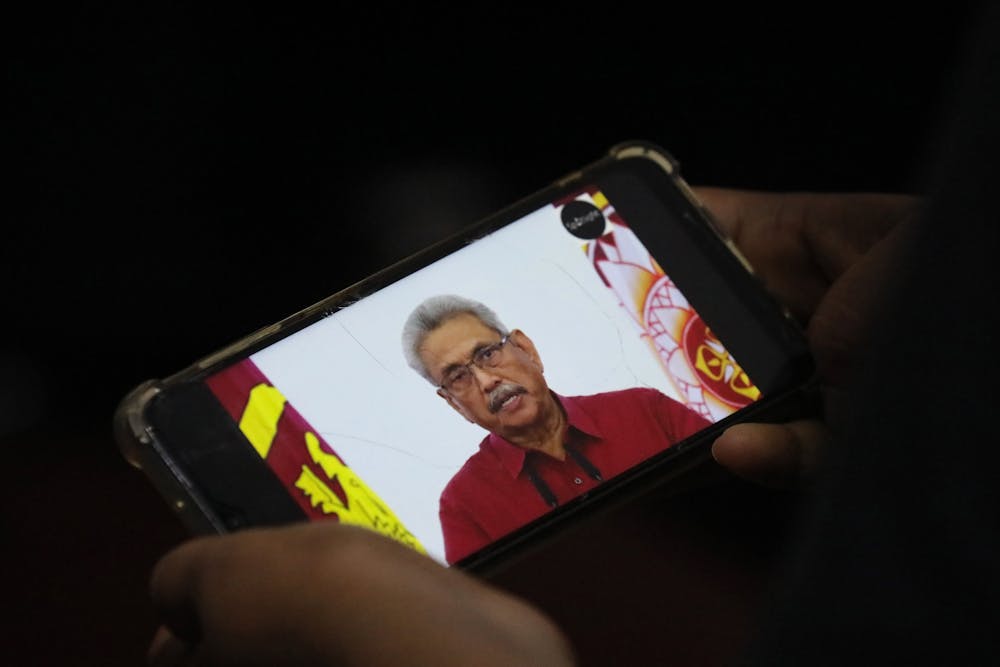 We found older Sri Lankan migrants in Australia are online and looking for news and current affairs information.
CHAMILA KARUNARATHNE/EPA
We found older Sri Lankan migrants in Australia are online and looking for news and current affairs information.
CHAMILA KARUNARATHNE/EPA
A greater role
COVID serves as an example of the role ethnic media outlets can play in keeping Australians informed but it is far from the only challenge facing Australia.
Victoria’s recent flooding crisis, for example, saw culturally and linguistically diverse communities negatively impacted by the absence of good systems to communicate important information quickly.
In future, perhaps governments and other authorities could engage Chinese and Sri Lankan community and ethnic media organisations to produce and disseminate disaster materials in language. A lack of engagement with ethnic media risks fuelling distrust of Australian authorities and creates the conditions under which misinformation can flourish.
Government and disaster authorities could consider creating registers of locally-based ethnic language media outlets (both digital and non-digital). These outlets could be briefed and called upon to spread important information when disaster strikes.
Governments could also consider funding training for staff working in ethnic media. Training could cover issues such as ethics, journalism codes of conduct, Australian media law, and ways to collaborate with their colleagues working in mainstream media.
There’s a role to play for mainstream media too. These organisations and their journalists should consult closely with migrant cultural associations to enable culturally inclusive coverage and the distribution of content that’s relevant to these communities.
Finally, governments should have a systematic approach to collaborating with ethnic language media to provide accurate, timely and culturally and linguistically accessible content to diverse communities during major public incidents.
Read more: Migrant communities keep our cemeteries alive as more Anglo-Australians turn to cremation
Authors: Wilfred Yang Wang, Lecturer in Media & Communications Studies, The University of Melbourne

















