

A China-backed dam in Indonesia threatens a rare great ape – and that's just the tip of the iceberg
- Written by Divya Narain, PhD Candidate, The University of Queensland
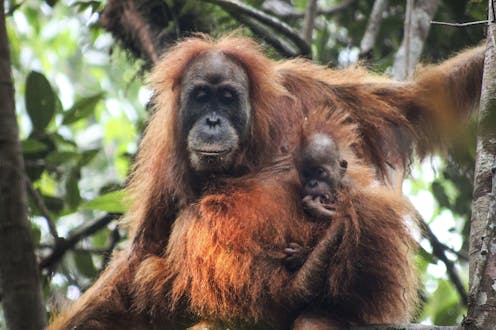
In 2017, scientists described a new species of great apes – the Tapanuli orangutan. The species, found in the Batang Toru ecosystem of North Sumatara, Indonesia was listed as critically endangered soon after.
The population of the species has declined by 83% over the past 75 years, largely due to hunting and habitat loss. Just 800 Tapanuli orangutans remain – and their last known habitat is threatened by a slew of infrastructure projects.
Chief among them is the Chinese-funded Batang Toru hydropower dam, which threatens to fragment and submerge a large chunk of the orangutan’s habitat. The project is just one of a staggering 49 hydropower dams China is funding: mostly across Southeast Asia, but also in Africa and Latin America.
In new research, my colleagues and I show the substantial risk to biodiversity posed by the sheer number of Chinese-funded dams. And yet, environmental regulation of these projects has serious flaws.
Big dams, big risks
Hydropower is expected to be an important part of the global renewable energy transition. But the technology brings environmental risks. Dams disrupt the flow of rivers, altering species’ habitat. And dam reservoirs inundate and fragment habitats on land.
Traditionally, financing of hydropower projects in low-income countries was the preserve of Western-backed multilateral development banks. China has now emerged as the biggest international financier of hydropower under its overseas infrastructure investment program, the Belt and Road Initiative.
Yet little is known about the scale of China’s hydropower financing or the biodiversity risks it brings. Whether adequate safeguards are applied to the projects by Chinese and host country regulators is also poorly understood. Our research attempted to remedy this.
We found China is funding 49 hydropower dams in 18 countries including Myanmar, Laos and Pakistan.
The dams are likely to impede the flow of 14 free-flowing rivers, imperilling the species they harbour. The first dam on a free-flowing river is akin to the proverbial “first cut” of a road into an intact forest ecosystem, causing disproportionate harms to biodiversity.
We also found Chinese-funded dams overlap with the geographic ranges of 12 critically endangered freshwater fish species, including the iconic Mekong Giant Catfish and the world’s largest carp species, the Giant Barb. The dams exacerbate the threats to these species and may push them closer to extinction.
Almost 135 square kilometres of critical habitat on land is also likely to be inundated and fragmented by the dams and their reservoirs.
Read more: The hydropower industry is talking the talk. But fine words won't save our last wild rivers
Lax environmental rules
Despite the biodiversity risks, we found serious gaps in the environmental rules applied to Chinese-funded dams.
A previous analysis found six Chinese state-owned banks – which together contribute most financing for Belt and Road projects – had no safeguard standards to limit biodiversity damage.
Complementing this analysis, our investigation found Chinese regulators also did not require hydropower projects to mitigate environmental damage. Some regulator policies, however, contained non-binding guidelines.
A number of Chinese government policies defer to host country laws on environmental protection. But our investigation found in most countries where the dams are being built, regulation to limit environmental harms was absent or still developing.
This poor governance leaves species and ecosystems in these countries vulnerable to environmental damage from dams.
A spotlight on Sumatra
The Batang Toru dam aims to bolster North Sumatra’s energy supplies. Its proponents say the dam uses environmentally-friendly technology that requires only a small area to be flooded.
Two multilateral development banks, however, distanced themselves from the project after concerns were raised about potential impact on the Tapanuli orangutan. The Chinese state-owned Bank of China also withdrew its finance offer after international protests. Chinese financier SDIC Power Holdings then stepped in to fund it.
Habitat destruction has confined the few remaining Tapanuli orangutans to a fragmented 1,400 square kilometre tract of rainforest in North Sumatra. Scientists say the Batang Toru dam further threatens this habitat.
Constructing the dam requires digging a tunnel in an area where most Tapanuli orangutans live. Experts also say the project will permanently isolate sub-populations of the species, increasing the risk of extinction.
The case illustrates the potential destruction hydropower projects can cause in the absence of appropriate planning and safeguards.
Read more: Orangutans: could 'half-Earth' conservation save the red ape?
Need for holistic planning
The sheer number of Chinese-funded dams presents significant biodiversity risks. It also presents an opportunity.
China is funding several hydropower projects in single river basins. This puts it in an advantageous position to carry out “basin-scale planning”.
This involves making decisions about dams not based solely on an individual project, but by considering it in the context of other projects within the basin, as well as in the broader context of communities and the environment.
This type of planning also means dams can be configured to have the least impact on critically endangered species, and other irreplaceable and vulnerable biodiversity elements.
Such “system scale” planning is a key recommendation of international initiatives such as the World Commission on Dams and the European Union’s Water Framework Directive.
It also involves determining whether a proposed dam is the best way to meet energy needs, or if alternatives – such as wind or solar – could do so with lower environmental risks.
In the case of the Batang Toru dam, a 2020 report by a leading international consulting firm found the dam would not “materially improve access to nor the regularity of power supply” in North Sumatra, which in fact had a power surplus.
Given the huge damage dams can cause to biodiversity, it is crucial that only those dams that are really needed get built – and any associated damage is minimised.
The many Chinese-funded dams on the horizon must undergo rigorous vetting if serious biodiversity damage is to be averted.
Read more: Why conservation areas are not living up to their potential in Indonesia
Authors: Divya Narain, PhD Candidate, The University of Queensland

















