

Half of Australia's biggest companies have net-zero emissions plans, but climate action may come too late
- Written by Tom Wainwright, System lead - Sustainable Corporates, Monash University
About half of Australia’s biggest listed companies have plans to reach net-zero greenhouse gas emissions, our new analysis has found.
We assessed the climate change commitments of 187 companies out of 200 listed on the Australian Stock Exchange – the ASX200. Together, these 187 companies produce 32% of Australia’s operational emissions – that is, emissions produced directly from a business’ operations or from the use of its energy products.
The net-zero plans represent a significant step for climate change action in Australia.
Property developer Lendlease, for example, aims to achieve absolute zero carbon by 2040. Fortescue Metals Group, meanwhile, plans to reach net-zero emissions along its entire value chain by 2040.
But more must be done by Australian companies.
Importantly, the net-zero plans we identified typically don’t include all emissions associated with a business’ operations, such as fossil fuel burned by customers. And much of the action promised will come too late to avert catastrophic global warming.
Comparing commitments
Meeting the Paris Agreement goal of limiting global warming to 1.5℃ is imperative if we’re to avoid the worst effects of climate change.
So, we set out to examine whether the net-zero corporate commitments of some of Australia’s biggest companies were in line with the crucial 1.5℃ goal, as well as three best practice principles:
a net-zero commitment by or before 2050
at least one appropriate and ambitious short or medium-term target
address scope 3 emissions.
We collected data in March and in November this year on the 187 ASX200 companies with operations in Australia. Our data coverage doesn’t extend beyond Australia’s borders.
We examined three types of emissions:
- Scope 1: those directly generated by a company’s operations, such as a steel manufacturer burning fuel on site in its blast furnace
- Scope 2: indirect emissions occurring from energy purchased and used by a company
- Scope 3: indirect emissions along the wider value-chain, which includes the raw materials required to make a product, transporting it, and emissions caused by others using the product.
From the March data, we found 84 of the 187 ASX200 companies had net-zero targets for scope 1 and 2 emissions. Some 96% of these emissions were covered by the targets. And 68% of these were covered by 1.5℃-aligned targets.
Of the 187 companies assessed, 100 had no net-zero commitment. But many of these were in relatively low-emitting sectors, such as communications, and hotels and restaurants.
Read more: Why it doesn't make economic sense to ignore climate change in our recovery from the pandemic
Most technology solutions required to decarbonise these sectors are already commercially viable, such as switching to renewables and increasing energy efficiency. But without action, emissions from these sectors are expected to rise.
Scope 3 emissions can be trickier to measure and address because a company has less visibility and influence over their suppliers and customers. Only 92 of the companies we assessed disclosed any scope 3 data. Of these, 21 companies had a net-zero target and only 16 were 1.5℃-aligned.
This means 71% of reported scope 3 emissions were not covered by net-zero commitments. Given scope 3 emissions typically comprise more than two-thirds of an organisation’s emissions overall, this is significant.
We similarly noted a lack of short (2022-2025) and medium-term (2026-2039) commitments. This means a lot of the promised action would come too late this decade to keep the goal of 1.5℃ alive.
Only 57 companies assessed had any interim emissions reduction targets for scope 1 and 2 emissions, and only 33 had 1.5℃-aligned interim targets.
This implies the ASX200 is overspending its carbon budget by 36%. A carbon budget is how much carbon can still be released into the atmosphere before we exceed a global warming threshold, in this case 1.5℃.
Momentum is gathering
We tracked the progress of these companies up until last month – and saw notable momentum compared to the March data.
As at November, 23 of Australia’s largest companies had all emissions under 1.5℃-aligned, net-zero targets. This represents a 44% increase since March.
There was a 40% increase in scope 3 net-zero targets, all of which were 1.5℃-aligned. And 20-30% more companies had interim targets.
For example, Origin Energy is responsible for approximately 10% of the ASX200 reported scope 3 emissions. It now aims to reach net-zero across all emissions scopes by 2050.
Overall, this means 62% of emissions reported by the companies studied are covered by some sort of net-zero target, up from 56% of reported emissions in March.
The resulting estimated carbon budget overspend for scope 1 and 2 emissions is 24%. This is a significant reduction from 36% in March.
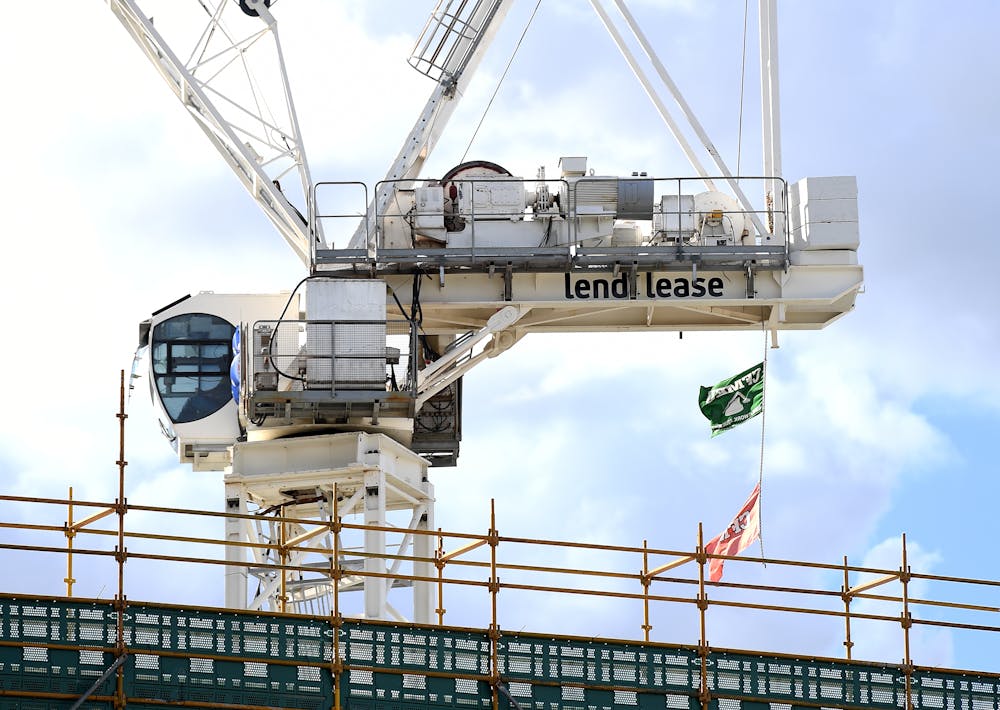 Lendlease aims to achieve absolute zero carbon by 2040.
AAP Image/Dave Hunt
Lendlease aims to achieve absolute zero carbon by 2040.
AAP Image/Dave Hunt
We need strong commitments from everyone
The momentum in the last six months demonstrates increasing corporate confidence, willingness, and an understanding of what’s required to reach net-zero emissions.
But 38% of reported ASX200 emissions are not yet covered by net-zero commitments. And it’s fair to assume that more emissions have not been disclosed.
Australian companies stand to benefit from the transition to clean energy, thanks to the continent’s wealth of natural resources, like sun, wind, and critical minerals. There’s much opportunity for companies to dial up their ambition, particularly in the energy sector where solutions are readily available today.
The costs of not acting strongly are tangible. The analysis highlights the importance of transparent reporting to track progress and hold companies accountable.
If Australia’s leading corporations don’t fully disclose their emissions, they risk exposing themselves to hardening consumer, investor and regulator expectations. For example, scope 3 emissions are the largest source of emissions, yet they’re the least reported.
Read more: 'Toxic cover-up': 6 lessons Australia can draw from the UN's scathing report on greenwashing
To avoid accusations of greenwashing, companies must go beyond setting targets. Any commitment needs to be backed up by a robust strategy, followed by demonstrable action and investment to give us confidence that it can be met.
This is the crucial decade for climate action. The recent momentum towards 1.5℃ shown by Australia’s leading corporations provides evidence they recognise the importance of this goal, and can see a path to get there.
Hopefully, the momentum translates to tangible progress, where Australia’s largest and most influential companies bring their peers and value chains along with them to a low-emissions future.
Authors: Tom Wainwright, System lead - Sustainable Corporates, Monash University

















