

Kim Mahood's Wandering with Intent redefines the Australian frontier
- Written by Tony Hughes-d'Aeth, Professor, Chair of Australian Literature, The University of Western Australia
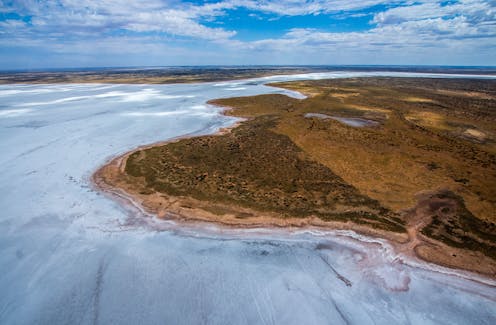
Kim Mahood came to prominence with the publication of her first book, Craft for a Dry Lake (2001), which detailed her efforts to reconnect with the land of her upbringing, a cattle station in the Tanami Desert.
Her journey was triggered by the death of her father, who was killed in a helicopter accident while out mustering in 1990. Craft for a Dry Lake is a mesmerising and prismatic account of a journey that folds together the author’s memories and her father’s letters and records. It is one of the defining works of memoir in Australian letters.
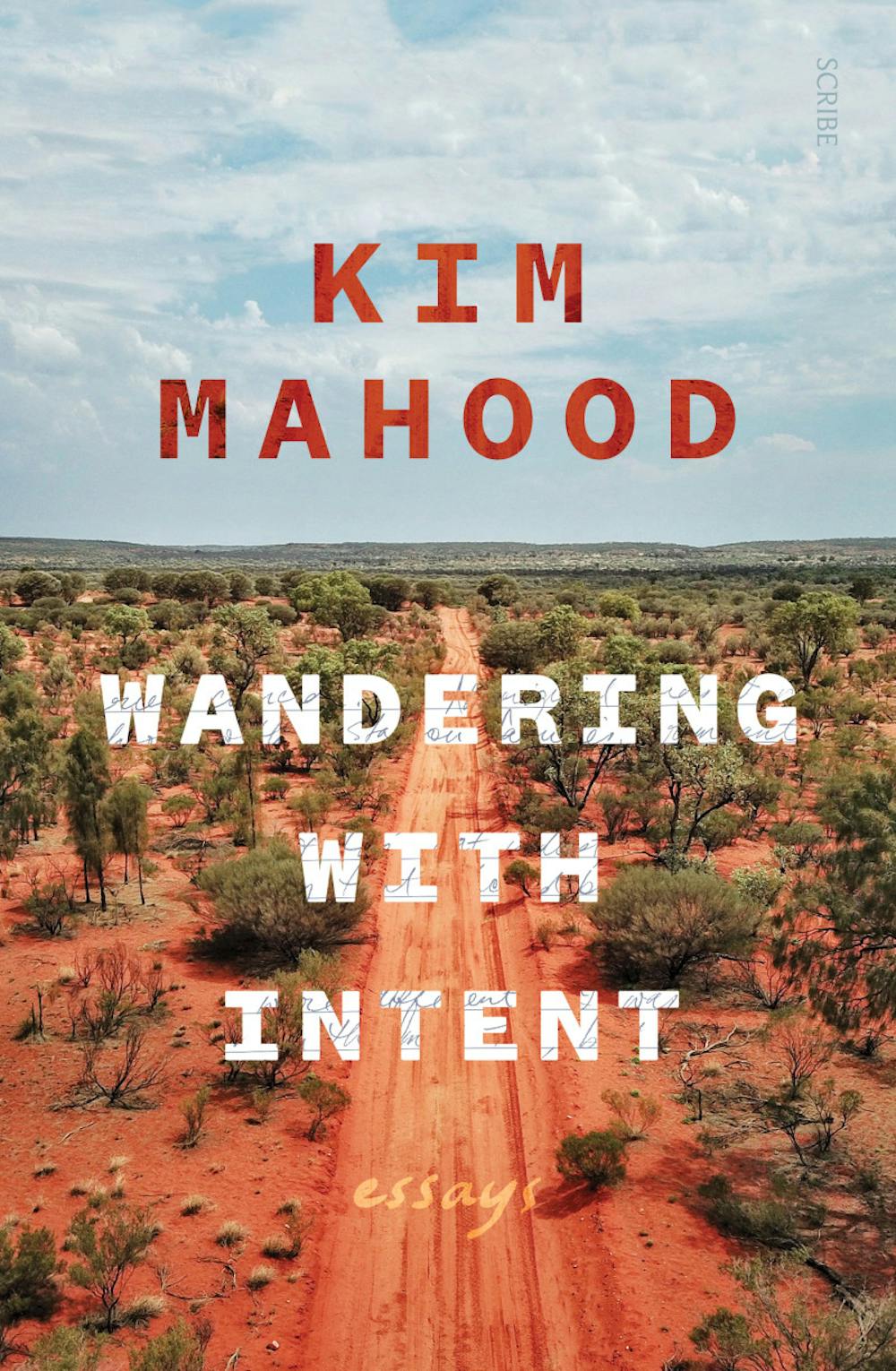
Review: Wandering with Intent: Essays - Kim Mahood (Scribe).
 Kim Mahood.
Scribe
Read more:
The case for Kim Scott's That Deadman Dance
‘Ground truthing’ and ‘deep mapping’
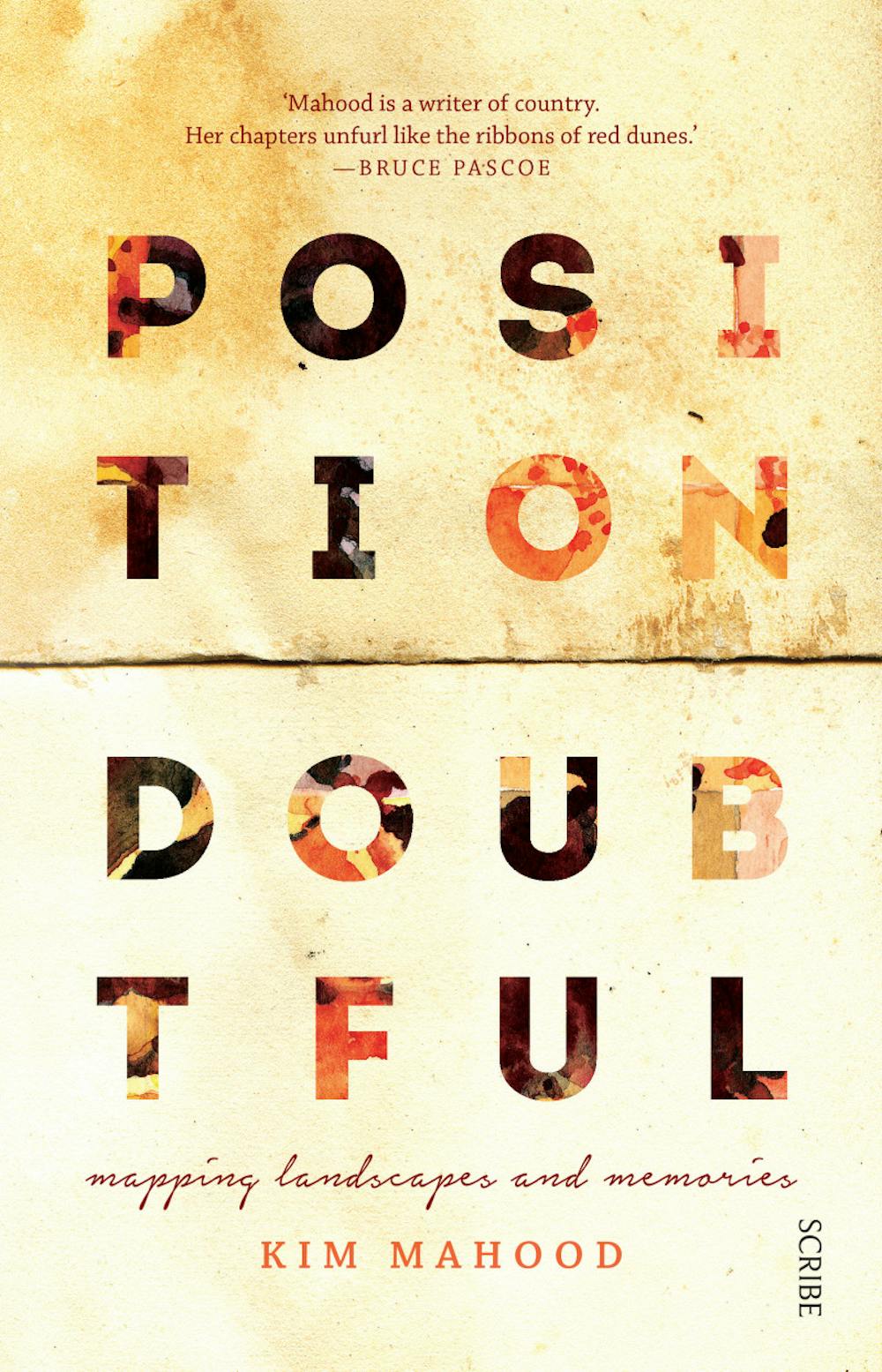
Wandering with Intent is Mahood’s third book – a collection of essays, some new, others originally published in Griffith Review, The Monthly, and Best Australian Essays. Where Position Doubtful was ostensibly a work of map-making, Wandering with Intent finds Mahood reflecting on the kinds of maps she finds herself trying to make.
They begin with Indigenous people, whose knowledge exercises a dimension of truth that will often elude the most accurate of maps. Like writer and academic Paul Carter, Mahood settles on the concept of “ground truthing” to suggest that maps only gather their truth when they are forced to collide with the memories and understanding of people who live on the ground – that is to say, somewhere other than the Cartesian plane of the mind’s virtual map.
My version of ground truthing begins with the physical attributes of place, and moves onto what has happened there. It puts people into place, which brings into play science, stories, husbandry, history, metaphor, and myth. This form of mapping has been called various things — co-mapping, cross-cultural mapping, counter-mapping, radical cartography. The wordsmith in me likes the flamboyant suggestiveness of radical cartography, but my bullshit detector finds it pretentious. There’s nothing radical about what I do. The only surprising thing about it is that it hasn’t been done before.
In North America, the kind of cartography that Mahood is engaged in is sometimes called “deep mapping”, following the seminal work of historian William Least Heat-Moon. The concept has been picked up more recently in Britain and Australia.
Kim Mahood.
Scribe
Read more:
The case for Kim Scott's That Deadman Dance
‘Ground truthing’ and ‘deep mapping’
Wandering with Intent is Mahood’s third book – a collection of essays, some new, others originally published in Griffith Review, The Monthly, and Best Australian Essays. Where Position Doubtful was ostensibly a work of map-making, Wandering with Intent finds Mahood reflecting on the kinds of maps she finds herself trying to make.
They begin with Indigenous people, whose knowledge exercises a dimension of truth that will often elude the most accurate of maps. Like writer and academic Paul Carter, Mahood settles on the concept of “ground truthing” to suggest that maps only gather their truth when they are forced to collide with the memories and understanding of people who live on the ground – that is to say, somewhere other than the Cartesian plane of the mind’s virtual map.
My version of ground truthing begins with the physical attributes of place, and moves onto what has happened there. It puts people into place, which brings into play science, stories, husbandry, history, metaphor, and myth. This form of mapping has been called various things — co-mapping, cross-cultural mapping, counter-mapping, radical cartography. The wordsmith in me likes the flamboyant suggestiveness of radical cartography, but my bullshit detector finds it pretentious. There’s nothing radical about what I do. The only surprising thing about it is that it hasn’t been done before.
In North America, the kind of cartography that Mahood is engaged in is sometimes called “deep mapping”, following the seminal work of historian William Least Heat-Moon. The concept has been picked up more recently in Britain and Australia.
 In Wandering with Intent, we see Mahood describe and reflect on some of the deep mapping projects she has been involved in. These have included working with the Martu people of the east Pilbara in their exhibition We Don’t Need a Map (2012) and the National Museum of Australia on their Songlines: Tracking the Seven Sisters (2017) exhibition. That Indigenous art functions as a map is one of the intriguing lines of argument in this book.
In explaining the title of her previous book, Mahood notes that “position doubtful” is an epithet that often attaches to points on the sketchy maps of desert Australia. In doing so, she lays the emphasis on the epistemological uncertainty that marks the limits of a map’s purported knowledge.
In this latest collection, however, Mahood openly concedes that it is really her own position, and that of anyone who ventures to stand where she does – which is in doubt. She had always been aware that she walked, in her life and her writing, a particular edge.
But the edge I walked when writing about my interactions with the people and country that occupied such a significant place in my life was getting thinner and sharper. It had always been necessary to filter what I wrote through a lens of white readership for whom the remote Indigenous world represented everything from a utopian idyll to a wretched dystopia, but so far I’d managed to meet my own standards of truth-telling. This was becoming more and more difficult to do.
As this edge narrows and sharpens, it begins to resemble what it was once called, which is a frontier. The concept of the frontier is inherently imperial, insofar as it invokes the current extent of conquest. But frontiers have always been places of interchange, where overt power disparities often come disquietingly undone.
Read more:
Australian literature’s legacies of cultural appropriation
Politics and administration
This is what Mahood’s writing is so good at showing. Among the essays included in Wandering with Intent are contemporary classics such as Blow-ins on the Cold Desert Wind (2007) and Kartiya are like Toyotas: White Workers on Australia’s Cultural Frontier (2012), both originally published in Griffith Review. These essays depict the structural confusion that exists in remote communities in the Western Desert, where Indigenous people live in their evolving worlds next to the agencies of Australian government.
In Wandering with Intent, we see Mahood describe and reflect on some of the deep mapping projects she has been involved in. These have included working with the Martu people of the east Pilbara in their exhibition We Don’t Need a Map (2012) and the National Museum of Australia on their Songlines: Tracking the Seven Sisters (2017) exhibition. That Indigenous art functions as a map is one of the intriguing lines of argument in this book.
In explaining the title of her previous book, Mahood notes that “position doubtful” is an epithet that often attaches to points on the sketchy maps of desert Australia. In doing so, she lays the emphasis on the epistemological uncertainty that marks the limits of a map’s purported knowledge.
In this latest collection, however, Mahood openly concedes that it is really her own position, and that of anyone who ventures to stand where she does – which is in doubt. She had always been aware that she walked, in her life and her writing, a particular edge.
But the edge I walked when writing about my interactions with the people and country that occupied such a significant place in my life was getting thinner and sharper. It had always been necessary to filter what I wrote through a lens of white readership for whom the remote Indigenous world represented everything from a utopian idyll to a wretched dystopia, but so far I’d managed to meet my own standards of truth-telling. This was becoming more and more difficult to do.
As this edge narrows and sharpens, it begins to resemble what it was once called, which is a frontier. The concept of the frontier is inherently imperial, insofar as it invokes the current extent of conquest. But frontiers have always been places of interchange, where overt power disparities often come disquietingly undone.
Read more:
Australian literature’s legacies of cultural appropriation
Politics and administration
This is what Mahood’s writing is so good at showing. Among the essays included in Wandering with Intent are contemporary classics such as Blow-ins on the Cold Desert Wind (2007) and Kartiya are like Toyotas: White Workers on Australia’s Cultural Frontier (2012), both originally published in Griffith Review. These essays depict the structural confusion that exists in remote communities in the Western Desert, where Indigenous people live in their evolving worlds next to the agencies of Australian government.
 What Mahood is able to depict, often with a brilliant comic eye, are the fundamental dilemmas that beset those who take on the jobs of administering “government services” in remote communities. She also dramatises the fundamental mismatch that often accompanies these daily encounters. It turns out that what local Indigenous people want is often rather different from the desires of Australian governance – even as the latter swing around with the winds of policy and the gusts of politics.
Compromises are reached, bargains are struck, deals broken, items lent and lost, compensations offered and on it goes. For Indigenous people, this is just the accepted texture of life, but for the interloping administrators – health workers, schoolteachers, police – this is often a source of profound disillusionment. They feel betrayed. But how is it that the coloniser has become the victim?
Mahood should be commended for openly depicting these situations and her work is essential reading for anyone who wishes to understand how the Australian frontier is by no means a thing of the past. The more romantic moments of her early memoir writing have been gradually washed away by her willingness to take seriously the present moment – to live it, in short.
In someone with less practical wisdom, cynicism would have taken hold. Indeed, at times Mahood seems haunted by the ghost of Heriot, the disillusioned priest in the Kimberley mission of Randolph Stow’s To the Islands (1958). Both Mahood and Stow had left childhoods forged with the image of station life to board at Perth’s prestigious private schools in the postwar years.
Unlike Heriot, however, Mahood does not fall into metaphysical crisis. Nor does she abandon a sense of the depth of desert life and culture. She knows that her profundity is not the same as that of her Indigenous companions, yet intuiting that it is only in taking seriously both the practicalities and profundities of life that something meaningful might be forged.
I write about what happens at the point of intersection, where traditional culture is still strong, where whites are in the minority but occupy most of the official positions, and where the unfolding narrative is complicated, nuanced, and evolving […]
That I exercise cultural privilege when writing about the desert Aboriginal people is a given. The question is whether I exercise this privilege in a way that can be justified. I have been grappling with this conundrum since I began writing, and it never gets any easier.
Authors: Tony Hughes-d'Aeth, Professor, Chair of Australian Literature, The University of Western Australia
What Mahood is able to depict, often with a brilliant comic eye, are the fundamental dilemmas that beset those who take on the jobs of administering “government services” in remote communities. She also dramatises the fundamental mismatch that often accompanies these daily encounters. It turns out that what local Indigenous people want is often rather different from the desires of Australian governance – even as the latter swing around with the winds of policy and the gusts of politics.
Compromises are reached, bargains are struck, deals broken, items lent and lost, compensations offered and on it goes. For Indigenous people, this is just the accepted texture of life, but for the interloping administrators – health workers, schoolteachers, police – this is often a source of profound disillusionment. They feel betrayed. But how is it that the coloniser has become the victim?
Mahood should be commended for openly depicting these situations and her work is essential reading for anyone who wishes to understand how the Australian frontier is by no means a thing of the past. The more romantic moments of her early memoir writing have been gradually washed away by her willingness to take seriously the present moment – to live it, in short.
In someone with less practical wisdom, cynicism would have taken hold. Indeed, at times Mahood seems haunted by the ghost of Heriot, the disillusioned priest in the Kimberley mission of Randolph Stow’s To the Islands (1958). Both Mahood and Stow had left childhoods forged with the image of station life to board at Perth’s prestigious private schools in the postwar years.
Unlike Heriot, however, Mahood does not fall into metaphysical crisis. Nor does she abandon a sense of the depth of desert life and culture. She knows that her profundity is not the same as that of her Indigenous companions, yet intuiting that it is only in taking seriously both the practicalities and profundities of life that something meaningful might be forged.
I write about what happens at the point of intersection, where traditional culture is still strong, where whites are in the minority but occupy most of the official positions, and where the unfolding narrative is complicated, nuanced, and evolving […]
That I exercise cultural privilege when writing about the desert Aboriginal people is a given. The question is whether I exercise this privilege in a way that can be justified. I have been grappling with this conundrum since I began writing, and it never gets any easier.
Authors: Tony Hughes-d'Aeth, Professor, Chair of Australian Literature, The University of Western Australia 
















