

Australia announces 'Magnitsky' sanctions against targets in Russia and Iran. What are they and will they work?
- Written by Amy Maguire, Associate Professor in Human Rights and International Law, University of Newcastle
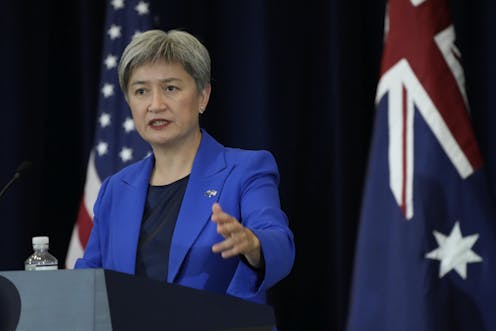
Foreign Affairs Minister Penny Wong chose Human Rights Day to announce Magnitsky-style sanctions against 13 Russian and Iranian individuals and two entities, in response to egregious human rights abuses.
Wong has described these sanctions as a means of holding human rights abusers to account, in situations where dialogue has proven ineffective.
What are Magnitsky sanctions?
Magnitsky sanctions are named after Sergei Magnitsky, a Russian lawyer who was killed in prison for exposing corruption. Unlike more traditional sanctions targeting nation states, Magnitsky sanctions freeze the assets of targeted individuals and prevent them from travelling freely.
Sanctions are a well-known tool of the modern international legal system. They are referenced in Article 41 of the United Nations Charter, in the context of the Security Council’s role to protect international peace and security.
The Security Council may decide what measures not involving the use of armed force are to be employed to give effect to its decisions, and it may call upon the Members of the United Nations to apply such measures. These may include complete or partial interruption of economic relations and of rail, sea, air, postal, telegraphic, radio, and other means of communication, and the severance of diplomatic relations.
The trade and financial embargo imposed on Iraq following its 1990 invasion of Kuwait was a prominent example of such sanctions. But sanctions against nation states may be blunt instruments impacting far beyond those responsible for violations of international law. The sanctions against Iraq under Saddam Hussein had dire humanitarian impacts for the Iraqi population.
Magnitsky sanctions are novel in comparison - they target individuals and entities accused of perpetrating human rights abuses. The goal is to have a deterrent effect on the type of human rights abuser who funnels and flaunts wealth around the globe and offers support to corrupt and aggressive regimes.
Human rights barrister Geoffrey Robertson has described Magnitsky sanctions as a “Plan B” for human rights. He envisages widespread cooperation among nation states to ostracise “people obnoxious enough to bear responsibility for torture and mass murder or for making massive profits out of child labour or modern slavery”. He writes:
International criminal law may not work well, but lists of particularly bad people, declared as such by tribunals of like-minded nations, checking and adopting each other’s decisions, would produce an international rogues’ gallery of people and companies to be denied entry and denied access to services and financial facilities.
Magnitsky sanctions under Australian law
The Australian government has had the power to issue autonomous sanctions since parliament passed the Autonomous Sanctions Act in 2011. These are sanctions imposed by Australia unilaterally, rather than through the United Nations.
In 2021, parliament amended this legislation to include Magnitsky-style sanctions powers.
These new powers permit the Australian government to issue “thematic sanctions”. These are sanctions that target particular issues, including serious human rights abuses, threats to international peace and security, and malicious cyber activities.
Australia first imposed Magnitsky sanctions in March this year. These targeted 39 Russian individuals who Australia held responsible for the corruption that Magnitsky exposed or for his torture and death.
But earlier this week, Australia was criticised for failing to use its Magnitsky powers since the initial announcement in March. Human Rights Watch called on Australia to coordinate with other nations and ensure the widest possible net is cast around human rights abusers.
Targets of Australia’s second round of Magnitsky sanctions
Australia’s Consolidated List of targets has not yet been updated to show all those sanctioned on December 10.
Wong noted some targets are complicit in the oppression of the people of Iran and recent violent crackdowns on protesters. Six Iranian individuals have been sanctioned, including Hossein Ashtari - commander-in-chief of the Iranian police. Australia also sanctioned the Basij Resistance Force and Iran’s hardline “morality police”.
Read more: What are Iran's morality police? A scholar of the Middle East explains their history
Other targets include seven individuals Australia identifies as connected to the attempted assassination of Russian former opposition leader, Alexei Navalny.
Beyond the human rights context, Australia is also targeting Iranian individuals and entities supplying drones to Russia for use in its illegal war in Ukraine.
Wong said:
The Australian Government calls on countries to exert their influence on Russia to end its illegal, immoral war. Australia stands with the people of Ukraine and with the people of Iran. We employ every strategy at our disposal towards upholding human rights – ranging from dialogue and diplomacy to sanctions – consistent with our values and our interests.
What can Magnitsky sanctions achieve?
The United States passed the first Magnitsky law in 2012. This first law was Russia-focused, but it was followed in 2016 by the Global Magnitsky Human Rights Accountability Act. Sanctions have since been issued against numerous targets from several countries.
One identified benefit is the capacity to target individuals without rupturing relations with their home state.
Complementary laws were subsequently passed by Canada, the United Kingdom and the European Union. One strategy of the Magnitsky sanctions regime is to build a cumulative effect, with multiple countries sanctioning the same targets to effectively constrain their finances and movement.
Most of these laws are very new. It is too early to judge how effective Magnitsky sanctions may prove to be. One obvious benefit to thematic sanctions is that they can allow swifter action in response to human rights abuses. When a country like Australia has a thematic sanctions regime in place, it can act simply by adding new names as appropriate.
But the focus on individuals rather than nation states does not protect the implementing state from political repercussions. Australia has been reluctant to impose sanctions against Chinese officials responsible for human rights abuses in Xinjiang. It has been urged to join other countries in that context to shield itself from exposure to Chinese state reprisals.
Australia is clearly taking a cautious and incremental approach to its early use of Magnitsky sanctions powers. Human rights advocates will apply pressure on the Australian government to expand its ambitions.
Authors: Amy Maguire, Associate Professor in Human Rights and International Law, University of Newcastle

















