

Is it ever okay for journalists to lie to get a story?
- Written by Andrea Carson, Associate Professor, Department of Politics, Media and Philosophy, La Trobe University
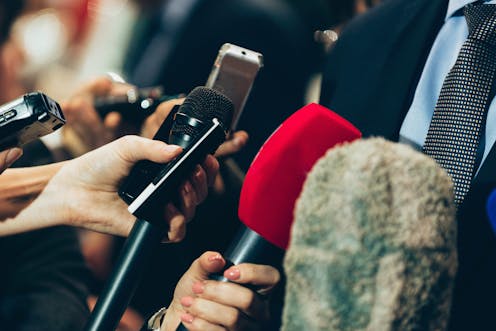
In a time of falling trust in the news media, it is vital journalists do not engage in news-gathering methods that further harm their credibility. Thanks to the rise of social media, misinformation and disinformation are rampant. Trust in news matters, so we can tell fact from fiction. Without it, democracy suffers.
In our new book, Undercover Reporting, Deception and Betrayal in Journalism, we ask whether deception is ever an acceptable method for journalists to use. In other words, is it ever okay to lie to a target to get a story?
We find it can be ethically justifiable under very specific conditions. We offer a six-point checklist for journalists (and the audience) to test if deception and betrayal are warranted.
Deception is one of the most common ethical problems in journalism. It ranges in seriousness from misrepresentation to the use of undercover reporting.
In fact, it is so common that some argue it is inherent in what journalists do. The late American writer and journalist Janet Malcolm, for instance, in her renowned book The Journalist and the Murderer, said in her opening paragraph:
Every journalist who is not too stupid or too full of himself [sic] to notice what is going on knows that what he does is morally indefensible. He is a kind of confidence man, preying on people’s vanity, ignorance, or loneliness, gaining their trust, and betraying them without remorse.
While we argue Malcolm pushes her argument too far, we present a range of case studies that show not only the range of deceptive practices in contemporary journalism, but also their seriousness.
Three of the case studies are drawn from high-profile undercover operations or acts of deception.
One concerns the use by Cambridge Analytica of data gathered by Facebook on 87 million of its users worldwide. These data were used to influence elections in several countries, including the United States in 2016.
Another involved the infiltration by Al Jazeera of the National Rifle Association in the US. It then repeated this with the One Nation party in Australia in 2019.
The third case is the deception and betrayal inflicted on thousands of innocent people in Britain by Rupert Murdoch’s News of the World newspaper in hacking their mobile phones. This is perhaps the most egregious example of journalists failing their ethical duty in Britain in the past century.
From our examination of these cases, including interviews with key journalists, and building on the work of two distinguished American journalists and scholars, Bill Kovach and Tom Rosenstiel, we developed our six-point framework for assessing the ethical justification for the use of undercover techniques, including those of masquerade and entrapment.
Read more: Hacking trial verdict: Coulson guilty and Brooks cleared, but end of an era for the red tops
Using this test, we concluded that the operation against Cambridge Analytica was ethically justified. It told the public important truths that we would not otherwise have known. The most notable of these was that Cambridge Analytica was in the business of interfering in sovereign elections – a direct threat to democratic wellbeing.
But we also find that the operations against the NRA and One Nation were not justifiable; nor in any way could the phone hacking of celebrities and ordinary citizens such as the murdered schoolgirl Milly Dowler ever be justified to produce stories for News of the World.
Our framework consists of these six questions:
Is the information sufficiently vital to the public interest to justify deception?
Were other methods considered and was deception the only way to get the story?
Was the use of deception revealed to the audience and the reasons explained?
Were there reasonable grounds for suspecting the target of the deception was engaged in activity contrary to the public interest?
Was the operation carried out with a risk strategy so it would not imperil a formal investigation by competent authorities?
Did the test of what is “sufficiently vital” to the public interest include an objective assessment of harm or wrongdoing?
We consider a further case study to look at other aspects of deception and betrayal.
It concerns the deceptive conduct that goes under the general name of “hybrid journalism”. This is where advertising is presented in a way that is difficult to distinguish from news.
It goes under a variety of names such as “branded content”, “sponsored content” or “native advertising”. More recently, another label has come into fashion: “From our partners”. Reputable platforms use typography that distinguishes this from news content, but less reputable ones make it difficult to discern one from the other.
Journalists also engage in a range of more everyday deceptive practices. These include failing to declare oneself as a journalist; attempting to ingratiate oneself with a person by feigning a romantic interest in them; agreeing to publish information known to be untrue in order to serve the interests of a valued source; and ambushing a subject by having a microphone open or a camera rolling when the subject has no reason to think they are being recorded.
As these case studies show, deception and betrayal in journalism take many forms, and the ethical decisions surrounding them are far from straightforward. However, they are not inherent to the practice of journalism. Whether they are justifiable must be closely scrutinised, because the public’s trust in the media is at stake.
Authors: Andrea Carson, Associate Professor, Department of Politics, Media and Philosophy, La Trobe University
Read more https://theconversation.com/is-it-ever-okay-for-journalists-to-lie-to-get-a-story-196358

















