

Modern Australian
The Times

To clean up Australia's power grid, we're going to need many thousands more skilled workers – and fast

  • Written by Jay Rutovitz, Research Director, Institute for Sustainable Futures, University of Technology Sydney

To clean up Australia's power grid, we're going to need many thousands more skilled workers – and fast

To get Australia’s grid 82% powered by renewables by 2030 is a huge increase. At present, the electricity powering eastern and southern states is around 33% renewable.

To get there means a lot of work. Over the next seven years, it would be equivalent to installing dozens of large wind turbines every month, and tens of thousands of solar panels every day.

And work needs workers. To make this happen, our modelling shows 15,000 more workers are needed by 2025 – less than three years away. That’s amid a skills shortage, an infrastructure boom and unemployment rates at the lowest level in decades.

So how to do it? We need to train more skilled workers and give them more security. Renewable projects have tended to operate on boom-bust cycles when it comes to jobs. But to get where we need to be, we need to shift to a long-term boom mentality. We’re going to need people doing these jobs for decades to come.
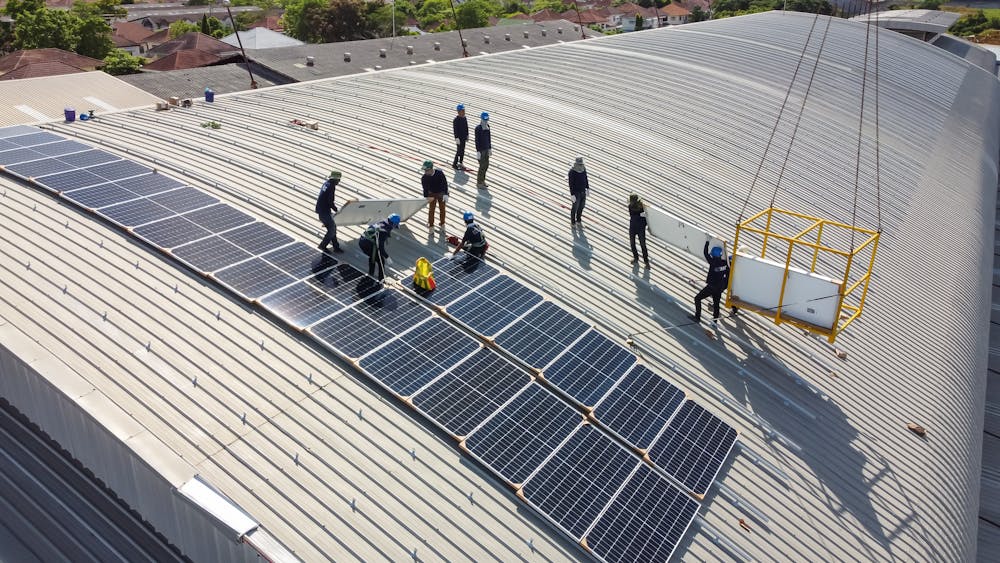
Solar panel installation
The big renewable build will only work if we have enough workers. Shutterstock

How big is this issue?

Big. Getting to 82% renewables and fast means we need to greatly scale up the electricity sector workforce in generation, storage and transmission line construction.

We estimate the current workforce is around 41,000, including 12,000 working in coal and gas power stations or supplying those power stations with fuel. This is only an estimate, as updated figures won’t be available until the federal government delivers its promised energy employment report.

Read more: Wind turbines off the coast could help Australia become an energy superpower, research finds

Australia’s energy market operator, AEMO, publishes regularly updated pathways to a clean-energy future. Now we have federal backing for accelerated timelines, the most likely outcome is the so-called “step change scenario”. This scenario envisages nine times more wind and solar by 2050, to boost capacity to 141 gigawatts, and four times more rooftop solar.

Under this scenario, 15,000 more workers must be ready and able to build and operate renewables and storage, or build transmission lines, by 2025.

The problem is, these workers don’t exist at present. Many existing skilled workers are already paid well by major infrastructure projects, such as metro rail projects in Melbourne and Sydney and regional projects such as inland rail. What’s more, unemployment rates are the lowest in decades, and peak demand for labour to build wind and solar projects is set to outstrip the entire current workforce in some regional areas where the renewable projects will be concentrated.

To add to the challenge, skilled workers tend to live in major population centres – but clean energy projects are virtually all in the regions. So the clean energy sector must compete with big infrastructure projects in the cities, which pay more and don’t involve travel. You can see the challenge. If we don’t get this right, the clean energy transition just won’t happen.

The common answer to workforce shortages is to train more workers. But here, too, there are challenges. Our skilled training sector has long been in the doldrums, with demand spread thin across far-flung regions and policy uncertainty leaving many gaps in capacity.

15,000 new skilled workers are just the start

We modelled the workforce needed to achieve three of the AEMO scenarios: the step change, the hydrogen superpower and the slow change. We also modelled an offshore wind scenario, using AEMO’s modified step change “sensitivity” which takes into account Victoria’s ambitious target for offshore wind.

Under the step change scenario, we found the demand for skilled jobs will increase 37,000 from 2023 and peak at 81,000 in 2049.

Jobs in generation, transmission construction and storage under different scenarios for the National Electricity Market.

But if Australia becomes a major exporter of renewable energy in the form of green hydrogen or green ammonia, as backers like iron ore billionaire Twiggy Forrest are hoping, that’s a different story. It would require up to twice the workers of the step-change scenario in the 2030s, and up to triple in the 2040s.

That’s a staggering peak demand of 237,000 jobs, with an average demand of 110,000. To get there, we would need 34,000 extra workers within three years.

Where will the jobs be? New South Wales will be the leading state in most scenarios, with a demand for over 20,000 skilled workers annually until 2050 under the step-change scenario. Across NSW, Queensland and Victoria, the job split by technologies is very similar in this scenario: 37% of jobs in solar, 27–30% for wind, and 17–22% in batteries. The pattern is similar in the offshore wind and slow-change scenarios.


What about the hydrogen superpower scenario? This would change things dramatically. Here, the highest demand for renewable jobs would be in Queensland, South Australia and Tasmania. Compared to the step-change scenario, Queensland would add over 100,000 jobs, while jobs in South Australia would more than treble and Tasmania quadruple from 2,200 to 9,400. Relatively modest growth is projected for NSW and Victoria – 4,000 new jobs in both states compared to the step change. Electricity sector jobs in the Step Change scenario by technology in the National Electricity Market. We can’t just leave it to the market Coordinated action is needed to plan and implement skills, training and workforce development. Here, state and territory governments can build on the recent creation of Renewable Energy Zones – essentially, renewable rich areas where transmission lines exist or will be built – to boost collaboration between industry and government on training strategies and programs. Workforce planning should be brought into overall energy system planning, to help reduce the employment boom-bust cycle. Most electricity planning favours “just in time” construction, where infrastructure is built as it is needed. That means demand for labour is volatile. The NSW government has created an electricity infrastructure jobs advocate and created EnergyCo to co-ordinate the development of the renewable energy zones and maximise local benefits. Given current shortages of workers, it’s vital governments take action now. Acting early would help future-proof our clean energy workforce and maximise benefits for regional areas. Even better, we could help boost numbers of workers from under-represented groups such as women and First Nations communities. Read more: How can Aboriginal communities be part of the NSW renewable energy transition? Authors: Jay Rutovitz, Research Director, Institute for Sustainable Futures, University of Technology Sydney

Read more https://theconversation.com/to-clean-up-australias-power-grid-were-going-to-need-many-thousands-more-skilled-workers-and-fast-195906

Road Signs: Understanding Their Role in Clear and Effective Signage

Effective signage and display hardware can help businesses communicate information, promote products and organise customer or visitor movement. Road...

Bottle Label Printing: Key Factors to Consider Before Your Next Packaging Run

Effective packaging begins with understanding the product, bottle material, artwork and production requirements when planning bottle label printing. H...

Planning a Long-Distance Move With Interstate Movers Melbourne

Moving between states involves more planning than a typical local relocation. Along with packing and transporting household belongings, you need to...

Understanding the Role of an I/O Controller in Industrial Automation

Modern industrial systems depend on accurate communication between sensors, machines and control systems. An I/O controller can help manage this commu...

How the Right Mining Hose Supports Demanding Operations

Mining environments place considerable demands on equipment used for material transfer, water management and processing. Hoses operating in these co...

Simple Ideas for Making Social Gatherings More Memorable

We have all been to those parties where everyone just stands around the kitchen island, staring at their phones, waiting for someone else to make a mo...

Outdoor Wall Lights: Improving Exterior Lighting Around Your Home

Lighting can influence how a room looks, feels and functions, so the right fitting should be selected according to both appearance and practical req...

Commercial Office Cleaning: Combining Routine Office Cleaning With Melbourne Service

Keeping a workplace clean requires a service that can accommodate everyday tasks as well as the particular needs of the business. Professional comme...

Caravan Sales in Queensland: How to Find the Right Caravan for Sale QLD

Caravan ownership is about more than having somewhere to sleep while travelling. For many Queenslanders, it is one of the best ways to explore regio...

What Sir Walter Buffalo Turf Actually Costs in 2026 (And Why Quotes Vary So Much)

Two quotes landed on a Hills District homeowner's kitchen table last spring for the exact same 80-square-metre backyard. One said $12 a metre. The o...

Nearly 1,300 NSW Hospital Beds Are Occupied By People Who Are Ready To Go Home

1,276 people in NSW hospitals have been medically cleared for discharge but remain in hospital because they're still waiting for NDIS or aged care sup...

National Survey Launched to Measure Operational Impacts of Federal NDIS Policy Reforms

The effects of recent NDIS reforms are beginning to move beyond policy papers and into day to day service delivery. A new national survey is asking ...

Beyond the Nappy Cake: Baby Shower Gifts That Get Used

What new Australian parents unwrap, keep, and quietly thank you for months later. Six weeks after my daughter was born, I did an audit of the baby sh...

Parent-Advocates Are Reshaping Frontline Disability Service Delivery

Parents have always been part of the disability sector. They advocate, coordinate services, challenge decisions and often become the person holding ev...

Vista Cruises Enters "Two-Flagship Era" as Vista Aurora Completes Inaugural Voyage

Vista Aurora Sets Sail along the Yangtze. (Photo courtesy of the company)YICHANG, China — August 5, 2026 — Vista Aurora, a high-end interprovinc...

A Digital Preparation Checklist For International Medical Conferences

An international medical conference compresses many responsibilities into a few days. A delegate may need to present research, move between venues, ...

The Growing Popularity of Lab Grown Diamonds in Sydney and Hong Kong

The diamond industry has changed significantly in recent years as more buyers seek ethical, affordable, and sustainable alternatives to mined diamon...

Modern AI SEO Agency vs Traditional SEO: What’s the Difference

Search engine optimisation has changed dramatically over the past few years. Search engines have become smarter, user behaviour has evolved, and bus...















